Context
- The National Statistical Office (NSO) has released the first-ever district-level estimates from the Annual Survey of Unincorporated Sector Enterprises (ASUSE) 2025.
- The survey covers unincorporated non-agricultural enterprises in manufacturing, trade and services.
- The data highlight a key paradox: higher female participation does not necessarily translate into better earnings, security or economic agency.
What Does the Data Show?
- Women constitute about 29% of workers in India’s unincorporated non-agricultural sector.
- In 237 districts, women form at least one-third of the workforce; in only 25 districts do they constitute more than half.
- Nirmal, Telangana, records the highest female share at about 78%.
- Districts with high female participation are concentrated particularly in southern and north-eastern India.
- At the lower end, Rudraprayag, Uttarakhand, records only about 6.7% female participation.
What Does the Regional Pattern Reveal?
- Local economic structure: Female participation varies with the type of industries, services and enterprises present in a district.
- Social context: Local norms, mobility and access to work influence women’s labour-market participation.
- Policy targeting: Wide district-level differences show why national averages alone are insufficient for designing employment policies.
Participation Is Not the Same as Empowerment
High workforce participation can coexist with poor-quality employment.
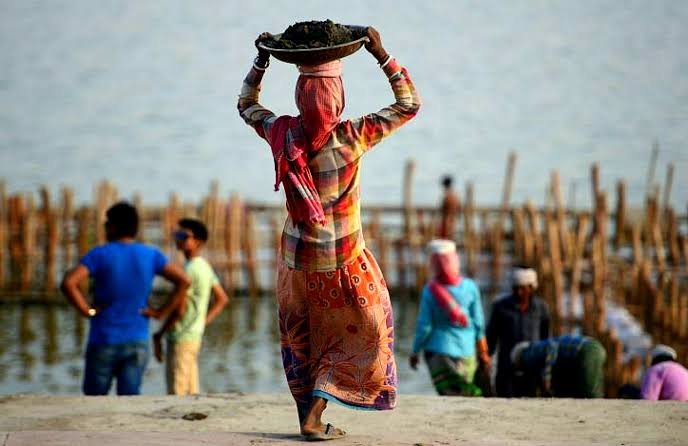
- Women are often concentrated in low-productivity and low-paying activities.
- Average annual emolument per hired worker in the sector is around ₹1.3 lakh.
- Even districts with high female participation do not necessarily record high earnings.
Therefore:
More women working ≠ Better work
Meaningful economic empowerment requires:
Participation + Adequate earnings + Social security + Skill mobility + Economic agency
Why Does Women’s Informal Work Matter?
- Household resilience: Women’s earnings supplement family income and reduce economic vulnerability.
- Local economy: Women contribute significantly to small manufacturing, trade and service activities.
- Entrepreneurship: Informal enterprises provide an important entry point for women into self-employment and business ownership.
- Inclusive growth: Greater female economic participation expands the productive workforce and supports more broad-based growth.
The informal sector is therefore not a marginal activity; it is an important part of India’s employment and production structure.
Key Concerns
- Low remuneration: Employment is often concentrated in low-value activities.
- Social-security deficit: Many workers lack pensions, insurance, paid leave and employment protection.
- Low-productivity trap: Limited skills and technology restrict movement into better-paying work.
- Financial exclusion: Women-owned micro-enterprises often face difficulty accessing formal credit and markets.
Existing Policy Support
- e-Shram: Creates a database of unorganised workers to improve welfare and social-security delivery.
- PM Vishwakarma: Provides artisans with skilling, tools, credit and market support.
- Udyam Assist Platform: Helps informal micro-enterprises enter the formal MSME ecosystem.
- Skill India Digital Hub: Expands access to skilling and employment-linked training.
Together, these schemes can support the transition:
Informality → Recognition → Capability building → Formal economic opportunity
Way Forward
- District-specific strategy: Use ASUSE data to identify local barriers and design targeted interventions.
- Move women up the value chain: Link skilling with technology adoption, market access and higher-productivity occupations.
- Portable social protection: Ensure informal workers can access welfare benefits regardless of employer or location.
- Enterprise graduation: Help women-owned micro-enterprises move from survival activity towards formal, creditworthy and scalable businesses.
FAQs
Q1. Which survey provides the district-level estimates?
The Annual Survey of Unincorporated Sector Enterprises (ASUSE) 2025.
Q2. Which district records the highest female share?
Nirmal, Telangana, at about 78%.
Q3. What is the all-India share of women in this workforce?
About 29%.
Q4. Why does high female participation not necessarily indicate empowerment?
Because employment may still involve low wages, poor social security and limited upward mobility.
Q5. Why are district-level estimates important?
They reveal local variations hidden by national averages and support place-specific policymaking.