Context
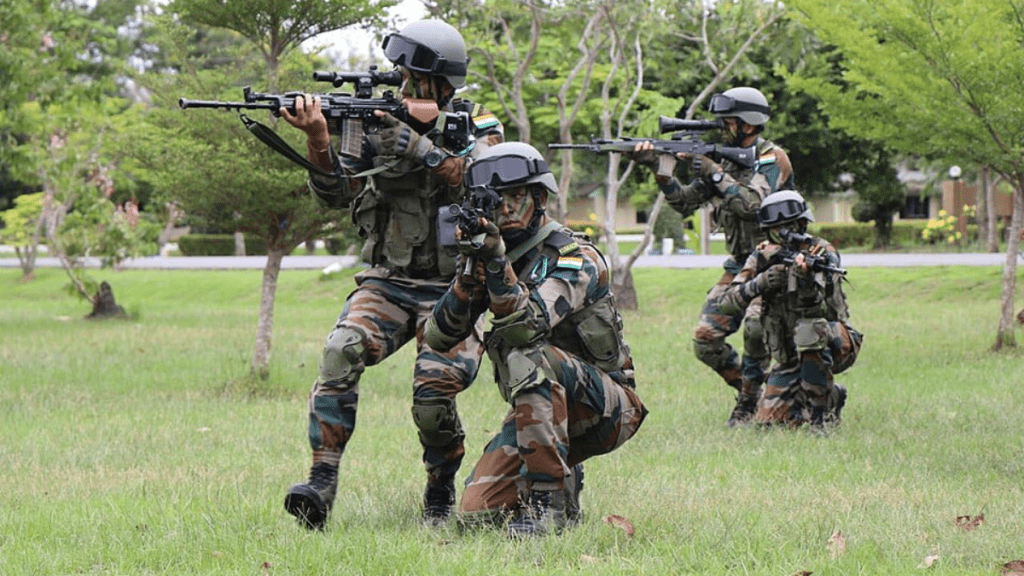
- India and the United States have commenced the 22nd edition of Exercise Yudh Abhyas, their annual bilateral Army exercise.
- The 2026 edition is being conducted in Rajasthan and Uttarakhand, exposing the participating forces to different operational environments.
About Exercise Yudh Abhyas
- It is aimed at improving interoperability, joint operational capabilities and military cooperation between the two forces.
- The exercise has progressively incorporated training related to emerging technologies and evolving battlefield requirements.
Key Features of the 2026 Edition
- Mahajan Field Firing Range, Rajasthan: The opening phase involves field-based combat training.
- Auli, Uttarakhand: The exercise then shifts to a high-altitude setting near the Line of Actual Control (LAC).
- 11th Airborne Division: Arctic-trained U.S. soldiers from Fort Wainwright, Alaska, are participating in the high-altitude component.
- 3rd Multi-Domain Task Force: Its participation brings long-range precision fires and integrated command-and-control capabilities into the exercise.
- The drills combine a Command Post Exercise (CPX) and a Field Training Exercise (FTX), followed by a joint live-fire demonstration.
- The Mobile Low, Slow, Small Unmanned Aircraft Integrated Defeat System (MLIDS) is being used for counter-drone training.
- The exercise is conducted under the broader U.S. military framework of Operation Pathways.
Strategic Significance
- High-altitude preparedness: Mountain warfare training improves readiness for operations in difficult terrain and extreme climatic conditions.
- Counter-drone capability: The focus on unmanned aerial threats reflects the growing role of drones in contemporary warfare.
- Precision-fire coordination: Joint training improves the integration and employment of long-range fire capabilities.
- Multi-domain preparedness: Participation by specialised U.S. formations broadens cooperation beyond conventional ground operations.
- Interoperability: Repeated joint exercises help the two armies develop compatible procedures, communications and operational practices.
Other Major India–U.S. Military Exercises
| Exercise | Participating Forces | Broad Focus |
| Vajra Prahar | Indian Army Special Forces and U.S. Army Special Forces | Special operations |
| Cope India | Indian Air Force and U.S. Air Force | Air combat and operational cooperation |
| Malabar | Indian, U.S., Japanese and Australian Navies | Maritime security and naval interoperability |
| Tiger Triumph | Indian and U.S. tri-services | Amphibious operations and Humanitarian Assistance and Disaster Relief (HADR) |
Conclusion
Yudh Abhyas 2026 reflects the widening scope of India–U.S. defence cooperation. Its focus on high-altitude operations, precision fires, counter-drone systems and multi-domain capabilities highlights the need to prepare for increasingly technology-driven and complex battlefields.
FAQs
Q1. What is a Command Post Exercise?
A Command Post Exercise (CPX) trains commanders and staff in operational planning, communication, decision-making and coordination through simulated situations.
Q2. What is a Field Training Exercise?
A Field Training Exercise (FTX) enables troops to practise tactics, manoeuvres and combat procedures in a realistic physical environment.
Q3. What does counter-UAS capability mean?
Counter-UAS refers to systems and procedures used to detect, track and neutralise unmanned aerial systems, including small drones.
Q4. Why is high-altitude warfare training significant?
High-altitude operations involve difficult terrain, extreme weather, thin air and complex logistics. Specialised training improves the preparedness of troops operating in mountainous areas.
Q5. What is a Multi-Domain Task Force?
A Multi-Domain Task Force is a U.S. Army formation designed to integrate capabilities such as long-range fires, intelligence, electronic warfare and information operations.
Q6. What is Operation Pathways?
Operation Pathways is a U.S. Army framework for strengthening military engagement, exercises and interoperability with partner countries in the Indo-Pacific region.
Q7. Why have counter-drone systems become important?
The growing use of drones for surveillance, targeting and attack has made their detection and neutralisation an important component of modern military preparedness.