Context
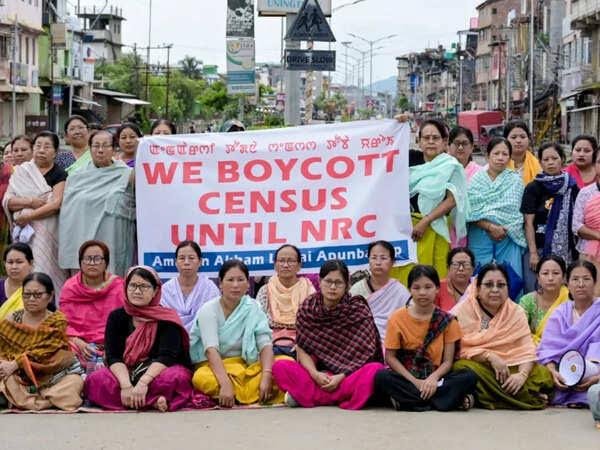
The Manipur Government has proposed 1951 as the baseline year for updating the National Register of Citizens (NRC). The proposal is not final, as implementation requires Central Government approval. The issue has gained importance amid concerns over migration, demographic change, ethnic displacement and the upcoming 2027 Census and delimitation.
Context and Rationale for the 1951 Baseline
The demand for an NRC in Manipur is linked to the state’s distinct demographic history.
- Manipur had a permit system for entry of outsiders, which was abolished in 1950.
- The 1951 Census, conducted after its abolition, is being considered an early reference point for assessing subsequent demographic changes.
- The Manipur People’s Protection Bill, 2018 had also considered 1951 as a possible baseline.
- 1951 provides an early demographic benchmark for examining later population changes.
- The decadal population growth rate rose from 12.8% in 1951 to 35.04% in 1961. However, population growth alone cannot establish illegal immigration.
Why Assam and Manipur Have Different Baselines
The historical context of migration differs across states.
- Assam: Migration concerns are closely linked to East Pakistan and Bangladesh. The relevant framework uses 1 January 1966 and 24 March 1971 as important reference dates.
- Manipur: Migration concerns are also linked to the Myanmar border, giving the issue a distinct geographical and security context.
Factors Behind the Renewed Debate
- Myanmar Crisis: The 2021 military coup in Myanmar was followed by increased movement across the India–Myanmar border, intensifying concerns over migration, border management and internal security in Manipur.
- Ethnic Violence: The violence that began in May 2023 resulted in large-scale displacement within the state, adding complexity to demographic verification.
- 2027 Census and Delimitation: Meitei and Naga organisations have sought completion of the NRC before the 2027 Census and subsequent delimitation, reflecting concerns over the possible effects of demographic changes on the state’s political landscape.
Major Concerns
- Incomplete Historical Records: The Kuki tribes have raised concerns that records from the 1950s may be incomplete, particularly in remote hill areas where accessibility was limited and enumeration may not have been comprehensive.
- Cross-Border Communities: The Kuki, Zomi and Chin communities have historically lived on both sides of the India–Myanmar border. A rigid reliance on historical documentation could create difficulties for such communities.
- Risk of Wrongful Exclusion: Genuine residents who were present during the relevant period but cannot produce sufficient historical documentation may face difficulty establishing their status, creating a risk of wrongful exclusion.
Changing Baselines
The proposed baseline has changed over time:
- 2018: The Manipur People’s Protection Bill initially considered 1971 and later shifted to 1951.
- 2022: 1961 was considered in connection with the Inner Line Permit framework.
- 2024: 1961 was recommended as the baseline.
- 2026: The state again proposed 1951.
The repeated changes have contributed to uncertainty over the final NRC framework.
Way Forward
- Build Centre–State consensus: A clear framework should be established before implementation, given the need for Central Government approval.
- Address documentation gaps: Historical records, particularly from remote areas, should be carefully examined.
- Prevent wrongful exclusion: Verification should provide adequate scope for genuine residents who lack complete historical documents.
- Consider border-community realities: The concerns of communities with longstanding cross-border linkages should be incorporated into the process.
- Ensure policy stability: A clearly defined baseline and consistent procedures are necessary to reduce uncertainty.
Conclusion
The Manipur NRC debate requires a balance between citizenship verification, border management and protection against wrongful exclusion.
FAQs
- Why does the choice of an NRC baseline matter?
It establishes the historical reference against which citizenship and population records are assessed. Its selection can therefore influence the verification process. - Why can population growth not by itself prove illegal immigration?
Population change can result from several factors. Therefore, a higher growth rate alone cannot establish illegal immigration. - Why can old records create difficulties during citizenship verification?
Historical records may be incomplete, particularly in remote areas. This can make it difficult for genuine residents to establish their status. - Why is the migration context important when determining a baseline?
Different states have experienced migration through different historical and geographical pathways. The source therefore links the baseline question to the specific context of each state. - Why does the NRC issue have an internal-security dimension in Manipur?
Manipur’s border with Myanmar makes population movement relevant to both citizenship administration and border security. - What is the main challenge in implementing an NRC in a region with cross-border communities?
The process must address historical population movement and documentation gaps without causing wrongful exclusion of genuine residents.