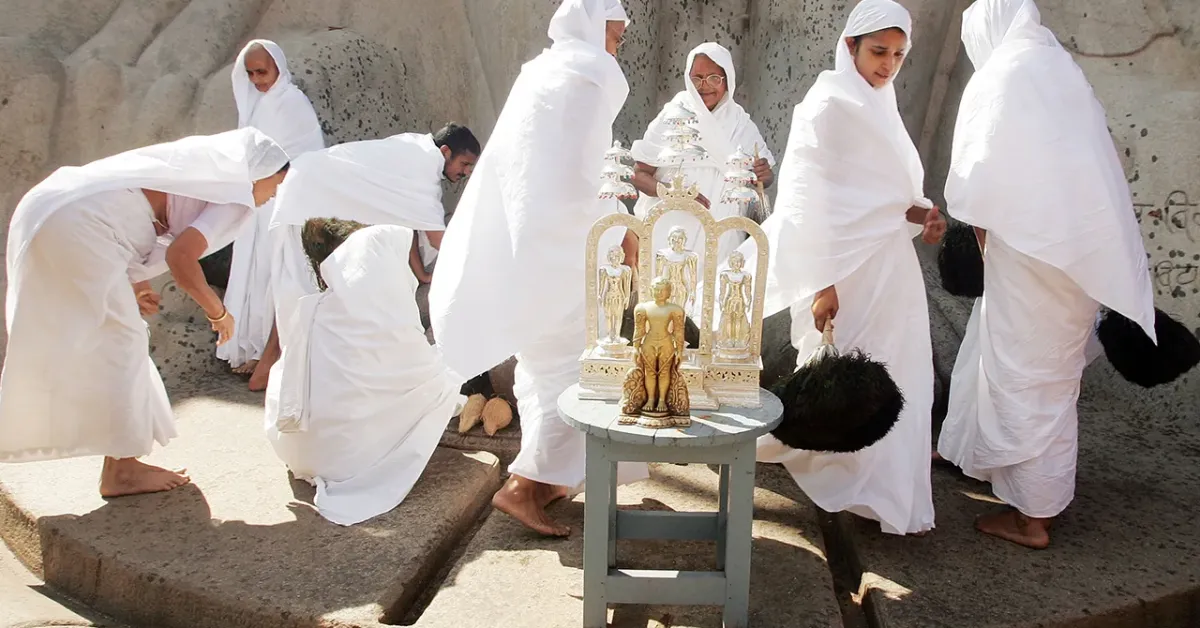
About Jainism
Jainism is an ancient Sramaṇa tradition centred on non-violence, self-discipline, renunciation and liberation from rebirth. It emerged prominently in 6th-century BCE India as a challenge to ritualism, social hierarchy and Vedic authority. Jain tradition recognises 24 Tirthankaras, spiritual teachers who attained Kevala Jnana (complete knowledge) and guided people towards liberation. Rishabhanatha was the 1st Tirthankara, Parshvanatha was the 23rd and Mahavira was the 24th Tirthankara. They are regarded as the most important Tirthankaras in Jain tradition.
Why Jainism Emerged
- Reaction to Ritualism: Costly sacrifices and complex Vedic rituals created dissatisfaction; Jainism offered a simpler path based on Ahimsa, self-control and personal effort.
- Challenge to Social Hierarchy: Opposition to Brahmanical dominance and Varna-based inequalities encouraged support for Jainism’s emphasis on conduct over birth.
- Support from Urban Groups: Growing trade and urbanisation, along with support from Kshatriyas and Vaishyas, helped Jainism gain followers.
- Simple Language: Use of Prakrit and other local languages made Jain teachings accessible to a wider population.
Mahavira: The 24th Tirthankara
- Birth: Born at Kundagrama near Vaishali (Bihar) into the Jnatrika Kshatriya clan; parents were Siddhartha (head of the Jnatrika Kshatriya clan) and Trishala (sister of Chetaka, the king of Vaishali).
- A symbol was associated with every Tirthankara and Mahavira’s symbol was a lion.
- Renunciation: Left worldly life at 30 and practised severe asceticism for about 12 years.
- Kevala Jnana: Attained perfect knowledge at the age of 42 and became known as Mahavira/Jina, meaning the conqueror of worldly attachments.
- Preaching: Travelled for nearly 30 years across Magadha, Kosala and eastern India to spread Jain teachings.
- Sermon: delivered his first sermon at Pava.
- Nirvana: Attained liberation at Pawapuri, Bihar, at about 72 years.
- Transmission: His teachings were initially preserved orally by his disciples, the Ganadharas.
Core Teachings
1. Panchamahavratas – Five Great Vows
- Ahimsa: Non-violence.
- Satya: Truthfulness.
- Asteya: Non-stealing.
- Brahmacharya: complete celibacy and control of sexual desires.
- Aparigraha: Non-possession and freedom from excessive attachment.
Parshvanatha is associated with the first four vows; Mahavira added Brahmacharya. Lay followers follow these as Anuvratas (limited vows).
2. Triratna (Ratnatraya) – Three Jewels
- Samyak Darshana: Right Faith or Right Perception.
- Samyak Jnana: Right Knowledge.
- Samyak Charitra: Right Conduct.
3. Jiva, Ajiva and Karma
- Jiva: Living soul or consciousness present in living beings.
- Ajiva: Non-living reality.
- Every living being possesses a Jiva, including forms of life that may not be visible to humans.
- Karma binds the Jiva (soul) to the cycle of birth and rebirth (transmigration); liberation occurs when karmic bondage is removed.
4. Concept of God and the Universe
- Jainism rejects a creator, preserver or destroyer God; the universe is eternal and functions according to its own laws.
- It accepts God in the form of liberated souls (Siddhas) who have destroyed all karma and attained infinite knowledge, perception, power and bliss.
- Every Jiva has the potential to attain this state; hence Jainism recognises innumerable liberated souls, not one supreme creator.
5. Moksha
- Moksha/Nirvana means freedom from karma, rebirth and suffering.
- It is attained through Triratna, self-discipline, austerity and removal of karmic bondage, rather than divine grace.
- Once liberated, the soul remains in a state of eternal bliss and perfection.
6. View of Vedas: It rejects the authority of the Vedas and does not consider Vedic sacrifices necessary for attaining liberation.
7. Sallekhana:
- It is a voluntary and gradual practice of reducing food and bodily attachments at the end of life, undertaken under strict religious discipline.
- It is viewed in Jainism as a form of detachment and spiritual purification, not ordinary suicide.
Important Jain Philosophical Doctrines
- 1. Anekantavada – Many-sided Reality: Reality has multiple aspects and cannot be fully understood from a single viewpoint. It promotes tolerance, intellectual humility and rejection of absolute claims.
- Syadvada – Conditional Judgment: Every statement about reality is conditional, depending on the viewpoint or context. It encourages qualified and balanced understanding of complex issues.
- Ahimsa – non-violence: Jainism gives Ahimsa its highest ethical importance. It extends to humans, animals and other forms of life.
Jain Theory of Knowledge
Jainism recognises five types of knowledge:
- Mati Jnana: Knowledge through senses and mind.
- Sruta Jnana: Knowledge gained from teachings and scriptures.
- Avadhi Jnana: Clairvoyant or super-sensory knowledge.
- Manahparyaya Jnana: Knowledge of others’ thoughts.
- Kevala Jnana: Perfect and absolute knowledge, attained at the highest spiritual stage.
Jain Literature
- Language: Early Jain texts were mainly written in Prakrit/Ardhamagadhi, making them accessible to common people.
- Agamas: The canonical texts include 12 Angas; Acharanga Sutra focuses on monastic discipline, while Bhagavati Sutra explains Jain doctrines.
- Literary Contribution: Jain scholars enriched Prakrit, Sanskrit and regional languages, especially Kannada and Tamil.
- Illustrated Texts: The Kalpasutra is an important illustrated Jain manuscript, contributing to the tradition of Jain miniature painting.
Jain Councils
| Council | Place & Period | Key Figure | Major Outcome |
| First Council | Pataliputra (Present day Patna), c. 3rd century BCE | Sthulabhadra | Teachings of Mahavira compiled into 12 Angas to replace lost 14 purvas |
| Second Council | Vallabhi, Gujarat, 5th–6th century CE | Devardhigani Kshamasramana | Final compilations of 12 Angas and 12 upangas |
Major Sects of Jainism
- Jain tradition associates the split with a 12-year famine in Magadha.
- Bhadrabahu is traditionally said to have led a group south with Chandragupta Maurya, while Sthulabhadra led the group that remained in Magadha.
- Differences in monastic practices and scriptures gradually led to the Digambara and Svetambara traditions.
| Basis | Digambara | Svetambara |
| Meaning | “Sky-clad” | “White-clad” |
| Clothing | Male monks traditionally practise nudity | Monks and nuns wear white clothes |
| Ideal of Renunciation | Emphasises complete non-possession | Permits minimal possessions, including clothing |
| Women & Moksha | Women cannot attain Moksha in the present body; must be reborn as male | Women can attain Moksha |
| Tirthankaras | Mallinatha was male | Mallinatha was female |
| Kevala Jnani & Food | A Kevala Jnani does not require food | A Kevala Jnani may continue to take food |
| Important Texts/Scholars | Kundakunda and works such as Samayasara are important | Agama literature and scholars such as Hemachandra are important |
| Tirthankara Images | Usually nude, unadorned and meditative | Usually clothed/decorated in temple representations |
| Monastic Discipline | Generally, follows stricter ascetic practices | Follows ascetic discipline while permitting certain limited possessions |
| Major Centres | Karnataka, Madhya Pradesh, Rajasthan, Bundelkhand | Gujarat, Rajasthan, Maharashtra |
| Major Sub-sects | Bisapantha, Terapantha, Taranapantha | Murtipujaka, Sthanakvasi, Terapanthi |
Spread of Jainism
- Role of Mahavira and Monks: Mahavira travelled widely and organised a four-fold community of monks, nuns, laymen and laywomen. Jain monks further spread the faith through preaching, travel and debates.
- Royal Patronage: Rulers such as Chandragupta Maurya are traditionally associated with Jainism. Mathura and Ujjain became important Jain centres in the early centuries CE.
- Urban and Trading Groups: Merchants and urban communities supported Jainism due to its emphasis on ethical conduct, non-violence and self-discipline.
- Cultural Contribution: Jain communities contributed to literature, education, architecture, sculpture and temple-building, strengthening the religion’s regional presence.
Jain Festivals and Practices
Paryushan Parva and Samvatsari
- Paryushan Parva is an important Jain period of self-discipline, fasting, meditation, repentance and spiritual reflection.
- Samvatsari, the concluding day of Paryushan for Svetambaras, is associated with Pratikraman (self-review and repentance) and seeking forgiveness.
- The practice of Micchami Dukkadam expresses the Jain ideal of forgiveness and non-violence.
Jain Architecture
- Jain architecture includes caves, temples, basadis and monumental statues, often adapting regional styles.
- Udayagiri–Khandagiri Caves (Odisha), Ellora Caves (Maharashtra), Dilwara Temples (Mount Abu, Rajasthan), Palitana and Girnar (Gujarat) are major Jain sites.
- Shravanabelagola (Karnataka): Famous for the Gommateshwara/Bahubali monolithic statue.
- Basadi: A term commonly used for Jain temples, particularly in Karnataka.
Jain Paintings
- Sittanavasal Paintings (Tamil Nadu): Important Jain murals, generally associated with the Pallava period; they depict lotus ponds, animals, birds and Samavasarana.
- Jain Manuscript Painting: Developed prominently in western India, especially through illustrated Kalpasutra and Kalakacharya-Katha manuscripts.
- Style: Jain manuscripts are known for bright colours, stylised figures, decorative borders and religious themes.
Jain Symbols
- Jain Emblem: The hand with a wheel symbolises Ahimsa and self-restraint.
- Three Dots: Represent the Triratna—Right Faith, Right Knowledge and Right Conduct.
- Swastika: Represents the four states of existence and the cycle of birth and rebirth.
- Three Tiers & Crescent: The upper part represents the path to liberation, with the Siddha-shila symbolising the abode of liberated souls.
Contemporary Relevance of Jainism
- Peace and Non-violence: Ahimsa promotes peaceful coexistence and offers an ethical response to violence and conflict.
- Environmental Conservation: Jain respect for all forms of life supports biodiversity conservation and ecological responsibility.
- Sustainable Lifestyle: Aparigraha (non-possession) discourages excessive consumption and is relevant to consumerism and resource depletion.
- Tolerance and Pluralism: Anekantavada recognises multiple viewpoints and promotes dialogue, tolerance and intellectual openness.
- Self-discipline: Jainism stresses individual responsibility, ethical conduct and self-control for spiritual progress.
UPSC-Oriented FAQs
Q1. Why did Jainism emerge in the 6th century BCE?
Ans. It arose against complex rituals, costly sacrifices, social hierarchy and Brahmanical dominance. It offered a simpler path based on Ahimsa, self-discipline and personal effort.
Q2. What are the Three Jewels of Jainism?
Ans. They are Right Faith (Samyak Darshana), Right Knowledge (Samyak Jnana) and Right Conduct (Samyak Charitra). Together, they lead to Moksha.
Q3. Does Jainism believe in God?
Ans. Jainism rejects a creator God. It recognises liberated souls (Siddhas) as perfected beings who have attained infinite knowledge, perception, power and bliss.
Q4. What are Anekantavada and Syadvada?
Ans. Anekantavada says reality has many aspects. Syadvada says that a statement about reality is conditional on the viewpoint.
Q5. Why did Jainism split into Digambara and Svetambara?
Ans. The division developed due to differences in monastic practices, clothing and scriptures, with Jain tradition linking its origin to a 12-year famine in Magadha.
Q6. What is the relevance of Jainism today?