Context
The Archaeological Survey of India (ASI) recently clarified that a structure discovered near Golconda Fort, Hyderabad, is not a tunnel but a small rectangular granite chamber.
About Golconda Fort
- Location: Western outskirts of Hyderabad, Telangana.
- The name comes from the Telugu “Golla Konda”, meaning “Shepherd’s Hill.”
- Its origins are generally traced to the 12th-century Kakatiya period.
- The fort was later expanded under the Qutb Shahi dynasty, which emerged after Quli Qutb-ul-Mulk declared independence from the Bahmani Sultanate in 1518.
- It remained the Qutb Shahi capital until 1591, when the capital shifted to Hyderabad.
- Aurangzeb captured Golconda in 1687 after a prolonged siege, bringing it under Mughal rule.
Architecture
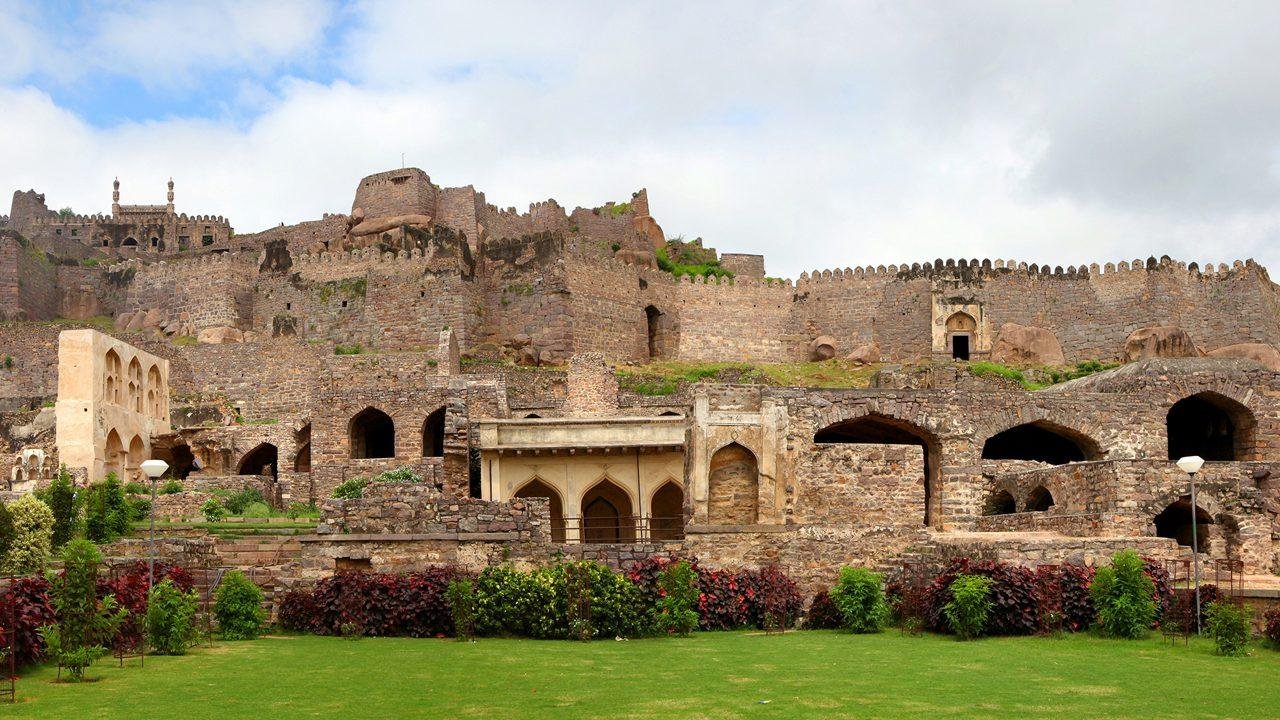
- The original mud fortification was gradually transformed into a massive stronghold with an outer wall of about 10 km.
- Built around a 400-foot-high granite hill, the fort has three concentric defensive enclosures incorporating masonry and natural boulders.
- It contains 8 gateways and 87 bastions, with the latter reportedly reaching 50–60 feet in height.
- Fateh Darwaza is noted for its acoustic engineering, allowing sound to be transmitted between designated points.
- The complex includes palaces, mosques, halls, parade grounds and residential quarters.
- The nearby Qutb Shahi tombs contain the mausoleums of the dynasty’s rulers.
FAQs
- What was Golconda originally known as?
The name is derived from “Golla Konda,” meaning “Shepherd’s Hill” in Telugu.
- Which dynasty is associated with Golconda’s early history?
Its origins are generally linked to the Kakatiyas, who established an early fortification in the region during the 12th century.
- Who captured Golconda Fort in 1687?
Mughal Emperor Aurangzeb captured the fort after a prolonged siege and incorporated it into the Mughal Empire.
- What is the significance of Fateh Darwaza?
It is known for an acoustic feature that enables sound to be heard between specific locations within the fort.
- Why is Golconda associated with diamonds?
The wider Golconda region was historically a major centre of diamond mining and trade, giving it international importance.
- What did the ASI recently clarify?
The structure recently found near the fort is a small rectangular granite chamber, not a tunnel.