Context
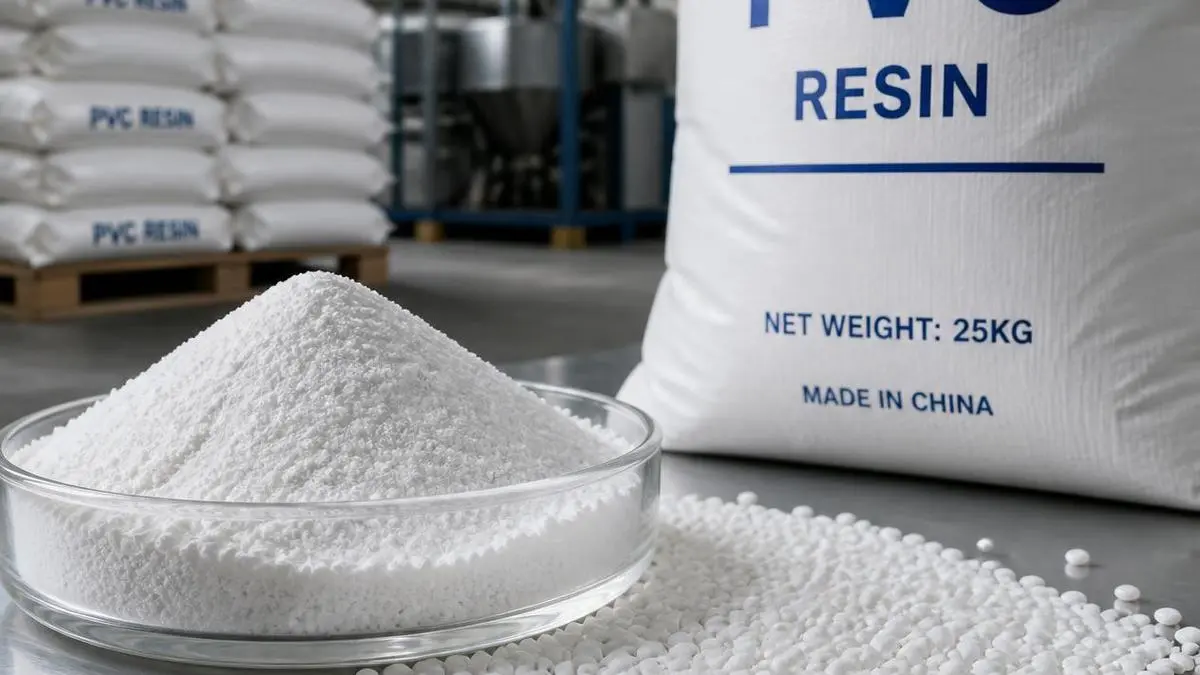
The Directorate General of Foreign Trade (DGFT) has imposed a six-month restriction on imports of Suspension Polyvinyl Chloride (S-PVC) resin, an important input for the PVC pipe and plastics industry.
About S-PVC
- S-PVC is a type of polyvinyl chloride (PVC) resin produced from vinyl chloride monomer (VCM) through suspension polymerisation.
- In this process, VCM is dispersed in water and converted into polymer particles using initiators and additives.
- PVC is manufactured mainly through four processes:
- Suspension polymerisation
- Emulsion polymerisation
- Bulk polymerisation
- Solution polymerisation
- S-PVC generally forms granular particles with varying porosity, making it suitable for industrial processing.
Applications
S-PVC is widely used in:
- Water-supply and irrigation pipes
- Electrical conduits
- Wires and cables
- Construction and infrastructure products
FAQs
- What is S-PVC?
S-PVC (Suspension Polyvinyl Chloride) is a PVC resin manufactured through suspension polymerisation of vinyl chloride monomer.
- What is the basic raw material for S-PVC?
The principal raw material is vinyl chloride monomer (VCM), which is converted into PVC through polymerisation.
- What are the main methods of producing PVC?
PVC can be produced through suspension, emulsion, bulk and solution polymerisation.
- What are the major uses of S-PVC?
It is mainly used in pipes, irrigation systems, electrical conduits, wires and construction products.
- Which authority imposed the import restriction?
The Directorate General of Foreign Trade (DGFT) imposed the six-month restriction on S-PVC imports.
- Why is S-PVC economically important?
It is an important input for construction, irrigation and electrical industries, making its supply relevant to downstream manufacturing costs.