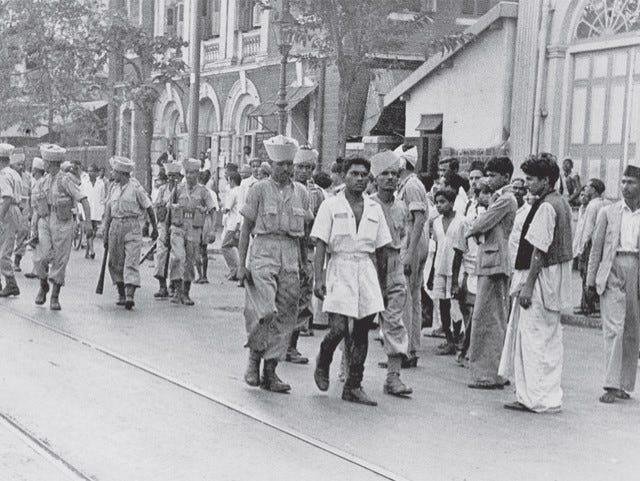
Context
The Royal Indian Navy (RIN) Mutiny of 1946 was a major episode of anti-British unrest during the final phase of colonial rule. It reflected growing dissatisfaction among Indian personnel in the armed forces and raised concerns about the ability of the British to retain military control over India.
About the RIN Mutiny
- The uprising began on 18th February 1946 at HMIS Talwar in Bombay (now Mumbai), with Indian sailors protesting against poor service conditions, racial discrimination and ill-treatment by British officers.
- It spread to naval establishments in Karachi, Calcutta, Madras and Visakhapatnam.
- More than 20,000 sailors associated with 78 ships and 20 shore establishments participated in the movement.
- The Naval Central Strike Committee (NCSC) coordinated the uprising under M. S. Khan and Madan Singh.
Causes
- Racial discrimination: Indian sailors faced unequal treatment, racial abuse and inferior status compared with British personnel.
- Poor service conditions: Inadequate food, low pay and poor living conditions fuelled resentment.
- Post-war uncertainty: Demobilisation after World War II created concerns about employment and future prospects.
- Impact of INA trials: The trials of Shah Nawaz Khan, P. K. Sahgal and G. S. Dhillon at the Red Fort strengthened nationalist sentiment among Indian sailors. The defence was led by Bhulabhai Desai, supported by Jawaharlal Nehru, Tej Bahadur Sapru, Kailash Nath Katju and Asaf Ali.
- Immediate trigger: Insulting remarks and high-handed conduct by British officers at HMIS Talwar turned existing grievances into open revolt.
- Earlier unrest: Episodes of dissatisfaction within the RIN during 1942–45 had already indicated declining morale.
Key Features
- Political demands: The movement expanded beyond service grievances to demand the release of INA prisoners and withdrawal of Indian troops from Indonesia.
- Wireless communication: Sailors used naval communication systems to coordinate the uprising across different establishments.
- Political unity: Congress, Muslim League and Communist Party flags were displayed together, reflecting temporary unity among the participants.
- Civilian support: Workers, students and civilians in Bombay supported the sailors through strikes, demonstrations and other forms of assistance.
- Wider military unrest: Sections of the Royal Indian Air Force and police also expressed support, increasing British concerns about discipline within the armed forces.
Response and End of the Mutiny
- British action: British forces used military force to suppress the uprising, resulting in casualties during clashes in Bombay.
- Political intervention: Sardar Vallabhbhai Patel and Muhammad Ali Jinnah urged the sailors to surrender to prevent further violence and preserve the political process.
- Communist support: The Communist Party of India (CPI) and Aruna Asaf Ali supported the uprising.
- Surrender: The sailors ended the strike and surrendered on 23 February 1946.
- Aftermath: Many participants subsequently faced dismissal and disciplinary action.
Significance
- Military discontent: The mutiny demonstrated that anti-colonial sentiment had reached sections of the Indian armed forces.
- Influence of INA nationalism: It reflected the wider impact of the INA trials and public sympathy for INA personnel.
- Mass mobilisation: Support from workers, students and civilians transformed a naval protest into a broader anti-British mobilisation in Bombay.
- British concerns: The possibility of wider disaffection within the armed forces posed a serious challenge to the sustainability of British rule.
- Contribution to independence: Along with the INA trials, post-war unrest and political mobilisation, the mutiny contributed to the broader crisis facing British authority in India.
Limitations
- Lack of unified leadership: The movement did not have a single national political leadership directing its course.
- Short duration: The uprising lasted only a few days and ended without achieving its principal demands.
- Limited political backing: The Congress and Muslim League did not support its continuation, while the CPI provided stronger support.
Conclusion
The RIN Mutiny of 1946 revealed the growing difficulty of maintaining unquestioned British authority over Indian armed personnel. Although short-lived, it demonstrated that colonial rule could no longer depend with certainty on the loyalty of the forces essential to its survival.
UPSC FAQs
Q1. When did the Royal Indian Navy Mutiny begin?
Ans. It began on 18 February 1946 at HMIS Talwar in Bombay.
Q2. What were the major causes of the RIN Mutiny?
Ans. Major causes included racial discrimination, poor food and living conditions, unequal treatment, post-war job insecurity and rising nationalist sentiment influenced partly by the INA trials.
Q3. What was the role of the Naval Central Strike Committee?
Ans. The NCSC coordinated the sailors’ actions and negotiations. M.S. Khan served as President and Madan Singh as Vice-President.
Q4. Was the RIN Mutiny the main reason for British withdrawal from India?
Ans. India’s independence had multiple causes; the RIN Mutiny was an important factor that weakened British confidence in the Indian armed forces.