Context
- The 2026 Parliamentary Standing Committee report stressed strengthening PDS databases, authentication and technology to prevent both leakages and exclusion.
- Pradhan Mantri Garib Kalyan Anna Yojana (PMGKAY) has been extended for five years from January 2024, providing free foodgrains to about 80 crore beneficiaries.
- Around 6.8 crore duplicate/ineligible ration cards were removed during 2013–2025, highlighting the impact of digitisation and database verification.
About Public Distribution System (PDS)
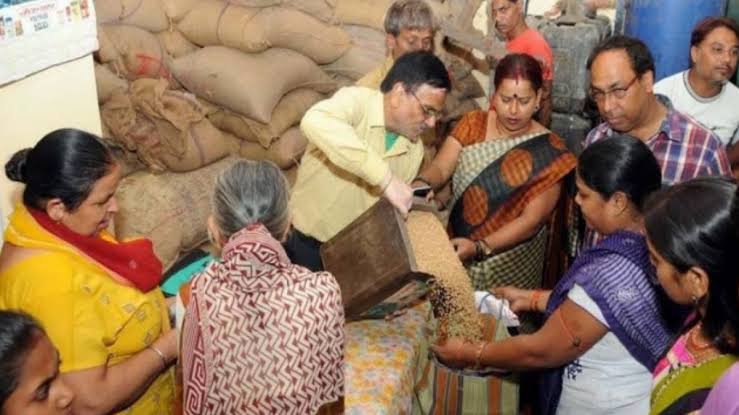
- PDS is a government system that supplies foodgrains to eligible households through Fair Price Shops (FPSs).
- It is jointly managed by the Central and State Governments:
-
- Centre: Through the Ministry of Consumer Affairs, Food & Public Distribution, it handles procurement, storage, transportation and allocation.
- States/UTs: Identify beneficiaries, issue ration cards and manage FPS distribution.
- Legal basis: The National Food Security Act (NFSA), 2013 provides a legal entitlement to foodgrains for eligible households.
Evolution of PDS
- Pre-1960s: PDS emerged mainly to tackle food shortages and price instability.
- 1992 – Revamped PDS (RPDS): Expanded PDS to remote, hilly, tribal and inaccessible areas.
- 1997 – Targeted PDS (TPDS): Shifted PDS from broad coverage to targeted support for poorer households and beneficiaries were classified into different categories based on economic status.
- 2000 – Antyodaya Anna Yojana (AAY):
-
- Targeted the poorest of the poor.
- Provides 35 kg of foodgrains per household per month under the NFSA framework.
- 2013 – National Food Security Act (NFSA):
-
- Made foodgrain support a legal entitlement.
- Covers up to 75% of rural and 50% of urban population.
- Provides 5 kg/person/month to Priority Households and 35 kg/household/month to AAY households.
- 2020 – Pradhan Mantri Garib Kalyan Anna Yojana (PMGKAY):
-
- Introduced during COVID-19 to provide additional free foodgrains to NFSA beneficiaries.
- Since January 2024, free foodgrains have been continued under PMGKAY for five years.
- Current phase: Focus on digitisation, electronic Point of Sale (e-PoS), Aadhaar authentication, ONORC and supply-chain modernisation to improve transparency and portability.
How PDS Functions
Procurement → Storage → Allocation → Distribution → FPS → Beneficiary
- Procurement: Food Corporation of India (FCI) and State agencies procure foodgrains mainly at Minimum Support Price (MSP).
- Storage: Grain is stored as central and buffer stocks.
- Allocation: Department of Food and Public Distribution (DFPD) allocates foodgrains to States/UTs.
- Distribution: States transport grain to Fair Price Shops (FPSs).
- Delivery: Beneficiaries receive ration through ration cards and e-PoS.
- One Nation One Ration Card (ONORC): Enables beneficiaries, especially migrants, to access ration from FPSs outside their home State.
Significance of PDS
- Food security: Provides subsidised/free foodgrains to around 80 crore beneficiaries, protecting vulnerable households from hunger.
- Poverty reduction: Lowers food expenditure and leaves more income for health, education and other needs.
- Price stability: Buffer stocks help manage shortages and sudden food-price rises.
- Farmer support: Government procurement at MSP provides an assured market, especially for rice and wheat farmers.
- Migrant welfare: ONORC allows migrant workers to collect ration outside their home State.
- Social protection: Acts as a safety net during inflation, unemployment and disasters. Eg. during COVID-19, including through PMGKAY.
Challenges
- Inclusion–exclusion errors: Outdated databases can exclude genuine beneficiaries, while duplicate/ineligible cards increase the subsidy burden. The 2026 Parliamentary Standing Committee stressed regular database updating and de-duplication.
- Digital exclusion: Aadhaar/e-PoS improves transparency, but biometric failure, poor connectivity or authentication errors can deny ration to genuine beneficiaries, especially elderly and manual workers.
- Leakages and weak last-mile delivery: Diversion or under-delivery may occur during transport, storage and FPS distribution.
- High fiscal burden: Procurement, storage, transportation and food subsidy create a large recurring burden. Excess stocks also raise FCI’s carrying costs.
- Rice–wheat concentration: Dependence on cereals limits dietary diversity and encourages water-intensive cropping, contributing to groundwater stress in Punjab and Haryana.
- Uneven State capacity: Differences in infrastructure, logistics and administration lead to varying PDS performance across States.
Government Reforms and Initiatives
- End-to-end computerisation: Digitises ration cards, allocation and supply chains.
- Aadhaar + e-KYC: Helps remove duplicate/ineligible beneficiaries.
- e-PoS: Enables digital authentication and transaction records at FPSs.
- ONORC: Provides nationwide ration portability, especially for migrants.
- Mera Ration App: Helps beneficiaries check entitlements and FPS details.
- SMART-PDS: Uses technology and data analytics to modernise PDS.
- e₹ food-voucher pilot: Puducherry is testing digital vouchers as an alternative delivery mechanism.
- GPS Tracking of Food Grain Transport Vehicles: Monitors truck movement to prevent route diversion, delay, or pilferage during transportation.
PDS, Cash Transfers and Food Vouchers: An Analytical Choice
|
Advantages | Limitations |
|
||||||
| PDS |
|
|
|
||||||
| Cash Transfers | Greater choice; easier delivery; less physical handling | Affected by inflation; depends on markets and banking; may not ensure food access |
Areas with reliable markets and banking |
||||||
| Food Vouchers | More choice than PDS while restricting support to food; encourage competition among retailers | Needs retailers and digital infrastructure; requires monitoring | Areas with functioning markets needing food-specific support |
Appropriate Model for India
PDS should remain the core safety net, especially for vulnerable groups and areas with weak markets. Cash transfers can be used where markets, banking and digital infrastructure are reliable. Food vouchers can offer greater choice while ensuring support is used for food. The Shanta Kumar Committee (2014–15) supported improving PDS efficiency and exploring cash transfers in suitable areas. Hence, India needs a hybrid, location-specific model rather than replacing PDS with a single alternative.
Way Forward
- Update Beneficiary Lists: Regularly revise NFSA databases to reduce exclusion and duplication.
- Ensure Inclusive Technology: Provide offline/manual authentication when Aadhaar or e-PoS systems fail.
- Strengthen FPS Delivery: Ensure timely supplies, adequate dealer margins and better infrastructure.
- Diversify Procurement: Reduce rice-wheat dependence and promote millets, pulses and decentralised procurement.
- Modernise Supply Chains: Improve scientific storage, transportation and logistics to reduce wastage and costs.
- Strengthen Accountability: Improve social audits, grievance redressal and vigilance mechanisms.
- Adopt a Hybrid Model: Use PDS, cash transfers and food vouchers according to local market conditions.
- Prioritise Nutrition Security: Shift from calorie-based support towards a diverse and nutritious food basket.
UPSC-Oriented FAQs
Q1. What is the legal basis of PDS in India?
Ans. The National Food Security Act, 2013 provides the principal legal framework. It creates statutory foodgrain entitlements for eligible households and nutritional support for specified groups.
Q3. What is the significance of ONORC?
Ans. One Nation One Ration Card allows beneficiaries to access ration from an FPS outside their home State. It is particularly important for inter-State migrant workers.
Q4. Why can cash transfers not completely replace PDS?
Ans. Cash provides purchasing power but depends on market availability, prices and banking access. During supply disruptions or in remote areas, cash may not guarantee access to food.
Q5. What are the major challenges of technology-based PDS?
Ans. Digitisation can reduce duplication and leakage, but biometric failure, connectivity problems and incorrect databases can exclude genuine beneficiaries. Alternative authentication is therefore important.
Q6. Why does PDS need nutritional diversification?
Ans. The current system is dominated by rice and wheat, which mainly provide calories. Greater inclusion of millets, pulses and other nutritious foods can help shift PDS from calorie security towards nutrition security.