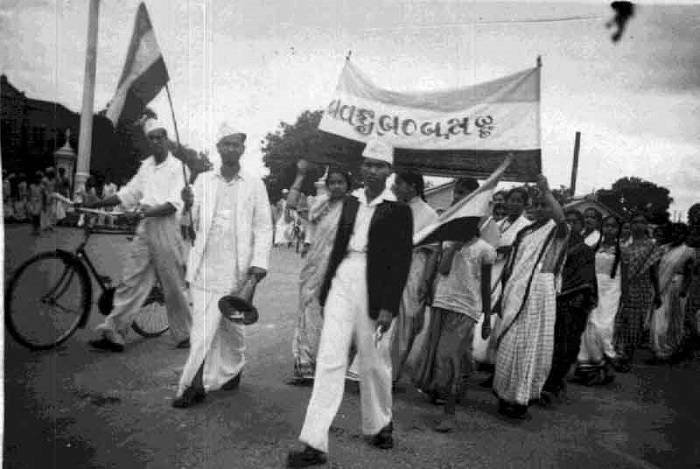
The closing decades of the nineteenth century witnessed the gradual development of national consciousness in India. Modern education, economic difficulties and growing awareness of colonial policies encouraged Indians to question British rule. Nationalist movements in Ireland, Japan, Egypt, Turkey, Persia and China also demonstrated that European dominance could be challenged.
The policies of Lord Curzon further intensified this political awakening. Measures such as the Indian Universities Act, the Calcutta Corporation Act and, most importantly, the Partition of Bengal in 1905 generated widespread opposition. The partition became the immediate trigger for the Swadeshi Movement.
The Swadeshi Movement
The movement initially emerged as an Anti-Partition campaign in Bengal. The early phase was led largely by the Moderates, who opposed the partition through petitions, public meetings and newspapers such as Hitabadi, Sanjibani and Bengalee. The campaign gradually developed into a wider programme based on the boycott of foreign goods and promotion of indigenous products.
The Swadeshi Movement was formally proclaimed at Calcutta Town Hall in August 1905. Foreign products, particularly Manchester cloth and Liverpool salt, became targets of the boycott. The campaign also acquired a cultural dimension. Vande Mataram became an important symbol of mobilisation, while Rabindranath Tagore’s Amar Sonar Bangla reflected the spirit of unity. The exchange of rakhis was also used to express solidarity.
Although Bengal remained the main centre, the movement spread to other parts of India. Bal Gangadhar Tilak led activities in Poona and Bombay, while Lala Lajpat Rai and Ajit Singh played prominent roles in Punjab. In Delhi, the movement was associated with Syed Haider Raza, while V. O. Chidambaram Pillai helped lead it in Madras.
Congress and the Rise of Radical Nationalism
The Indian National Congress condemned the Partition of Bengal in 1905 and supported the anti-partition and Swadeshi campaigns. Differences soon emerged over the methods and scope of the struggle.
The Radical Nationalists or Extremists wanted to take the campaign beyond the boycott of foreign goods towards broader political resistance. Their influence grew particularly between 1905 and 1908. Lala Lajpat Rai, Bal Gangadhar Tilak and Bipin Chandra Pal, popularly known as Lal-Bal-Pal, became prominent figures of this phase.
At the Calcutta Session of the Congress in 1906, presided over by Dadabhai Naoroji, the Congress declared Swaraj or self-government as its goal. This reflected the growing demand for a more assertive response to colonial rule.
The Radicals also advocated the boycott of government schools and colleges, government services, courts, legislative councils, municipalities and official titles, thereby extending the struggle beyond economic nationalism.
Participation and Wider Impact
The movement widened political participation, particularly among students and women. Students actively participated in Bengal, Poona, Guntur, Madras and Salem, despite government measures such as expulsions, arrests, fines and restrictions on scholarships and employment.
Women also became more visible in nationalist activities. However, Muslim participation remained limited. Sections of the upper and middle-class Muslim population supported the partition because they expected greater political opportunities in the proposed Muslim-majority eastern Bengal.
The campaign promoted economic self-reliance. The boycott increased demand for Indian products and encouraged the development of textile mills, soap and match factories, tanneries, banks and insurance companies. It also contributed to the revival of cottage industries.
Education became another important field of nationalist activity. The National Council of Education was established in 1906, while institutions such as the Bengal National College and Bengal Institute of Technology promoted national and technical education.
Decline of the Movement
The open phase of the movement weakened by 1908. Government repression, including the arrest and deportation of leaders, disrupted organised mobilisation. Differences between Moderates and Radical Nationalists weakened unity, while inadequate organisation made it difficult to sustain prolonged mass action.
Its social reach was also limited. Support was strongest among the urban middle and upper classes, while participation by the peasantry remained limited.
Historical Significance
The Swadeshi Movement marked an important transition in India’s national movement. It transformed opposition to the Partition of Bengal into a broader programme of economic nationalism, political mobilisation and indigenous enterprise. It strengthened the demand for Swaraj, encouraged wider public participation and contributed to the political environment in which later constitutional developments, including the Morley-Minto Reforms of 1909, took place.
Conclusion
The Swadeshi Movement connected the pursuit of political freedom with economic self-reliance. Although its organised phase declined by 1908, its emphasis on indigenous enterprise, public mobilisation and Swaraj strengthened the foundations of India’s subsequent nationalist struggle.
Q1. What was the immediate cause of the Swadeshi Movement?
Ans: The Partition of Bengal in 1905 under Lord Curzon triggered the movement. The Anti-Partition campaign gradually developed into a wider programme of boycotting foreign goods and promoting Indian products.
Q2. When and where was the Swadeshi Movement formally proclaimed?
Ans: It was formally proclaimed at a large public meeting held at Calcutta Town Hall in August 1905.
Q3. Who were the major leaders associated with the Swadeshi Movement?
Ans: Important leaders included Bal Gangadhar Tilak, Lala Lajpat Rai, Bipin Chandra Pal, Ajit Singh and V. O. Chidambaram Pillai. The Lal-Bal-Pal group was particularly prominent among the Radical Nationalists.
Q4. Which leaders were associated with the movement in different regions?
Ans: Tilak was prominent in Poona and Bombay; Lala Lajpat Rai and Ajit Singh in Punjab; Syed Haider Raza in Delhi; and V. O. Chidambaram Pillai in Madras.
Q5. What was the significance of the 1906 Calcutta Congress Session?
Ans: Under Dadabhai Naoroji, the Congress declared Swaraj or self-government as its goal, reflecting the growing assertiveness of Indian nationalism.
Q6. How did the Swadeshi Movement promote economic nationalism?
Ans: The boycott of foreign goods encouraged the use of Indian products and supported the growth of indigenous industries, banks, insurance companies and cottage industries.
Q7. Why did the Swadeshi Movement decline by 1908?
Ans: Government repression, arrests and deportations, organisational weaknesses, differences among nationalist leaders and limited peasant participation weakened the movement.