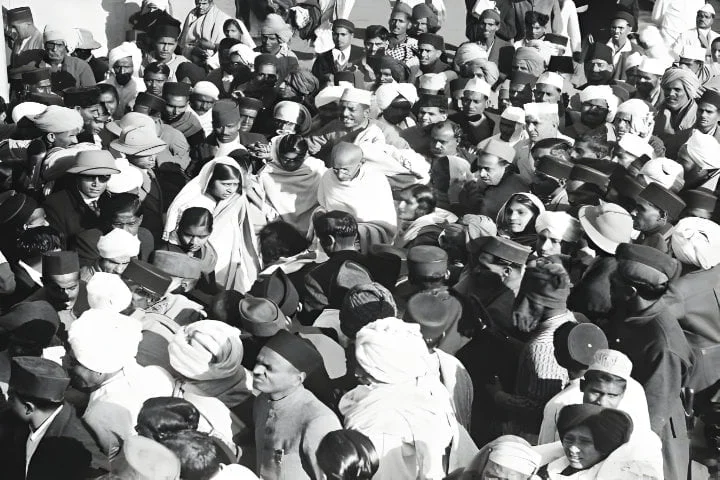
The period from 1919 to 1922 marked a turning point in India’s freedom struggle. It witnessed the emergence of the Khilafat Movement and the Non-Cooperation Movement, the first nationwide mass movements directed against British rule. Although the two movements arose from different immediate issues, they adopted the common principles of non-violence and non-cooperation, providing a shared platform for collective political action. Their convergence strengthened cooperation between the Indian National Congress and the Muslim League, broadened the social base of the nationalist movement and transformed the demand for Swaraj into a mass national objective under the leadership of Mahatma Gandhi. These developments marked the beginning of organised mass politics in India’s struggle for independence.
Genesis of the Movements
The Khilafat and Non-Cooperation Movements emerged from growing political discontent and economic hardship in the aftermath of the First World War. During this period, British policies convinced many Indians that constitutional methods alone were insufficient to secure justice or self-government.
Public resentment intensified with the enactment of the Rowlatt Act (1919), which granted extraordinary powers to the colonial administration. This was followed by the imposition of martial law in Punjab and the Jallianwala Bagh massacre, exposing the repressive character of British rule. The situation worsened when the Hunter Commission failed to ensure accountability for the Punjab atrocities, while the House of Lords endorsed the actions of General Dyer. These developments significantly weakened Indian faith in the impartiality of the colonial administration.
Alongside these repressive measures, the Montagu–Chelmsford Reforms (1919) failed to satisfy the growing demand for responsible government. The introduction of Dyarchy transferred only limited administrative powers to Indian ministers, while effective authority remained with the British executive. Consequently, constitutional reforms lost much of their credibility and strengthened support for a more assertive national movement.
Economic conditions further deepened public dissatisfaction. The post-war years witnessed rising prices, declining industrial production, increasing taxation and higher land rents, placing severe pressure on almost every section of society. The combined impact of political repression, ineffective constitutional reforms and economic hardship created favourable conditions for the emergence of a nationwide movement against colonial rule.
The Khilafat Issue: Immediate Catalyst
While dissatisfaction against British rule was steadily increasing within India, developments in West Asia supplied the immediate catalyst for mass mobilisation. Indian Muslims regarded the Sultan of Turkey, known as the Khalifa (Caliph), as the spiritual head of the Islamic world. During the First World War, Turkey allied with Germany and Austria against Britain and its allies. Despite this alignment, many Indian Muslims supported the British war effort in the belief that the position of the Khalifa and the territorial integrity of the Ottoman Empire would be protected after the war.
The post-war settlement shattered these expectations. The partition of the Ottoman Empire, the dismemberment of Turkey and the weakening of the Khalifa’s authority generated widespread resentment among Indian Muslims. This process culminated in the Treaty of Sevres (May 1920), which formally dismantled the Ottoman Empire and confirmed the post-war territorial arrangements. Many Indian Muslims regarded these developments as a betrayal of British assurances, transforming the Khilafat question from a religious concern into a major political issue.
To organise the agitation, the All India Khilafat Committee was established in 1919 under the leadership of Mohammad Ali, Shaukat Ali, Maulana Abul Kalam Azad, Ajmal Khan and Hasrat Mohani. Its primary objective was to persuade the British Government to revise its policy towards Turkey while mobilising public opinion across India. The All India Khilafat Conference, held in Delhi in November 1919, appealed for the boycott of British goods and laid the foundation for a nationwide campaign. Indian Muslims demanded:
- Retention of the Khalifa’s authority over Muslim holy places.
- Preservation of adequate territories under the Khalifa’s control after the post-war settlement.
Although the Khilafat Movement originated in response to developments affecting the Ottoman Empire, its significance extended far beyond a religious issue. It united large sections of the Muslim community on a common political platform and created favourable conditions for cooperation with the Indian National Congress. Thus, the Khilafat issue became the immediate political catalyst that enabled Mahatma Gandhi to convert widespread public discontent into India’s first organised nationwide movement against British rule.
Congress Support and the Formation of a United National Movement
The Khilafat leaders recognised that their movement required wider political support to achieve its objectives. Although the Indian National Congress was initially divided over the adoption of non-cooperation, Mahatma Gandhi viewed the Khilafat issue as an opportunity to unite Hindus and Muslims in a common struggle against colonial rule. He believed that such cooperation would strengthen the national movement while encouraging broader public participation.
Consequently, the Congress decided to support the Khilafat Movement, and the Muslim League also agreed to cooperate with the Congress on wider political issues. This collaboration marked a significant turning point in the freedom struggle by bringing different political and religious groups onto a common platform of peaceful resistance. It also laid the foundation for the launch of the Non-Cooperation Movement, which soon evolved into India’s first truly nationwide mass movement.
Evolution and Launch of the Non-Cooperation Movement
The Non-Cooperation Movement marked the beginning of Gandhian mass politics in India. Before initiating a nationwide campaign, Mahatma Gandhi had successfully organised local struggles at Champaran, Kheda and Ahmedabad, demonstrating that Satyagraha, based on truth and non-violence, could effectively mobilise ordinary people against injustice. These experiences convinced him that peaceful mass action could be extended to the national level.
The repression that followed the Jallianwala Bagh massacre, together with the denial of justice to its victims, strengthened Gandhi’s conviction that Swaraj could not be secured through constitutional methods alone. Instead, he argued that Indians should peacefully withdraw cooperation from colonial institutions.
The movement acquired an organised national character through a series of developments. In June 1920, an All-Party Conference at Allahabad approved a programme calling for the boycott of government schools, colleges and law courts and requested Mahatma Gandhi to lead the movement. On 31st August 1920, the Khilafat Committee formally launched the campaign of non-cooperation. The programme received political approval at the Special Session of the Indian National Congress at Calcutta (September 1920), which resolved to continue the movement until the Punjab and Khilafat grievances were redressed and Swaraj was achieved. Finally, at the Nagpur Session (December 1920), the Congress formally endorsed the movement and reorganised its structure by establishing a 15-member Congress Working Committee (CWC) to provide effective leadership to the nationwide campaign.
Programme of the Non-Cooperation Movement
The movement sought to weaken colonial authority by withdrawing voluntary cooperation from British institutions while simultaneously promoting national self-reliance. Its programme combined political resistance, economic boycott and constructive social reform, distinguishing it from earlier phases of the national movement.
Its major components included:
- Political boycott: Surrender of British titles and honours; boycott of legislatures and law courts.
- Educational boycott: Withdrawal from government schools and colleges.
- Economic boycott: Boycott of foreign goods, particularly imported cloth; promotion of Swadeshi, Khadi and the Charkha.
- Constructive programme: Promotion of Hindu–Muslim unity, removal of untouchability, and discouragement of the consumption of alcoholic beverages.
Public bonfires of imported cloth became a visible expression of resistance, while Khadi and the Charkha emerged as enduring symbols of self-reliance, economic nationalism and the constructive programme of the freedom struggle. Together, these measures sought not only to challenge colonial authority but also to build the social and economic foundations of an independent Indi
Participation in the Non-Cooperation Movement
The Non-Cooperation Movement rapidly expanded beyond political circles and became India’s first truly nationwide mass movement. Unlike earlier phases of the freedom struggle, it attracted participation from diverse sections of society, enabling ordinary people to become active participants in the nationalist movement. Although the extent of involvement varied across regions and social groups, the movement fundamentally broadened the social base of Indian nationalism.
Students were among the first to respond to Mahatma Gandhi’s call, leaving government schools and colleges in large numbers to support the movement. The urban middle class initially provided organisational leadership and actively participated in the boycott campaign, although sections of it gradually became hesitant about the continuation of Gandhi’s programme. Indian businessmen also extended considerable support because the emphasis on Swadeshi encouraged indigenous industries and reduced dependence on imported goods.
The movement acquired a strong rural character through the participation of peasants, many of whom used it to express their grievances against colonial rule as well as local forms of social and economic oppression. In some regions, however, these developments also intensified tensions between different social groups. Women emerged as an important force by giving up purdah, contributing jewellery to the Tilak Swaraj Fund, and actively participating in the picketing of shops selling foreign cloth and liquor. Their participation considerably broadened the social reach of the movement and marked a significant step towards greater public involvement in the freedom struggle.
The movement also received the support of several prominent national leaders, including C. Rajagopalachari, Vallabhbhai Patel, Gopabandhu Das, Ajmal Khan, Jawaharlal Nehru, Subhash Chandra Bose, Motilal Nehru and Chittaranjan Das. Some leaders, particularly Motilal Nehru and Chittaranjan Das, even gave up their legal practice to join the movement, reflecting the growing national commitment to non-cooperation. Collectively, these developments transformed the freedom struggle into a genuinely broad-based national movement.
Government Response
As the movement gathered momentum across the country, the colonial administration responded with increasing repression instead of political accommodation. Police firing was used to suppress demonstrations, resulting in the loss of several lives. The Congress and Khilafat volunteer organisations were declared unlawful, public meetings were prohibited, and most prominent nationalist leaders, except Mahatma Gandhi, were arrested. These measures reflected the British Government’s determination to curb the movement through administrative coercion rather than dialogue.
Withdrawal of the Non-Cooperation Movement
The movement came to an abrupt end following the Chauri Chaura incident in February 1922, when an agitated crowd set fire to a police station in present-day Uttar Pradesh, resulting in the death of twenty-two policemen. Deeply disturbed by this outbreak of violence, Mahatma Gandhi concluded that the movement had deviated from its fundamental principle of non-violence. Believing that moral discipline was indispensable to Satyagraha, he decided to withdraw the movement despite its growing momentum.
The decision generated considerable debate within the nationalist leadership. Leaders such as C.R. Das, Motilal Nehru, Jawaharlal Nehru and Subhash Chandra Bose believed that suspending the movement at its peak represented a major political setback. Shortly afterwards, in March 1922, Gandhi was arrested and sentenced to six years’ imprisonment, bringing this phase of the national movement to a close.
Causes of the Movement’s Failure
Although the Non-Cooperation Movement transformed Indian politics, it did not achieve its immediate objective of securing Swaraj. Its decline resulted from a combination of political, organisational and international developments.
The British Government adopted a policy of sustained repression and showed little willingness to negotiate with nationalist leaders, making it increasingly difficult to maintain the movement’s momentum. At the same time, the Khilafat issue, which had initially united large sections of Indian Muslims with the national movement, gradually lost its relevance following political developments in Turkey. Under the leadership of Mustafa Kamal Pasha, political authority was taken away from the Sultan, Turkey adopted a secular framework, and in 1924 the institution of the Khilafat itself was abolished. Consequently, one of the principal issues that had mobilised public opinion disappeared.
The movement also failed to secure a uniform response across the country. In major urban centres such as Calcutta, Bombay and Madras, the response to calls for resignations from government service and the surrender of official titles remained limited. Furthermore, the success of Gandhi’s strategy depended upon strict adherence to non-violence, but the Chauri Chaura incident demonstrated that sections of the movement had not fully internalised this principle, ultimately leading to its withdrawal.
Impact and Significance
Despite its premature withdrawal, the Non-Cooperation Movement fundamentally transformed the character of India’s freedom struggle and left a lasting political, social and economic legacy.
Politically, it carried nationalist ideas to villages, towns and cities across the country, bringing peasants, artisans, students, traders, women and the urban poor into active public life. The movement thus converted the freedom struggle into a genuinely mass-based movement and firmly established Mahatma Gandhi as its principal leader. Although the Khilafat issue originated outside Indian politics, it also strengthened Hindu–Muslim unity during this phase of the national movement.
The movement also encouraged the establishment of several national educational institutions, including Gujarat Vidyapith, Kashi Vidyapith, Bihar Vidyapith, Bengal National University, Jamia Millia Islamia and the National Muslim University. These institutions promoted indigenous education and reduced dependence on government-controlled institutions.
Economically, the boycott of foreign goods strengthened the Swadeshi Movement and encouraged the use of indigenous products. Imports of foreign cloth declined sharply between 1921 and 1922, while many merchants and traders refused to deal in imported goods or finance foreign trade. These developments reinforced the idea of economic self-reliance and provided fresh momentum to indigenous industries.
Although the Non-Cooperation Movement did not immediately achieve Swaraj, it permanently changed the nature of India’s national movement. It demonstrated the power of organised mass mobilisation, established non-cooperation as an effective instrument of political resistance, and prepared the ground for the subsequent phases of the freedom struggle under Mahatma Gandhi.
Conclusion
The Khilafat and Non-Cooperation Movements demonstrated the effectiveness of organised, non-violent mass mobilisation against colonial rule and redefined the direction of the national movement. Despite their immediate limitations, these movements laid the foundation for the subsequent phases of India’s struggle for independence.
FAQS
Q1. Why did the Khilafat Movement begin in India?
Answer:
The Khilafat Movement arose after the First World War, when the Ottoman Empire was partitioned and the authority of the Khalifa (Caliph) was weakened. Indian Muslims opposed British policy towards Turkey and demanded the restoration of the Khalifa’s authority over Muslim holy places and adequate territories.
Q2. Why did the Indian National Congress support the Khilafat Movement?
Answer:
Although the Khilafat issue was religious in origin, Mahatma Gandhi regarded it as an opportunity to strengthen Hindu–Muslim unity and broaden the national movement. Congress support enabled wider Muslim participation and helped transform the movement into a nationwide anti-colonial campaign.
Q3. How was the Non-Cooperation Movement formally launched?
Answer:
The movement evolved through a series of political developments. An All-Party Conference at Allahabad (June 1920) approved the boycott programme, the Khilafat Committee formally launched the campaign on 31 August 1920, the Calcutta Special Session (September 1920) approved it, and the Nagpur Session (December 1920) formally endorsed it while reorganising the Congress through the establishment of a 15-member Congress Working Committee (CWC).
Q4. What were the major programmes of the Non-Cooperation Movement?
Answer:
The movement encouraged Indians to withdraw cooperation from the colonial government through the surrender of British titles, boycott of legislatures, courts, schools and colleges, boycott of foreign goods, promotion of Swadeshi, Khadi and the Charkha, and social reform measures such as promoting Hindu–Muslim unity, removing untouchability, and discouraging the consumption of alcohol.
Q5. Why did Mahatma Gandhi withdraw the Non-Cooperation Movement?
Answer:
The movement was withdrawn after the Chauri Chaura incident (February 1922), in which an agitated crowd killed twenty-two policemen by setting a police station on fire. Gandhi believed that the incident violated the principle of non-violence, which formed the foundation of the movement, and therefore decided to suspend it.
Q6. What were the principal reasons for the failure of the Non-Cooperation Movement?
Answer:
The movement declined because of continued government repression, the gradual loss of relevance of the Khilafat issue following political changes in Turkey, uneven public participation in some regions, and the outbreak of violence at Chauri Chaura, which led to its withdrawal.
Q7. What was the significance of the Non-Cooperation Movement in India’s freedom struggle?
Answer:
The movement transformed the national movement into a mass-based struggle, bringing peasants, students, traders, women and other sections of society into active politics. It also strengthened the Swadeshi Movement, encouraged the establishment of national educational institutions, promoted Hindu–Muslim unity, and established non-cooperation as an effective method of anti-colonial resistance.