Context
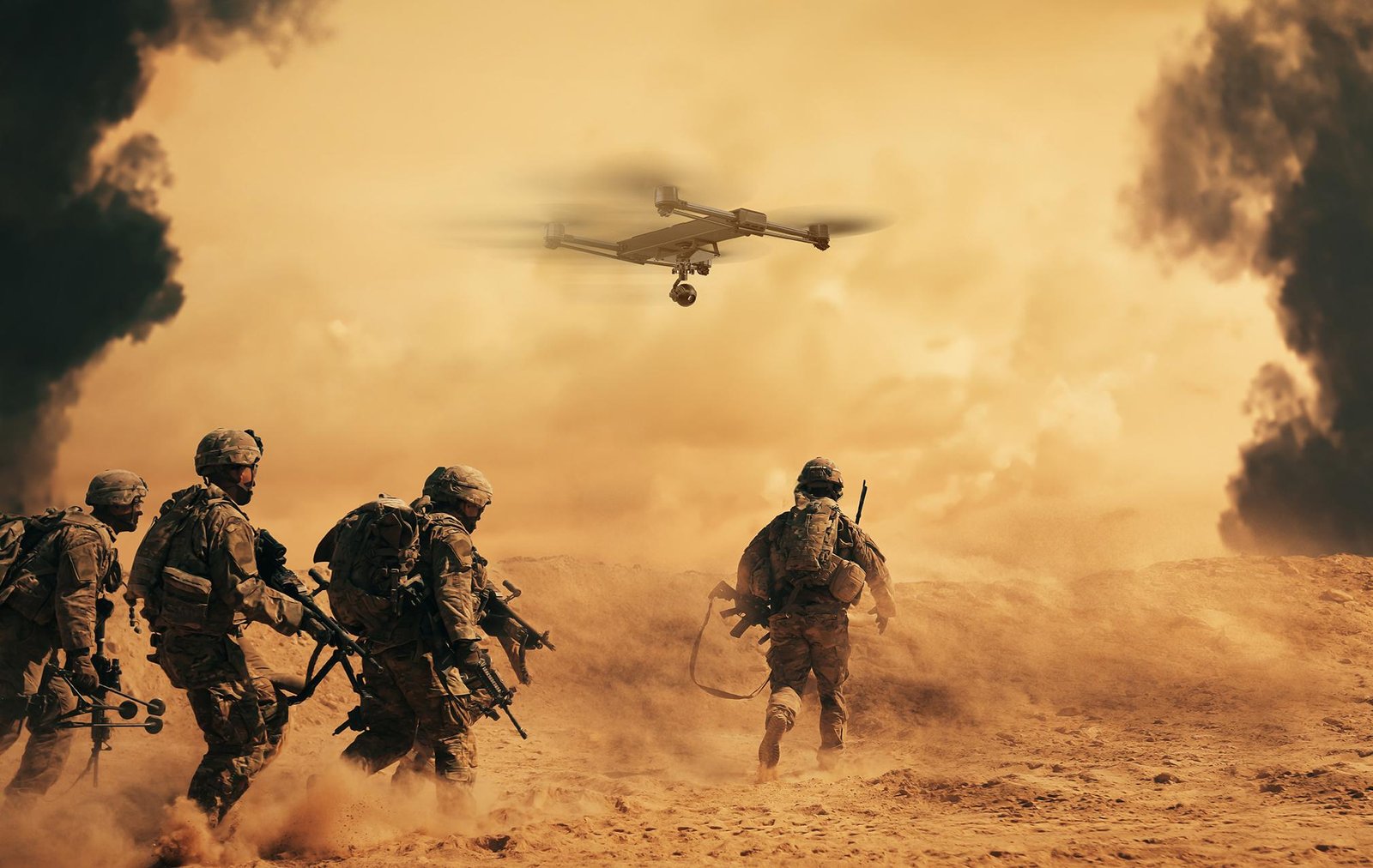
Recent conflicts in Ukraine, Lebanon, and West Asia have demonstrated the increasing centrality of drones in warfare. Their widespread deployment has transformed battlefield operations and altered traditional approaches to military power and conflict management.
Concept of Drone Warfare
Drone warfare refers to the employment of Unmanned Aerial Systems (UAS) for military purposes, including surveillance, reconnaissance, targeting, combat missions, logistics support, and electronic warfare. Their affordability, scalability, and versatility have made them integral to modern military strategies.
Types of Military Drones
- Reconnaissance Drones: Used for intelligence collection, surveillance, and battlefield awareness.
- Strike Drones: Armed systems designed to engage enemy personnel, equipment, and infrastructure.
- Loitering Munitions: Platforms capable of remaining airborne before identifying and attacking targets.
- FPV (First-Person View) Drones: Remotely controlled drones employed for highly precise attacks on tactical targets.
Transformation of Warfare
The proliferation of drones has challenged the traditional link between military strength and expensive conventional platforms. Drones now support a wide spectrum of operations, including:
- Intelligence, Surveillance and Reconnaissance (ISR)
- Target acquisition and battlefield coordination
- Precision engagement of enemy assets
- Electronic warfare operations
- Logistics and tactical support
This has created an environment where battlefield visibility is significantly enhanced and operational secrecy is increasingly difficult to maintain.
Ukraine: The Rise of Drone-Intensive Warfare
The Russia–Ukraine conflict has emerged as a major example of large-scale drone integration in combat.
Ukraine initially modified commercially available drones for reconnaissance and strike missions. Over time, drones became indispensable for battlefield awareness, target engagement, and attacks on military infrastructure and supply chains.
FPV Drones
FPV drones have become one of the most widely used systems in the conflict.
Their roles include:
- Precision attacks against armoured vehicles and military positions.
- Delivery of explosive payloads on tactical targets.
- Long-range strikes on logistics facilities and critical infrastructure.
Their effectiveness highlights how inexpensive systems can generate substantial battlefield impact.
Loitering Munitions: It provides the ability to search for targets before conducting precision strikes, enhancing operational flexibility and responsiveness.
Fibre-Optic Drones: A significant innovation has been the emergence of fibre-optic drones, which use fibre-optic cables instead of radio-frequency links for communication. This reduces vulnerability to electronic jamming and improves performance in contested electromagnetic environments.
Iran’s Approach to Drone Warfare
Iran employs drones as instruments of deterrence and regional influence. Through indigenous development and support to allied groups, it has expanded its ability to project power and impose costs on adversaries across West Asia without relying on expensive conventional assets.
Changing Economics of Conflict
The increasing use of drones has altered the cost structure of warfare:
- Affordable systems can neutralize high-value military assets.
- Manufacturing capacity has become a strategic advantage.
- Sustained innovation is essential to maintain operational effectiveness.
- Long-term military competitiveness increasingly depends on the ability to adapt to evolving technologies.
Challenges Associated with Drone Warfare
- Greater exposure of military bases and critical infrastructure to low-cost attacks.
- Difficulties in detecting and intercepting small unmanned systems.
- Wider availability of drone technology to non-state actors and terrorist organisations.
- Rising importance of cyber and electronic warfare capabilities.
- Regulatory and ethical concerns surrounding autonomous weapon systems.
Implications for India
India faces growing drone-related security challenges along both its western and northern frontiers, making preparedness a strategic necessity.
Key Priorities
- Promote indigenous drone development through initiatives such as Make in India and iDEX.
- Strengthen counter-drone capabilities through both kinetic and electronic measures.
- Expand capacities in swarm drones and unmanned combat systems.
- Invest in advanced technologies, including fibre-optic drones and AI-enabled platforms.
- Enhance coordination among the armed forces, DRDO, start-ups, and private industry.
- Develop a resilient defence manufacturing ecosystem capable of rapid innovation and scale.
Significance
- Illustrates the growing role of unmanned systems in military operations.
- Reduces the cost barrier to precision-strike capabilities, altering traditional military power equations.
- Narrows the distinction between conventional and asymmetric warfare.
- Increases the relevance of automation, artificial intelligence, and electronic warfare in conflict.
- Encourages military organisations to adapt doctrine, force structures, and procurement strategies to emerging technologies.
Conclusion
Drone warfare has become a defining feature of twenty-first-century conflict. As military effectiveness increasingly depends on technological adaptability and innovation, the ability to develop, deploy, and counter advanced unmanned systems will play a decisive role in shaping future security outcomes.