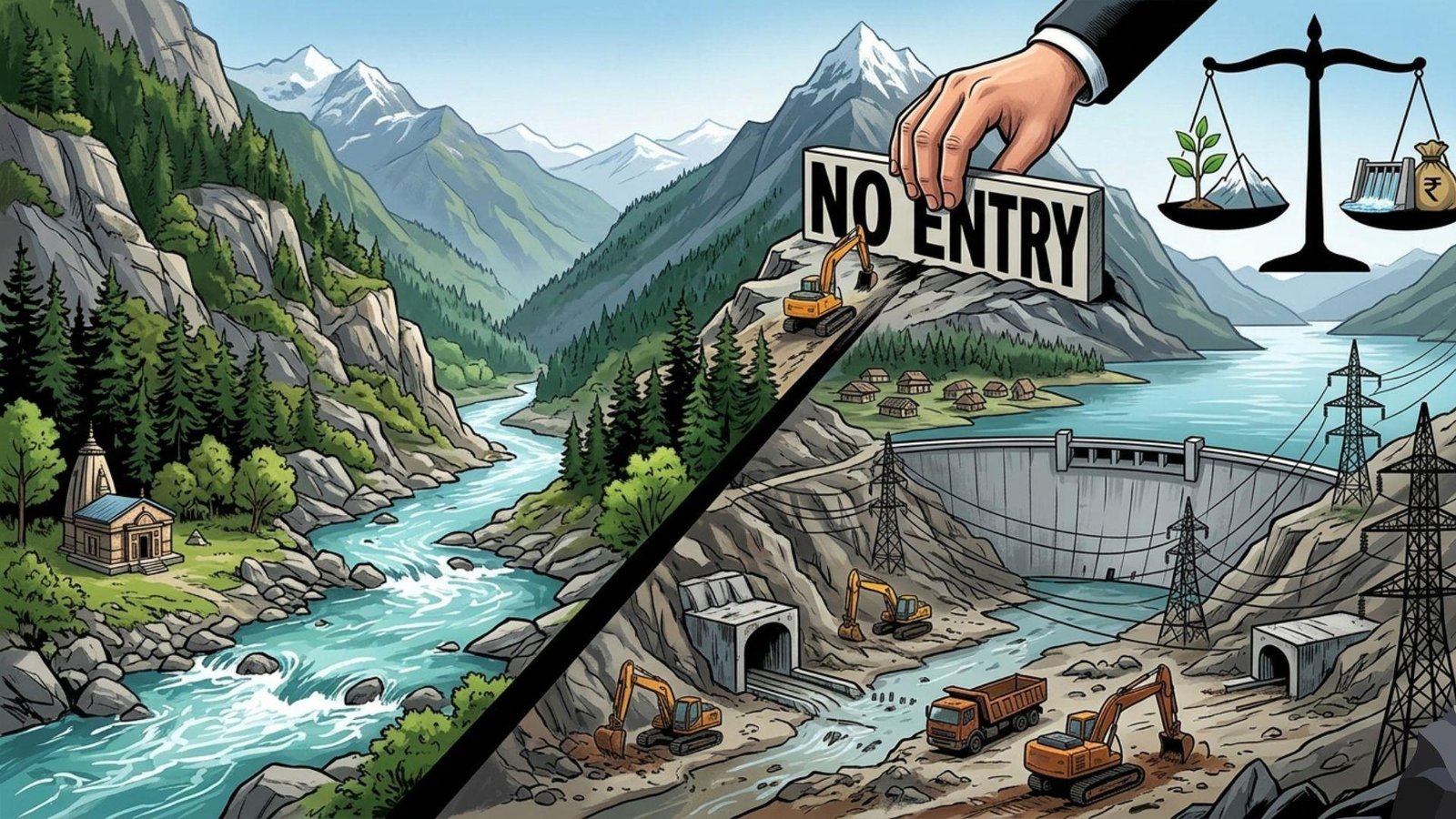
The Union Government has informed the Supreme Court that it does not support new hydropower projects on the Alaknanda River and Bhagirathi River, the major headstreams of the Ganga. The decision reflects a shift towards ecological sustainability and precautionary development planning in the fragile Himalayan region.
The issue gained prominence after the 2013 Kedarnath disaster, which intensified concerns regarding the impact of large infrastructure projects on Himalayan ecology and disaster vulnerability.
Core Issues in the Upper Ganga Debate
Following the Kedarnath disaster, the Supreme Court directed a review of hydropower projects in Uttarakhand and suspended fresh environmental and forest clearances.
The debate centred on balancing:
- Energy and development needs,
- Ecological flow of the Ganga,
- Environmental carrying capacity of the Himalayas,
- Increasing climate and disaster risks.
Expert Committees and Institutional Differences
Ravi Chopra Committee
The Environment Ministry constituted an expert committee under Ravi Chopra to assess the environmental impact of hydropower projects in the upper Ganga basin.
The committee concluded that most proposed projects could:
- Harm biodiversity,
- Disrupt river ecosystems,
- Increase ecological vulnerability in the Himalayan region.
The Environment Ministry broadly supported these findings.
Divergence Among Agencies
The Central Electricity Authority and Central Water Commission opposed the conclusions, arguing that:
- Hydropower projects have relatively low carbon emissions,
- They were not directly responsible for the Kedarnath disaster.
These differences resulted in prolonged policy uncertainty regarding hydropower development in the upper Ganga basin.
Reassessment and Centre’s Final Position
In 2015, the Supreme Court directed the formation of another committee under B.P. Das to examine:
- Cumulative environmental impact,
- Carrying capacity of the Ganga basin,
- Glacial and seismic risks,
- Socio-economic implications of hydropower projects.
Although the committee cleared several projects, disagreements among the Environment Ministry, Ministry of Jal Shakti, and Power Ministry delayed a final decision.
In 2021, the Union Government adopted a compromise approach by supporting only projects that were substantially completed or had major financial investments.
Subsequently, in 2024, the Supreme Court directed a committee headed by Cabinet Secretary T.V. Somanathan to reconsider earlier recommendations and clarify the government’s stand.
After consultations with the Uttarakhand Government, central ministries, and civil society organisations, only a limited number of projects were considered suitable.
Key Concerns Considered
- Ecological Sensitivity
Projects with major ecological consequences were excluded due to concerns regarding:
- Biodiversity loss,
- Disturbance to river ecosystems,
- Impact on eco-sensitive zones.
- Disaster Vulnerability
The committee highlighted increasing risks from:
- Glacial Lake Outburst Floods (GLOFs),
- Flash floods,
- Landslides,
- Seismic instability in the Himalayas.
The 2023 Sikkim disaster was cited as evidence of rising climate-related risks in mountain ecosystems.
Centre’s Final Stand
In 2026, the Union Government informed the Supreme Court that it would not support new hydropower projects in the Alaknanda and Bhagirathi basins.
The Centre described the region as ecologically and culturally significant because of:
- Fragile Himalayan geology,
- High disaster vulnerability,
- Rich biodiversity,
- Religious importance of the upper Ganga basin.
The government also referred to recent disasters such as:
- 2021 Rishi Ganga floods,
- Flash floods in Uttarakhand,
- Land subsidence in Joshimath.
It further highlighted the ecological importance of protected areas including:
- Nanda Devi National Park,
- Valley of Flowers National Park,
- Gangotri National Park,
- Kedarnath Wildlife Sanctuary.
Broader Policy Implications
The Centre’s position reflects growing recognition of the limits of infrastructure expansion in ecologically fragile Himalayan regions. It also indicates a broader policy shift towards climate-resilient and environmentally sustainable development planning.
The issue highlights the challenge of balancing:
- Renewable energy generation,
- Economic development,
- Ecological conservation,
- Disaster resilience.
The upper Ganga basin is increasingly emerging as an important case for sustainable river basin management and environmentally responsible infrastructure planning in India.
Conclusion
The upper Ganga hydropower debate highlights the growing importance of ecological sustainability in development policymaking. As climate-related disasters intensify in the Himalayas, future infrastructure planning will require greater emphasis on scientific assessment, environmental carrying capacity, and long-term ecological security. The upper Ganga debate may become an important framework for balancing development needs with ecological security in fragile Himalayan ecosystems.