Context
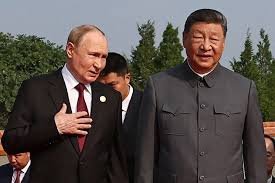
Russian President Vladimir Putin recently visited Beijing amid renewed diplomatic engagement between China and the United States. The visit reflects deepening Russia–China strategic convergence in an increasingly multipolar world order. As major centres of global power, the evolving relationship among Russia, China, and the United States will significantly influence international stability, global governance, and regional security dynamics.
Evolution of Russia–China Relations
- Relations strengthened after the Communist Revolution in China and the signing of the 1950 Treaty of Friendship between the Soviet Union and China.
- However, ideological differences and strategic rivalry later led to the Sino-Soviet split and border clashes in 1969.
- The weakening of Soviet–China relations subsequently enabled closer engagement between the United States and China during the Cold War period.
- Following the collapse of the Soviet Union, Russia and China gradually rebuilt ties through strategic cooperation agreements beginning in the 1990s.
- Relations entered a new phase under Vladimir Putin and Xi Jinping, culminating in the declaration of a “no-limits” partnership in 2022.
In recent years, geopolitical tensions and Western sanctions on Russia have accelerated strategic convergence between the two countries.
Factors Driving Russia–China Strategic Convergence
Economic Complementarity
The partnership is supported by complementary economic interests:
- China provides markets, technology, investment, and industrial goods.
- Russia supplies energy resources, defence equipment, and strategic raw materials.
Impact of Western Sanctions
Sanctions imposed on Russia after the Ukraine conflict significantly increased Moscow’s dependence on Beijing. Chinese firms replaced several Western companies in sectors such as:
- Telecommunications,
- Automobiles,
- Electronics.
Consequently, the partnership is increasingly marked by asymmetry, with Russia becoming more economically dependent on China.
Expanding Energy Cooperation
Energy cooperation has become a major pillar of bilateral relations through:
- Oil and gas trade,
- Power of Siberia pipeline projects,
- Long-term energy agreements.
Strategic and Financial Coordination
Both countries have expanded trade in national currencies such as the Yuan and Ruble to reduce dependence on the US dollar. Frequent leadership interactions also indicate growing geopolitical coordination against perceived Western dominance.
Strategic Outcomes of the Putin–Xi Summit
The recent summit between Vladimir Putin and Xi Jinping resulted in agreements relating to:
- Energy,
- Technology,
- Investment,
- Economic cooperation.
Shared Strategic Objectives
Both countries emphasised:
- Strengthening bilateral resilience amid geopolitical uncertainty,
- Expanding cooperation in response to external strategic pressures.
Common Geopolitical Position
The joint statement reflected support for:
- A multipolar international order,
- Reform of global governance institutions,
- Opposition to unilateral and hegemonic policies.
However, no final agreement was reached regarding the proposed Power of Siberia-2 pipeline project.
Limits to a Formal Russia–China Alliance
Russia and China are moving closer strategically because both increasingly perceive the United States as a major geopolitical competitor. However, the relationship still falls short of a formal military alliance.
A military alliance requires binding defence commitments and mutual security obligations, and both countries remain cautious about such arrangements.
- China seeks to avoid direct involvement in Russia’s confrontation with the West over Ukraine.
- Russia is reluctant to become entangled in China’s tensions with the United States regarding Taiwan.
Consequently, both countries currently prefer strategic coordination without treaty-bound military commitments. Although defence cooperation is expected to deepen further, a formal alliance remains unlikely in the near future.
Recent diplomatic engagement between the United States and China has also reduced the immediate possibility of an overt Russia–China military bloc.
Implications for India
The growing Russia–China proximity presents important strategic challenges for India.
Shrinking Strategic Space
India has traditionally balanced:
- Strong defence ties with Russia,
- Expanding strategic cooperation with the United States.
However, evolving geopolitical realities are reducing India’s room for strategic balancing among major powers.
Key Strategic Concerns
- Increasing Russian dependence on China could reduce India’s influence over Moscow.
- Closer Russia–China coordination may strengthen China’s strategic position against India.
- India may face greater geopolitical pressure in Eurasia and the Indo-Pacific.
- External balancing options may become less reliable amid intensifying great-power competition.
Policy Imperatives for India
India may need to:
- Preserve strategic autonomy,
- Diversify defence and technology partnerships,
- Accelerate indigenous defence capabilities,
- Continue a flexible multi-alignment strategy,
- Strengthen regional and global diplomatic engagement.
Conclusion
The deepening Russia–China partnership reflects broader shifts towards an increasingly multipolar but competitive international order. While strategic and economic cooperation between the two countries is expected to intensify, structural and geopolitical constraints make a formal military alliance unlikely in the near future. For India, navigating these evolving power equations will require calibrated diplomacy, sustained strategic autonomy, and greater self-reliance in security and economic capabilities.