Important questions for UPSC Pre/ Mains/ Interview:
|
Context
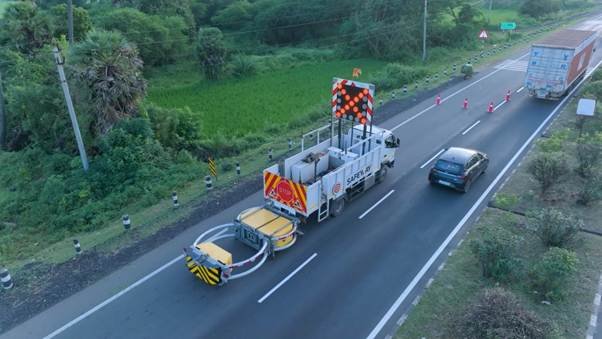
The Ministry of Road Transport and Highways has introduced Truck Mounted Attenuators (TMAs) to enhance road safety in construction and maintenance zones.
Q1. What is a Truck Mounted Attenuator (TMA), and what is its primary purpose in road safety management?
- A Truck Mounted Attenuator (TMA) is a safety device attached to the rear of a truck.
- It is designed to absorb impact during collisions, especially in road work zones.
- Its main purpose is to protect workers and motorists by reducing accident severity.
- It is widely used in highway construction, maintenance and repair operations.
Q2. How does a Truck Mounted Attenuator function to absorb impact and reduce accident severity?
- TMAs work by absorbing and dissipating kinetic energy during a collision.
- They reduce the force transferred to vehicles and individuals involved.
- This helps:
- Prevent severe damage to the impacting vehicle
- Protect road workers positioned ahead
- The system acts as a buffer between moving traffic and work zones.
Q3. What are the key safety features of TMAs, including warning systems and visibility enhancements?
- Equipped with high-intensity wig-wag warning lights.
- Lights flash in alternating patterns forming directional arrows.
- Provide clear visual signals to approaching drivers.
- Effective during:
- Night-time operations
- Foggy or low-visibility conditions
- These features ensure early detection and response by drivers.
Q4. How do TMAs help in preventing accidents in highway construction and maintenance zones?
- Provide advance warning to drivers about ongoing work zones.
- Reduce the likelihood of rear-end collisions.
- Act as a protective barrier, absorbing crash impact if accidents occur.
- Improve traffic management and driver awareness in high-speed corridors.
- Thus, they contribute to both accident prevention and damage reduction.
Q5. What is the significance of introducing TMAs in India’s road safety and infrastructure framework?
- Enhances worker safety in hazardous road construction zones.
- Reduces fatalities and injuries on highways.
- Aligns with global best practices in traffic and construction safety.
- Supports government efforts towards safer highways and infrastructure development.
Q6. What are the broader benefits of TMAs for road users and highway management systems?
- Improves overall traffic safety and efficiency.
- Reduces economic losses from accidents and disruptions.
- Ensures smoother maintenance operations without compromising safety.
- Builds public confidence in road infrastructure systems.
Q7. What challenges and measures are required for effective implementation of TMAs in India?
- Challenges:
- High initial cost of deployment
- Need for training and awareness among operators
- Limited adoption across all regions
- Measures:
- Mandate use in all major highway projects
- Provide training and guidelines for usage
- Integrate TMAs into road safety policies and standards
Conclusion
Truck Mounted Attenuators are a crucial innovation in road safety management, reducing risks in high-speed work zones. Their effective implementation can significantly improve highway safety outcomes in India.