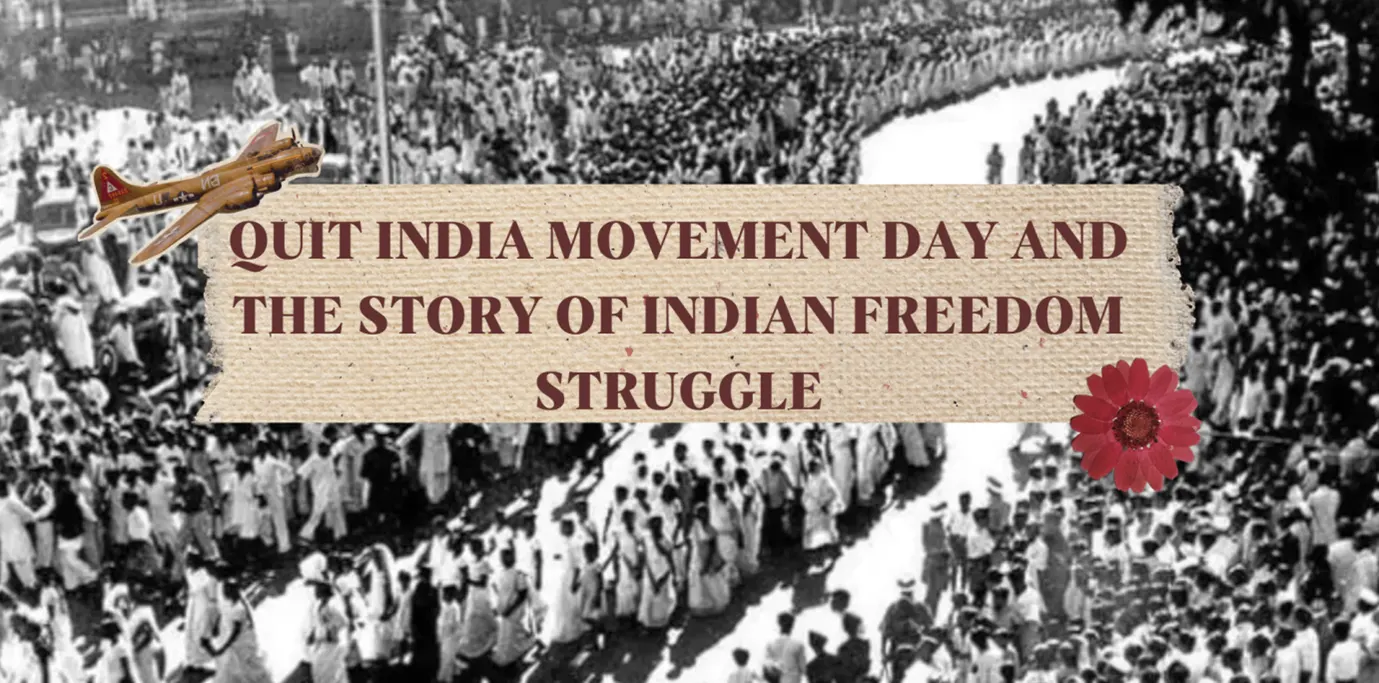
The Quit India Movement, launched on August 8, 1942, stands as the most radical and widespread struggle in the history of the Indian independence movement. Also known as the “August Kranti Movement,” it was a decisive “final strike” initiated by Mahatma Gandhi at the Gowalia Tank Maidan in Bombay. Unlike previous non-violent satyagrahas, the 1942 uprising was characterized by a “leaderless” mass defiance of British authority, fueled by the iconic slogan “Do or Die” (Karo ya Maro).
Although the British responded with unprecedented repression, the movement signaled that the colonial government no longer held the moral or administrative mandate to rule India. It paved the way for the eventual transfer of power in 1947.
Causes and Background of the Quit India Movement
The movement was the culmination of multiple geopolitical and socio-economic factors that intensified Indian resentment toward British rule.
- Failure of the Cripps Mission: The mission led by Stafford Cripps failed to promise immediate self-rule or a concrete plan for independence, offering only a vague “Dominion Status” after World War II.
- Economic Hardships of World War II: The war led to soaring inflation, severe shortages of essential commodities like rice, and heavy taxation. These conditions eventually contributed to the devastating Bengal Famine of 1943.
- Japanese Threat: With Japanese troops knocking at India’s borders after conquering Burma, Indian leaders felt that only a free India could effectively defend its territory.
- Disillusionment with British “Racial” Policy: The differential treatment of Indian and British subjects during the retreat from South-East Asia exposed the deep-seated racial discrimination of the colonial regime.
The Launch: August 8, 1942
The movement was formally proposed at the Wardha meeting (July 1942) and ratified at the Gowalia Tank session in Bombay.
- The “Do or Die” Mantra: Gandhi declared that every Indian should consider themselves a free citizen and act accordingly. He called for a complete and immediate British withdrawal.
- Operation Zero Hour: In a pre-emptive strike on the morning of August 9, 1942, the British government arrested all top leaders, including Gandhi, Nehru, Sardar Patel, and Maulana Azad.
- Immediate Detention: Gandhi was imprisoned in the Aga Khan Palace (Poona), while other leaders were moved to the Ahmednagar Fort.
Nature of the Movement: A Leaderless Uprising
With the top leadership behind bars, the movement transitioned into a decentralized and often radical struggle.
- Shift in Strategy: Unlike the peaceful Non-Cooperation (1920) or Civil Disobedience (1930) movements, the Quit India Movement saw widespread acts of sabotage against communication lines, railways, and telegraphs.
- Underground Resistance: Younger leaders took charge of underground networks to maintain public morale. Usha Mehta established an underground radio station in Bombay to broadcast news of the struggle.
- Parallel Governments: In several regions, the British authority was completely ousted, and “Parallel Governments” (Prati Sarkar) were established:
| Region | Leader | Key Activities |
| Ballia (UP) | Chittu Pandey | Released Congress leaders and took over administration. |
| Tamluk (Bengal) | Satish Chandra Samanta | Formed the Jatiya Sarkar; active in famine and cyclone relief. |
| Satara (Maharashtra) | Nana Patil, Y.B. Chavan | The longest-running parallel government; set up village courts. |
Mass Participation and British Repression
The movement saw the “subaltern” classes taking the lead, making it a true people’s movement.
- Students and Youth: Students from Patna and Benares played a pivotal role in organizing protests and disrupting colonial machinery.
- Women’s Leadership: In the absence of male leaders, women like Aruna Asaf Ali (who hoisted the flag at Gowalia Tank) and Sucheta Kripalani emerged as symbols of defiance.
- Peasants and Tribals: While active in Bihar and Eastern UP, tribal communities in Bengal and Orissa also participated in guerrilla tactics against the state.
- The British Crackdown: The colonial government used extreme force. Over 100,000 people were detained, and firing on crowds led to thousands of deaths. The All India Muslim League, Hindu Mahasabha, and the Communist Party of India officially stayed away from the movement.
Significance and Limitations
Significance
- Inevitability of Independence: It proved that the British could no longer govern India without the consent of the masses.
- Rise of New Leadership: It catapulted socialist leaders like Jayaprakash Narayan and Ram Manohar Lohia into the national spotlight.
- Change in Global Perception: The movement increased international pressure (especially from the USA) on Britain to address Indian demands.
Limitations
- Immediate Failure: The movement did not result in immediate independence and was largely suppressed by 1944.
- Communal Divide: The absence of the Muslim League weakened the unified front and indirectly strengthened the demand for a separate state of Pakistan.
- Lack of Coordination: The “leaderless” nature led to fragmented efforts and confusion in certain regions.
FAQs: Quit India Movement 1942
WHO STARTED THE QUIT INDIA MOVEMENT IN 1942?
The movement was launched by Mahatma Gandhi and the All India Congress Committee (AICC) on August 8, 1942.
WHAT HAPPENED ON 9TH AUGUST 1942?
The British launched “Operation Zero Hour,” arresting all prominent Congress leaders, including Gandhi and Nehru, to prevent the movement from starting.
WHO GAVE THE QUIT INDIA SLOGAN?
While Gandhi launched the movement, the slogan “Quit India” was coined by Yusuf Meherally, a socialist leader and Mayor of Bombay.
WHO HOISTED THE NATIONAL FLAG AT GOWALIA TANK AFTER THE ARRESTS?
Aruna Asaf Ali hoisted the Indian National Flag at the Gowalia Tank Maidan on August 9, 1942.
WHICH POLITICAL PARTIES DID NOT SUPPORT THE MOVEMENT?
The Muslim League, the Hindu Mahasabha, and the Communist Party of India did not support the Quit India Movement for various political and ideological reasons.
WHAT WAS THE ROLE OF USHA MEHTA IN THE MOVEMENT?
She organized and operated an underground “Congress Radio” to spread the message of the movement when the mainstream press was censored.
WHAT WAS THE SIGNIFICANCE OF THE SATARA PARALLEL GOVERNMENT?
Led by Nana Patil, the Satara Prati Sarkar was the most successful and long-lasting parallel government (1943–1945), establishing its own system of justice and administration.
WHO GAVE THE CALL “DO OR DIE”?
Mahatma Gandhi gave the call “Do or Die” during his speech at the Gowalia Tank Maidan in Bombay.
WHERE WAS GANDHI IMPRISONED DURING THE MOVEMENT?
Gandhi was detained at the Aga Khan Palace in Poona (Pune).
HOW DID THE MOVEMENT IMPACT THE BRITISH WAR EFFORT?
The widespread sabotage of railways and communication lines caused significant logistical disruptions for the British during World War II.