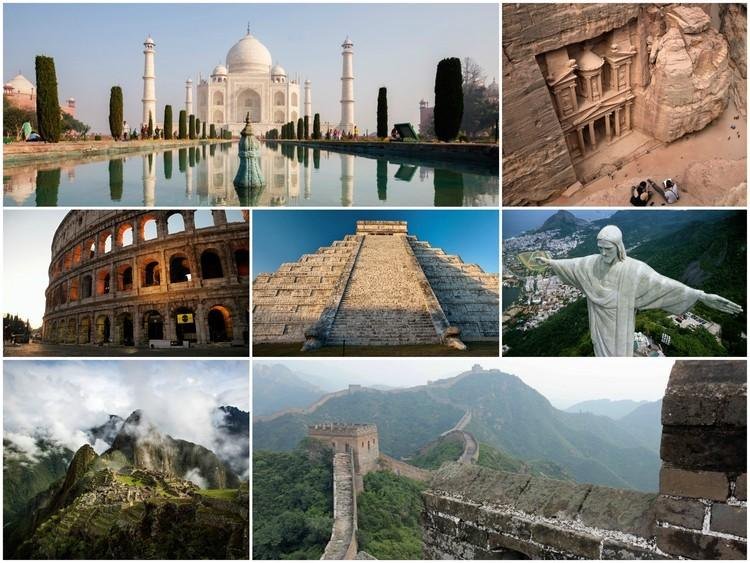
The 7 Wonders of the World represent the pinnacle of human ingenuity, architectural brilliance, and cultural endurance. Across the globe, these landmarks serve as monumental reminders of the artistic and engineering capabilities of ancient and modern civilizations. From the sprawling fortifications of the Great Wall of China to the ethereal symmetry of the Taj Mahal, these seven sites were selected through a global initiative to celebrate the world’s most exceptional heritage.
In 2000, a campaign was launched by a Swiss foundation to update the classical list of wonders. Out of 200 nominated monuments, the final “New 7 Wonders” were announced in 2007, reflecting a more global and culturally diverse selection of human achievement.
The New 7 Wonders of the World:
The following table details the seven monuments recognized globally for their exceptional design and historical impact.
| No. | Name of the Wonder | Primary Location | Estimated Year of Completion |
| 1 | The Great Wall of China | China | 700 BC (Early sections) |
| 2 | Petra | Ma’an, Jordan | 312 BC |
| 3 | The Colosseum | Rome, Italy | AD 80 |
| 4 | Chichen Itza | Yucatan, Mexico | AD 600 |
| 5 | Machu Picchu | Cusco Region, Peru | AD 1450 |
| 6 | The Taj Mahal | Agra, India | AD 1643 |
| 7 | Christ the Redeemer | Rio de Janeiro, Brazil | AD 1931 |
Detailed Insights into the 7 World Wonders
1. The Great Wall of China (China)
One of the most massive construction projects ever undertaken, the Great Wall is a complex network of fortifications built to protect Chinese empires from nomadic invasions.
- Structure: It consists of parallel walls and various branches stretching over 21,196 kilometers.
- Timeline: While construction began as early as the 7th century BC, the most famous sections were built during the Ming Dynasty (1368–1644).
- Status: It was designated a UNESCO World Heritage site in 1987.
2. Petra (Jordan)
Hidden within sandstone mountains, Petra was the capital of the Nabataean Kingdom. It is famously known as the “Rose City” due to the color of the stone from which it is carved.
- Engineering: The Nabataeans were masters of water management, creating complex conduits and chambers in an arid landscape.
- Trade: It served as a vital hub for the ancient spice trade.
3. The Colosseum (Italy)
Originally known as the Flavian Amphitheater, this massive oval arena in Rome is an icon of Imperial Roman architecture.
- History: Commissioned by Emperor Vespasian in AD 72 and completed by his son Titus in AD 80.
- Capacity: Built from concrete and sand, it was designed to host large-scale public spectacles and gladiatorial contests.
4. Chichen Itza (Mexico)
A powerful city of the Maya civilization, Chichen Itza showcases the advanced astronomical and mathematical knowledge of its creators.
- The Pyramid: The El Castillo pyramid features 365 steps, representing each day of the solar year.
- Cultural Hub: At its peak (9th–10th centuries CE), it was a major center for trade and religious ceremonies.
5. Machu Picchu (Peru)
Perched 7,970 feet above sea level in the Andes Mountains, this Inca citadel remained hidden from the world until its rediscovery in 1911 by Hiram Bingham.
- Construction: Famous for its sophisticated dry-stone walls where stones are fused without mortar.
- Purpose: Believed to have been a royal estate for the Inca emperor Pachacuti.
6. The Taj Mahal (India)
Located in Agra, the Taj Mahal is a global symbol of eternal love and the finest example of Mughal architecture.
- Origin: Built by Emperor Shah Jahan in memory of his wife, Mumtaz Mahal.
- Effort: It took 22 years and the labor of 20,000 workers to complete this white marble masterpiece.
- Recognition: Designated a UNESCO World Heritage site in 1983.
7. Christ the Redeemer (Brazil)
Standing atop Mount Corcovado, this Art Deco statue of Jesus Christ overlooks the city of Rio de Janeiro.
- Design: Created by engineer Heitor da Silva Costa and sculptor Paul Landowski.
- Dimensions: The statue is 30 meters tall with an arm span of 28 meters, constructed from reinforced concrete and soapstone mosaic tiles.
The Original 7 Wonders of the Ancient World
The concept of “wonders” originated in the 5th century BCE with Greek historian Herodotus. However, of the original seven, only one remains intact today.
- Great Pyramid of Giza (Egypt): The only ancient wonder still standing.
- Hanging Gardens of Babylon (Iraq): Believed to have been 75 feet high, though their exact location remains a mystery.
- Statue of Zeus at Olympia (Greece)
- Temple of Artemis at Ephesus (Turkey)
- Mausoleum at Halicarnassus (Turkey)
- Colossus of Rhodes (Greece)
- Lighthouse of Alexandria (Egypt)
The Selection Process: How the New List was Formed
The transition from the ancient list to the modern one was driven by a global public voting campaign initiated by the New7Wonders Foundation.
- Democratic Choice: Millions of people worldwide participated in the vote, making it one of the largest public polls in history.
- Criteria: Selection was based on architectural beauty, historical significance, cultural impact, and the level of preservation.
- The Giza Exception: While the Great Pyramid of Giza is an iconic wonder, it was granted an honorary status as a “historic landmark” rather than being a competing member of the new list.
FAQs: 7 Wonders of the World
WHICH OF THE ORIGINAL 7 WONDERS STILL EXISTS TODAY?
Only the Great Pyramid of Giza in Egypt remains intact today.
WHO BUILT THE TAJ MAHAL AND WHY?
Mughal Emperor Shah Jahan built it as a mausoleum for his beloved wife, Mumtaz Mahal.
WHERE IS MACHU PICCHU LOCATED?
It is located in the Cusco Region of Peru, high in the Andes Mountains.
WHY IS PETRA CALLED THE ROSE CITY?
It earned the nickname because of the reddish-pink hue of the sandstone from which the city’s structures are carved.
WHICH WONDER IS THE LARGEST AMPHITHEATER EVER BUILT?
The Colosseum in Rome, Italy, holds the record as the largest amphitheater in the world.
HOW LONG IS THE GREAT WALL OF CHINA?
The entire system, including all its branches and trenches, measures approximately 21,196 kilometers.
WHAT IS THE SIGNIFICANCE OF EL CASTILLO IN CHICHEN ITZA?
It is a pyramid that reflects the astronomical precision of the Maya, featuring 365 steps corresponding to the days of the year.
IN WHICH YEAR WAS THE CHRIST THE REDEEMER STATUE COMPLETED?
The statue was completed and inaugurated in AD 1931.
WHO REDISCOVERED MACHU PICCHU IN THE 20TH CENTURY?
American explorer Hiram Bingham brought Machu Picchu to international attention in 1911.
WHAT IS THE OLDEST MONUMENT ON THE NEW 7 WONDERS LIST?
The Great Wall of China is the oldest, with its earliest fortifications dating back to approximately 700 BC.