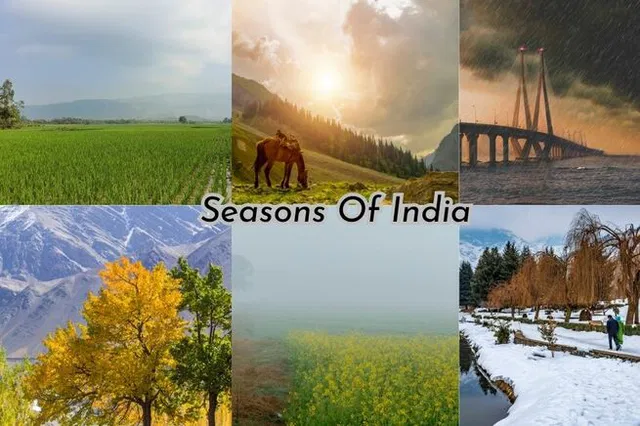
India’s climate is a rhythmic orchestration of meteorological phenomena, primarily governed by its vast latitudinal extent (8°N to 37°N) and the majestic Himalayas. The country’s seasonal cycle is not merely a change in weather but a transformative force that dictates the pace of the agrarian economy, social festivities, and ecological balance. Guided by the monsoon system and solar movement, India experiences a unique blend of tropical and subtropical climatic conditions.
Classification of Seasons in India
The India Meteorological Department (IMD) officially divides the Indian year into four primary seasons based on the movement of the Inter-Tropical Convergence Zone (ITCZ) and monsoon winds.
1. The Winter Season (December to February)
- Characteristics: Northern India faces sharp temperature drops due to the southward migration of the sun. Average temperatures in the plains range between 10°C and 15°C, while the Himalayas experience sub-zero conditions.
- Western Disturbances: Originating in the Mediterranean region, these cyclonic storms bring essential light rain and snow to the northwest, benefiting Rabi crops like wheat and mustard.
- 2024 Status: The IMD reported 2024 as one of the warmest years on record, with temperature anomalies reaching +0.65°C above the long-term average.
2. The Summer Season or Pre-Monsoon (March to May)
- Characteristics: Rapid heating of the Indian landmass creates a low-pressure zone in the Thar Desert.
- Local Phenomena: Loo: Hot, dry winds in the northern plains.
- Mango Showers: Pre-monsoon rain in Kerala and Karnataka aiding early mango ripening.
- Nor’westers (Kalbaisakhi): Violent thunderstorms in West Bengal and Assam.
3. Southwest Monsoon Season (June to September)
The primary rainy season, contributing nearly 75% of India’s annual rainfall.
- The Burst: Usually occurs in early June when moist winds from the Arabian Sea and Bay of Bengal strike the subcontinent.
- ITCZ Influence: The monsoon trough’s position dictates the “Active” and “Break” spells of rain.
- 2024 Performance: Rainfall was 106% of the Long Period Average (LPA), though distribution remained uneven, causing floods in Himachal and deficits in Maharashtra.
4. Post-Monsoon or Retreating Monsoon (October to November)
- Characteristics: The monsoon withdraws from the northwest first. Clear skies and high humidity lead to the phenomenon known as “October Heat.”
- Northeast Monsoon: The retreating winds pick up moisture from the Bay of Bengal and bring rain to Tamil Nadu, Kerala, and Andhra Pradesh, accounting for nearly 50% of Tamil Nadu’s annual rainfall.
Traditional Indian Seasons (The Six Ritus)
According to the Hindu Panchang, the year is divided into six distinct two-month periods (Ritus):
| Season (Ritu) | Period | Corresponding English Season |
| Vasanta | Mid-Feb to Mid-Apr | Spring |
| Grishma | Mid-Apr to Mid-Jun | Summer |
| Varsha | Mid-Jun to Mid-Aug | Monsoon |
| Sharad | Mid-Aug to Mid-Oct | Autumn |
| Hemant | Mid-Oct to Mid-Dec | Pre-winter |
| Shishir | Mid-Dec to Mid-Feb | Winter |
Geographical Influences on Indian Seasons
India’s geography acts as the master architect of its climate:
- The Himalayas: Act as a double barrier—blocking freezing Central Asian winds and forcing the monsoon winds to shed their moisture over the plains.
- Western Ghats: Cause a massive rain-shadow effect; the windward side (coastal Karnataka/Kerala) receives heavy rain while the leeward side (Deccan) often faces drought.
- Jet Streams: The Subtropical Westerly Jet influences winter weather, while the Tropical Easterly Jet is crucial for the monsoon’s onset.
- Thar Desert: Its intense heating in summer creates the thermal low necessary to pull the moisture-laden winds from the Indian Ocean.
Impact on Agriculture and Economy
The Reserve Bank of India (RBI) 2023-2024 Report highlighted that despite monsoon variability, foodgrain production reached record highs.
- Kharif Season: Sown with the monsoon (Rice, Maize, Sugarcane).
- Rabi Season: Sown in winter (Wheat, Gram, Barley).
- Zaid Season: Short summer crop (Watermelons, Cucumbers).
- Economic Linkage: Adequate rainfall reduces inflation, boosts rural income, and ensures reservoir levels for hydropower and industrial use.
Climate Change: Shifting Patterns
The IPCC AR6 and recent IMD reports indicate significant alterations in traditional cycles:
- Temperature Rise: India’s average temperature rose by 7°C (1901–2018).
- Extreme Events: Shorter but more intense monsoon spells, increasing the risk of urban flooding.
- Glacial Retreat: Melting Himalayan glaciers are altering the perennial flow of the Ganga and Brahmaputra.
- Oceanic Shifts: El Niño conditions in 2023 caused heatwaves.
Government Initiatives: “Mission Mausam”
To combat the unpredictability of seasons, the Ministry of Earth Sciences launched Mission Mausam (2024-2026) with an outlay of ₹2,000 crore.
- National Monsoon Mission-III: Focused on improving rainfall prediction using AI and satellite-based tracking.
- PMKSY: Enhancing irrigation efficiency to reduce “Monsoon Dependency.”
- GKMS: Providing real-time agro-meteorological advisories to over 100 million farmers.
10 FAQs: Understanding Seasons in India
Q1 What are the four main seasons recognized by the IMD?
The IMD recognizes Winter, Summer (Pre-monsoon), Southwest Monsoon (Rainy), and Post-Monsoon (Retreating Monsoon).
Q2 Which winds bring rainfall to Tamil Nadu during winter?
The Northeast Monsoon (or Retreating Monsoon) winds are responsible for winter rains in Tamil Nadu and coastal Andhra Pradesh.
Q3 What is “October Heat”?
It is the weather condition during the retreating monsoon phase characterized by high temperatures and high humidity after the rains have ceased but the land is still moist.
Q4 How does the El Niño effect impact the Indian monsoon?
El Niño typically leads to below-normal rainfall and warmer temperatures in India, often causing droughts.
Q5 What are “Western Disturbances”?
These are low-pressure systems originating in the Mediterranean Sea that bring winter rain and snow to Northwest India, crucial for the wheat crop.
Q6 Which is the wettest place in India (and the world)?
Mawsynram in Meghalaya receives the highest annual rainfall due to the funneling effect of the Khasi Hills.
Q7 What are “Mango Showers”?
These are pre-monsoon rainfall occurring in Kerala and Karnataka during late summer, which helps in the early ripening of mangoes.
Q8 What is the significance of the “LPA” in monsoon reports?
LPA (Long Period Average) is the average rainfall recorded over a 50-year period; it serves as a benchmark to determine if a monsoon is “normal,” “above normal,” or “deficient.”
Q9 Which crops are grown during the Zaid season?
Zaid crops include watermelon, cucumber, muskmelon, and leafy vegetables, grown in the short gap between Rabi and Kharif.
Q10 What is the “Mission Mausam” scheme?
Launched in 2024, it is a ₹2,000 crore government initiative to upgrade weather forecasting infrastructure and AI-driven climate modeling for accurate predictions.