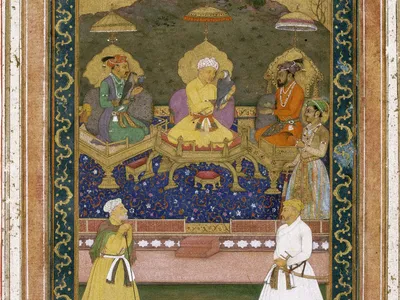
The Mughal Empire was a transcontinental powerhouse that redefined the political, architectural, and cultural landscape of the Indian subcontinent for over three centuries. Founded in 1526 by Babur, a descendant of both Timur and Genghis Khan, the empire established a centralized administration that bridged Persian, Central Asian, and Indian traditions. At its zenith under Aurangzeb, the empire stretched across almost the entire subcontinent, leaving behind a legacy of iconic monuments like the Taj Mahal and sophisticated systems like the Mansabdari and Zabt.
The Foundation and Rise of the Mughals
The Mughal dynasty began when Babur, a Timurid prince, capitalised on the internal fractures of the Delhi Sultanate. Between 1519 and 1524, he invaded the Punjab region, eventually crossing the Indus after securing Kabul.
The Great Mughals: Chronology and Key Achievements
| Ruler | Reign | Significant Milestones |
| Babur | 1526–1530 | Defeated Ibrahim Lodi in the First Battle of Panipat; wrote the Baburnama. |
| Humayun | 1530–1540, 1555–1556 | Briefly lost the empire to Sher Shah Suri; regained Delhi in 1555. |
| Akbar | 1556–1605 | Expanded the empire immensely; abolished Jizya; founded Din-i-Ilahi. |
| Jahangir | 1605–1627 | Era of administrative consolidation and exquisite Shalimar Gardens. |
| Shah Jahan | 1628–1658 | Golden Age of Architecture; built the Taj Mahal and Red Fort. |
| Aurangzeb | 1658–1707 | Maximum territorial expansion; reimposed Jizya; faced numerous revolts. |
Administrative and Socio-Economic Structure
The Mughals established a sophisticated, multi-tiered administrative machinery that allowed them to govern a diverse and vast population.
Central and Provincial Governance
The Emperor (Badshah) held supreme authority, assisted by key ministers:
- Wazir: Prime Minister.
- Diwan: Head of Finance.
- Mir Bakshi: Head of the Military.
- Sadr-us-Sadur: Head of Religious Affairs.
The empire was divided into Subas (provinces), which were further divided into Sarkars (districts) and Parganas (village clusters).
The Mansabdari System
This was a unique grading system for civil and military officials.Each official was assigned a Mansab (rank) comprising two parts: Zat (personal status/salary) and Sawar (number of cavalrymen maintained). Ranks were not hereditary, and payment was often made through Jagirs (land revenue assignments).
Land Revenue Systems
- Zabt/Bandobast System: Developed by Raja Todar Mal under Akbar, it involved detailed land measurement and classification based on soil fertility.
- Dahsala System (1580): Standardised revenue based on the average produce and prices of the last ten years.
Mughal Art, Architecture, and Literature
The Mughals are globally renowned for their aesthetic contributions, blending Indo-Islamic styles with Persian symmetry.
Architectural Landmarks
- Humayun’s Tomb (Delhi): The first substantial example of Mughal architecture in India.
- Fatehpur Sikri (Agra): Built by Akbar, featuring the Buland Darwaza.
- Taj Mahal (Agra): Shah Jahan’s masterpiece, representing the pinnacle of Mughal symmetry.
- Bibi Ka Maqbara (Aurangabad): Built by Aurangzeb, often called the “Poor Man’s Taj.”
Mughal Painting
Mughal painting flourished with the integration of Persian techniques and Indian sensibilities.
- Akbar: Commissioned the Hamzanama and Akbar Nama.
- Jahangir: The zenith of Mughal painting; focused on naturalism, portraits, and animal studies (led by masters like Abul Hasan and Mansur).
Economic Conditions and Trade
The economy was largely agrarian, but urban centers thrived as hubs of trade and manufacture.
- Crops: Introduction of new crops such as tobacco, maize, chilli, potato, and tomato.
- Trade: India was a global leader in cotton textiles, silk, and indigo.
- Financial Tools: The use of Hundi (letters of credit) facilitated long-distance trade across the empire.
Decline of the Mughal Empire
After the death of Aurangzeb in 1707, the empire began a steady disintegration due to:
- Succession Wars: Frequent infighting among royal family members.
- Weak Successors: Later rulers were often “puppet emperors” controlled by powerful nobles.
- Rise of Regional Powers: The Marathas, Sikhs, and Jats challenged Mughal dominance.
- Foreign Invasions: Nadir Shah’s invasion in 1739 and Ahmad Shah Abdali’s raids stripped the empire of its wealth and prestige.
FAQs: Mughal Empire
Q1 Who founded the Mughal Empire and in which battle?
The Mughal Empire was founded by Babur in 1526 after defeating Ibrahim Lodi in the First Battle of Panipat.
Q2 What was the ‘Din-i-Ilahi’?
Din-i-Ilahi was a syncretic religion or ethical code introduced by Akbar in 1582, aiming to merge the best elements of the religions practiced in his empire.
Q3 Which Mughal Emperor is associated with the ‘Golden Age of Architecture’?
Shah Jahan is associated with this period, having commissioned the Taj Mahal, Red Fort, and Jama Masjid.
Q4 What was the Mansabdari system?
It was an administrative system where officials were given a rank (Mansab) that determined their status, salary, and the number of troops they were required to maintain.
Q5 Who wrote the ‘Humayun Nama’?
Gulbadan Begum, the sister of Humayun, wrote the Humayun Nama, which provides a detailed biography of his life.
Q6 Which Mughal Emperor reimposed the Jizya tax?
Aurangzeb reimposed the Jizya tax on non-Muslim subjects in 1679, reversing Akbar’s earlier policy of religious tolerance.
Q7 What was the ‘Zabt’ system?
The Zabt system was a land revenue system developed by Raja Todar Mal under Akbar, involving land measurement and classification for taxation purposes.
Q8 Who were the ‘Sayyid Brothers’?
They were powerful nobles (the “Kingmakers”) during the Later Mughal period who controlled the appointment and removal of several emperors.
Q9 Which foreign invader took away the Peacock Throne and the Koh-i-Noor diamond?
The Persian ruler Nadir Shah took these treasures following his invasion of Delhi in 1739.
Q10 What was the official language of the Mughal administration?
Persian was the official language used for administrative, legal, and literary purposes during the Mughal era.