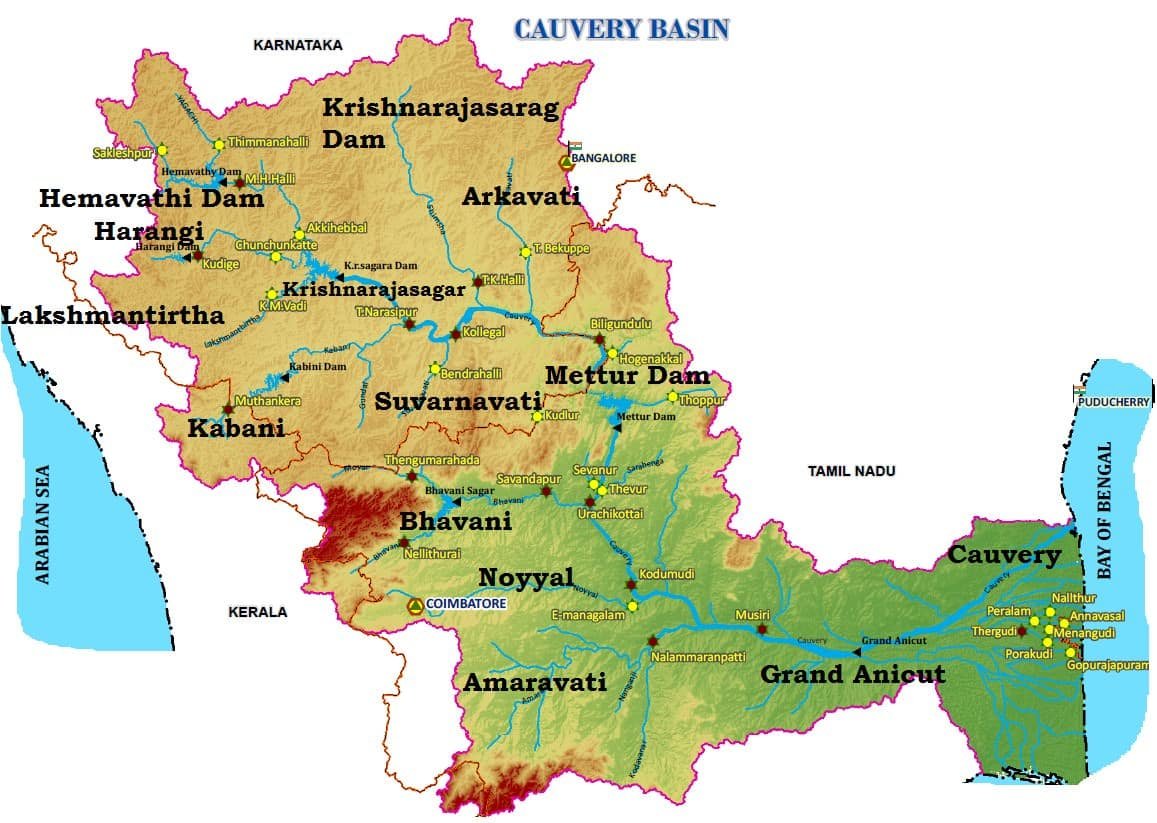
The Kaveri River System (also spelled Cauvery) is the lifeline of South India, revered as the ‘Dakshin Bharat ki Ganga’ (Ganga of the South). Spanning approximately 800 km, it is one of the few rivers in Peninsular India that remains perennial, thanks to its unique position that allows it to receive rainfall from both the Southwest Monsoon (June–September) and the Northeast Monsoon (October–December).
From its misty origins in the Western Ghats to its sprawling fertile delta on the Coromandel Coast, the Kaveri is central to the agriculture, hydroelectric power, and cultural identity of Karnataka and Tamil Nadu.
Origin and Course of the Kaveri River
The Kaveri River originates at Talakaveri, located in the Brahmagiri Range of the Western Ghats in the Kodagu (Coorg) district of Karnataka, at an elevation of approximately 1,341 meters.
- Initial Descent: The river flows in a south-easterly direction through the Mysore Plateau.
- The Falls: As it descends from the Deccan Plateau to the plains, it forms several spectacular waterfalls, including the famous Shivanasamudra Falls (the site of one of India’s first hydroelectric projects).
- The Delta: Upon entering Tamil Nadu, the river reaches the Eastern Ghats and eventually fans out into a vast, highly fertile distributary network known as the Kaveri Delta.
- The Outfall: The river finally empties into the Bay of Bengal at Poompuhar in Tamil Nadu.
Geographical and Soil Profile of the Basin
The Kaveri basin is geographically diverse, divided into the Western Ghats, the Mysore Plateau, and the Cauvery Delta. The delta is often referred to as the “Garden of Southern India” due to its immense agricultural productivity.
Soil Types Found in the Basin:
- Black Soils: Highly moisture-retentive, found in parts of the plateau.
- Red Soils: Predominant across the basin.
- Alluvial Soils: Rich deposits found primarily in the fertile Delta region.
- Laterites and Forest Soils: Located in the hilly tracts of the Western Ghats.
The Tributary Network: Left Bank vs. Right Bank
The Kaveri is fed by several major tributaries that drain the lush landscapes of Karnataka, Kerala, and Tamil Nadu.
Left Bank Tributaries
These rivers generally originate in the northern and western parts of the basin:
- Harangi River: Originates in the Pushpagiri Hills (Kodagu) and flows 50 km before joining the Kaveri near Kudige.
- Hemavati River: A significant 245 km long tributary originating in Chikmagalur; it joins the Kaveri at the Krishnarajasagara reservoir.
- Shimsha River: Originates in the Tumkur region and flows for 221 km before its confluence.
- Arkavathi River: Rises from the Nandi Hills near Bengaluru and joins the Kaveri south of Kanakapura.
Right Bank Tributaries
These rivers drain the southern reaches of the basin:
- Lakshmana Tirtha: Rises in the Brahmagiri range and joins the Kaveri at Krishna Raja Sagara.
- Kabini River: A vital tributary originating in Kerala (Wayanad); it joins the main stream in the Mysore district.
- Bhavani River: Rises in the Nilgiri Hills, passes through Silent Valley (Kerala), and meets the Kaveri at Kooduthurai.
- Noyyal River: A smaller tributary passing through the industrial hubs of Coimbatore and Tirupur.
- Amaravathi River: The longest tributary of the Kaveri, it flows northward through Tamil Nadu and features the Amaravathi Dam.
Major Dams and Hydroelectric Projects
The Kaveri River is one of the most highly utilized rivers in India for irrigation and power.
| Dam/Project | State | Significance |
| Krishna Raja Sagara (KRS) | Karnataka | Primary water source for Mysore and Bengaluru; essential for irrigation. |
| Mettur Dam | Tamil Nadu | One of India’s largest dams; creates the Stanley Reservoir and supports the Delta’s rice bowl. |
| Grand Anicut (Kallanai) | Tamil Nadu | Built by the Chola King Karikala in the 2nd Century AD; one of the oldest water-regulator structures in the world. |
| Kabini Dam | Karnataka | Crucial for both Karnataka and Kerala; supports wildlife and agriculture. |
| Lower Bhavani Project | Tamil Nadu | Vital for water management in the Erode and Coimbatore districts. |
Cultural Significance: Kaveri Pushkaram
The Kaveri is not just a water source but a sacred entity. The Kaveri Pushkaram is a major religious festival held every 12 years. In recent years, significant efforts (costing approx. ₹3 crores) were made to renovate the Thula Kattam at Mayiladuthurai and revive sacred springs dating back to the Chola period to facilitate the Maha Pushkaram.
FAQs: Kaveri River System
Where does the Kaveri River originate?
The Kaveri originates at Talakaveri in the Brahmagiri range of the Western Ghats, located in the Kodagu district of Karnataka.
Why is the Kaveri called a perennial river?
Unlike most South Indian rivers, the Kaveri receives water from the Southwest Monsoon in its upper catchment (Karnataka) and the Northeast Monsoon in its lower catchment (Tamil Nadu).
Which is the longest tributary of the Kaveri?
The Amaravathi River is considered one of the longest and most significant right-bank tributaries.
What is the “Garden of Southern India”?
The Kaveri Delta in Tamil Nadu is known by this name because of its extreme fertility and high agricultural output, particularly rice.
Which States/UTs are part of the Kaveri basin?
The basin covers parts of Karnataka, Tamil Nadu, Kerala, and the Union Territory of Puducherry.
What is the total length of the Kaveri River?
The river flows for approximately 800 kilometers from its source to the Bay of Bengal.
Which is the oldest dam in the Kaveri system?
The Kallanai (Grand Anicut), built by the Chola dynasty nearly 2,000 years ago, is still in use today.
Which tributary flows through the Silent Valley National Park?
The Bhavani River passes through the Silent Valley National Park in Kerala before entering Tamil Nadu.
Where does the Kaveri River empty into the sea?
The river merges into the Bay of Bengal at Poompuhar in the Mayiladuthurai district of Tamil Nadu.
What are the major waterfalls on the Kaveri?
The most famous waterfalls are the Shivanasamudra Falls (Karnataka) and the Hogenakkal Falls (on the border of Karnataka and Tamil Nadu).