The relationship between India and China is arguably the most significant bilateral dynamic in the Indo-Pacific region. As the world’s two most populous nations and fastest-growing major economies, their interaction shapes the “Asian Century.” Since formalizing diplomatic ties on April 1, 1950, the relationship has swung from the optimistic “Hindi-Chini Bhai-Bhai” era to the frostiness of prolonged military standoffs. Today, the relationship is characterized by a “competitive coexistence,” where deep economic interdependence clashes with unresolved territorial sovereignty and strategic rivalry.
Historical Evolution of India-China Ties
The contact between these two ancient civilizations dates back over two millennia, predominantly through trade and spirituality.
Ancient and Colonial Exchanges
- Buddhism as a Bridge: Starting in the 1st Century A.D., Buddhism traveled from India to China, creating a lasting cultural bond.
- The Silk Road Scholars: Renowned Chinese travelers like Fa Xian and Xuan Zang visited India, while Indian monks like Bodhidharma took Zen Buddhism to China.
- Independence Movements: During the struggle against colonialism, leaders showed mutual solidarity. Notable events include Rabindranath Tagore’s 1924 visit to China and the Aid China Medical Mission (1938) involving Dr. Dwarakanath Kotnis.
Post-Independence and Panchsheel
India was the first non-socialist country to recognize the People’s Republic of China (PRC). In 1954, the two nations signed the Panchsheel Agreement (Five Principles of Peaceful Coexistence):
- Mutual respect for territorial integrity and sovereignty.
- Mutual non-aggression.
- Mutual non-interference in internal affairs.
- Equality and mutual benefit.
- Peaceful coexistence.
The Border Context: Geography and Disputes
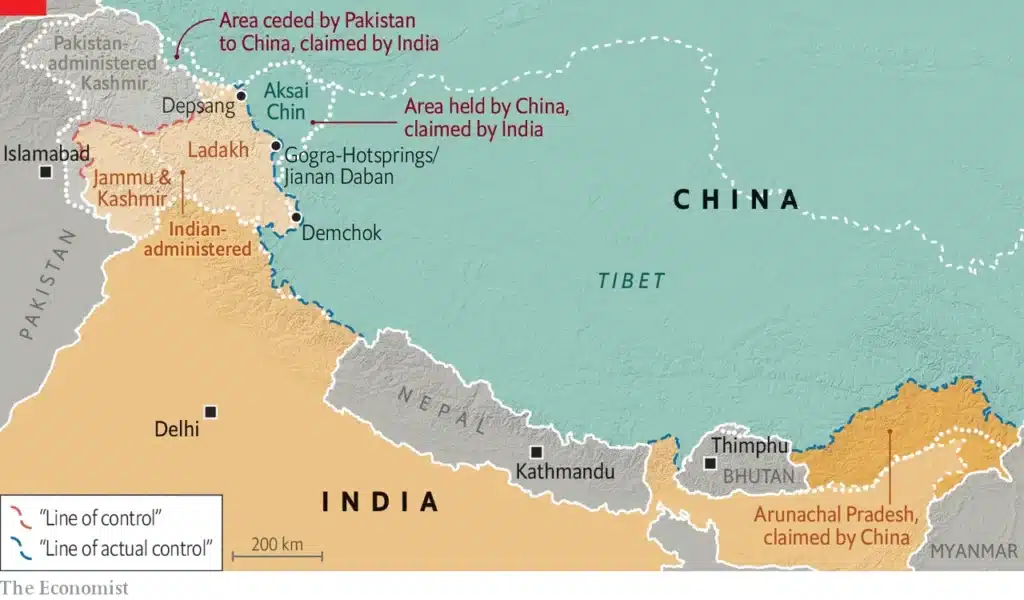
The Line of Actual Control (LAC) remains the primary source of friction. The 3,488 km border is divided into three sectors: Western (Ladakh), Middle (Himachal/Uttarakhand), and Eastern (Sikkim/Arunachal Pradesh).
Major Border Conflicts
- 1962 Sino-Indian War: A pivotal conflict fought over Aksai Chin and the North-East Frontier Agency (now Arunachal Pradesh), leading to a long-term rupture in ties.
- Nathu La Clashes (1967): Tactical military encounters in Sikkim where India successfully repelled Chinese advances.
- Doklam Standoff (2017): A 73-day military face-off near the tri-junction with Bhutan over Chinese road construction.
- Galwan Valley (2020): The first fatal confrontation in 45 years, occurring in Eastern Ladakh, which led to a complete freeze in bilateral normalization.
- Yangtse (2022): A physical clash in the Tawang sector of Arunachal Pradesh, highlighting the volatile nature of the un-demarcated border.
Economic and Trade Dynamics
Despite political tensions, China remains India’s top trading partner, creating a complex “economic-security” paradox.
- The Trade Deficit: In the fiscal year 2024, India’s trade deficit with China stood at USD 85.1 billion. India largely exports raw materials while importing high-value electronics, active pharmaceutical ingredients (APIs), and machinery.
- Investment Trends: Following the 2020 border tensions, Chinese investments in India saw a sharp decline (3% decrease in 2021). India has also implemented stricter scrutiny on Chinese FDI and banned several Chinese apps citing security concerns.
Strategic Challenges: The “Five Fingers” and “String of Pearls”
India faces systemic challenges due to China’s assertive foreign policy maneuvers.
Geopolitical Strategies
- Five Finger Policy: A Chinese strategy regarding Tibet as the palm and Ladakh, Nepal, Sikkim, Bhutan, and Arunachal Pradesh as fingers that must be “liberated.”
- Salami Slicing: The practice of using small, incremental territorial gains to change the status quo without triggering a full-scale war.
- String of Pearls: China’s attempt to encircle India through a network of military and commercial facilities in the Indian Ocean (e.g., Gwadar in Pakistan, Hambantota in Sri Lanka)..
Water and Maritime Security
- Yarlung Zangbao (Brahmaputra) Dam: China’s planned “super-dam” raises fears of water diversion and ecological damage in lower riparian India and Bangladesh.
- Indian Ocean Incursions: The presence of Chinese “research” vessels like Yuan Wang 5 in the Indian Ocean is viewed as a spying threat by New Delhi.
India’s Policy Response and The Way Forward
As both nations move toward the 75th anniversary of diplomatic relations in 2025, India’s strategy focuses on “Equilibrium” through strength and diplomacy.
Strategic Frameworks
- Atmanirbhar Bharat: Reducing dependence on Chinese imports by boosting local manufacturing and the Make in India
- Infrastructure: Developing border regions through Project Arunank and the Vibrant Villages Program.
- Global Alliances: Strengthening the QUAD (with US, Japan, Australia) and the I2U2 to ensure a free and open Indo-Pacific.
- Necklace of Diamonds: Expanding India’s maritime footprint to counter Chinese encirclement.
FAQs
WHAT IS THE CURRENT STATUS OF THE INDIA-CHINA BORDER?
As of early 2026, both nations have agreed to a staged reduction in border tensions, specifically disengaging and resuming patrolling in the Depsang Plains and Demchok areas to restore the pre-May 2020 status quo.
WHAT IS THE PANCHSHEEL AGREEMENT?
Signed in 1954, it consists of Five Principles of Peaceful Coexistence, including mutual respect for sovereignty and non-interference in internal affairs.
WHAT IS CHINA’S “FIVE FINGER POLICY”?
It is a Chinese geopolitical view that considers Tibet as the right-hand palm and Ladakh, Nepal, Sikkim, Bhutan, and Arunachal Pradesh as the five fingers that should be under Chinese control.
HOW LARGE IS THE TRADE DEFICIT BETWEEN INDIA AND CHINA?
In the fiscal year 2024, India’s trade deficit with China reached a staggering USD 85.1 billion.
WHAT IS THE MCMAHON LINE?
The McMahon Line is the boundary line between the Northeastern region of India and Tibet, which India recognizes as the border but China officially repudiates.
WHO WAS DR. DWARAKANATH KOTNIS?
He was an Indian physician who was part of the Aid China Medical Mission in 1938 and is revered in China for his humanitarian service during the Second Sino-Japanese War.
WHAT IS THE SIGNIFICANCE OF THE “STRING OF PEARLS” STRATEGY?
It is a Chinese strategy to build a network of commercial and military bases around the Indian Ocean to encircle India and secure its energy routes.
HAS THE KAILASH MANSAROVAR YATRA RESUMED?
Recent diplomatic developments in 2025-26 indicate a mutual agreement to resume the Kailash Mansarovar Yatra and increase direct flights between the two nations.
WHAT IS “SALAMI SLICING” IN THE CONTEXT OF FOREIGN POLICY?
It refers to a strategy of making small, incremental territorial gains over time that are individually too small to cause a war but collectively lead to a major change in the border status.