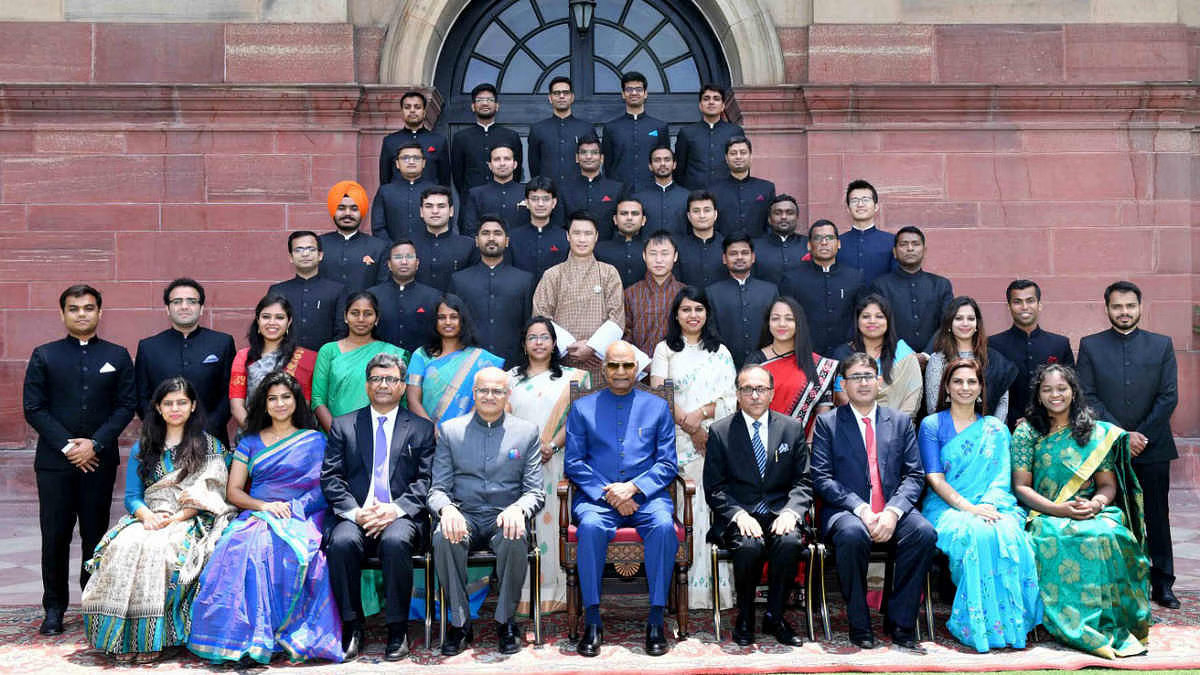
- The full form of IFS is the Indian Foreign Service.
- It is classified under the Group ‘A’ Central Services and functions as an essential component of the Civil Services of India.
- Alongside the Indian Administrative Service (IAS) and the Indian Police Service (IPS), the IFS is regarded as one of the three premier arms of the All India Services.
- The primary responsibility of IFS officers is to represent India on the global stage.
- Their role includes managing India’s external affairs, such as international diplomacy, trade negotiations, and cultural exchanges with foreign countries.
- They play a crucial part in fostering and maintaining India’s international image and relationships.
- In addition to diplomatic representation, the IFS is tasked with the formulation and execution of India’s foreign policies.
- It also oversees the functioning and administration of Indian embassies, high commissions, and consulates located across the world.
- Among the various civil services, the Indian Foreign Service is considered one of the most prestigious and competitive, ranking just after the IAS in popularity.
- Each year, the Union Public Service Commission (UPSC) allocates approximately 17–18 vacancies for IFS posts, making the selection process extremely competitive due to the limited number of positions.
- The IFS is not only one of the most elite services in India but also one of the smallest cadres in terms of the number of officers, adding to its exclusivity and prestige.
What is IFS?
- The Indian Foreign Service (IFS) is the diplomatic and administrative wing of the Group A and Group B Central Services under the Government of India.
- It plays a crucial role in managing the country’s external affairs, including diplomacy, trade negotiations, and cultural relations with foreign nations.
- The IFS is known for its challenging responsibilities and attractive salary structure, which makes it a highly sought-after career among civil service aspirants.
- One of the most exciting aspects of being an IFS officer is the opportunity to travel across various countries, allowing officers to immerse themselves in diverse cultures, languages, and cuisines..
Recruitment Process of IFS
- Officers for the Indian Foreign Service (IFS) are primarily selected through the Civil Services Examination (CSE) conducted annually by the Union Public Service Commission (UPSC).
- This examination is one of the most competitive in India and is designed to recruit candidates into Group A and Group B Central Services.
- The UPSC Civil Services Examination comprises three stages:
- Preliminary Examination – An objective-type screening test.
- Main Examination – A descriptive written exam.
- Personality Test (Interview) – The final stage to assess the candidate’s suitability for civil services.
- Candidates who successfully clear all three stages are allotted services based on their merit rank and preference.
- Those selected for the IFS undergo foundation training at the Lal Bahadur Shastri National Academy of Administration (LBSNAA) in Mussoorie, followed by specialized training at the Sushma Swaraj Institute of Foreign Service (SSIFS) in New Delhi.
- Apart from direct recruitment, there is also a second mode of entry into the IFS, through promotion from Group B services.
- This process is handled by the Staff Selection Commission (SSC).
- Officers inducted through this route can rise through the ranks and may eventually be appointed to senior positions such as Joint Secretary in the Ministry of External Affairs.
Role of an IFS Officer
The Indian Foreign Service (IFS) plays a crucial role in handling the external affairs of India, which include diplomacy, international trade, cultural exchange, and strategic relations with foreign nations. IFS officers act as the face of India on the global stage and contribute directly to shaping and executing the country’s foreign policy.
Below are the key responsibilities of an IFS officer:
- Representation of India Abroad
- IFS officers are posted in Indian Embassies, High Commissions, Consulates, and Permanent Missions to Multilateral Organizations such as the United Nations (UN).
- They represent India’s interests at international forums, bilateral meetings, and multilateral negotiations.
- Promoting Bilateral and Cultural Relations
- They work to foster friendly relations with all relevant stakeholders in the host country, including Non-Resident Indians (NRIs) and Persons of Indian Origin (PIOs).
- Officers also promote India’s cultural heritage, tourism, and soft power abroad.
- Safeguarding India’s Interests
- IFS officers are tasked with protecting India’s political, economic, and strategic interests in the country where they are deputed.
- They report important developments in the host country that could influence India’s national interests or foreign policy.
- Diplomatic Negotiations
- They engage in negotiating agreements, treaties, and strategic deals on behalf of India with foreign governments and organizations.
- This includes trade agreements, defence cooperation, climate treaties, and strategic partnerships.
- Consular Duties
- IFS officers provide consular services to Indian citizens living abroad, such as:
- Passport and visa assistance
- Legal and emergency help
- IFS officers provide consular services to Indian citizens living abroad, such as:
- Repatriation support
- They also extend services to foreign nationals visiting or engaging with India.
- Other Key Functions of IFS Officers
- Keep MEA updated on strategic developments in their host country.
- Facilitate economic cooperation and act as a bridge between Indian industries and foreign markets.
- Help in framing and executing foreign policy based on real-time inputs from ground postings.
- Manage Indian missions abroad, ensuring their effective functioning and alignment with India’s strategic goals.
Divisions of the Ministry of External Affairs (MEA)
The Ministry of External Affairs (MEA) is the central body responsible for formulating and managing India’s foreign policy. It has two key divisions:
- Territorial Division
- Deals with political, economic, and bilateral relations with specific countries or regions.
- Each desk is dedicated to a particular country or group of countries.
- Functional Division
- Handles multilateral diplomacy, including:
- Regional groupings (like SAARC, BRICS)
- Legal affairs
- Handles multilateral diplomacy, including:
- Disarmament issues
- Press, media, and publicity
- Cultural diplomacy
- Policy formulation and coordination
IFS officers, both in India and abroad, are vital to maintaining India’s diplomatic presence, expanding its global influence, and protecting the interests of Indian citizens and the state on the world stage. Their role is central in building trust, cooperation, and strategic depth with other nations.
Required Skills
To excel in the Indian Foreign Service (IFS), a candidate must possess a unique combination of personal, intellectual, and diplomatic qualities. The following skills are essential for performing effectively in India’s foreign affairs domain:
- Interpersonal Skills
- Strong interpersonal skills are crucial for building and maintaining positive relationships with foreign dignitaries, local authorities, and Indian citizens abroad.
- Officers must be able to navigate different cultural sensitivities and maintain cordial relations in all situations.
- Effective Communication
- Both oral and written communication must be clear, professional, and persuasive.
- An IFS officer must be able to articulate India’s positions and negotiate diplomatically at international forums.
- Deep Knowledge of India’s Policy and Global Affairs
- A strong grasp of India’s domestic and foreign policies, economic strategies, international relations, and global developments is critical.
- Officers are expected to represent India’s stance and interests knowledgeably and confidently.
- Diplomatic Approach
- IFS officers must handle sensitive issues with tact, discretion, and diplomacy.
- They should be able to maintain neutrality, manage conflicts, and engage in constructive dialogue, even under pressure.
- Leadership and Decision-Making Ability
- Officers often head missions or represent India independently in high-level meetings.
- This requires sound judgment, quick thinking, and decisive leadership, especially during emergencies or international negotiations.
- Physical and Mental Stamina
- A career in the IFS demands high levels of endurance—officers must adapt to changing time zones, long hours, frequent travel, and high-pressure situations.
- Mental resilience is as important as physical strength.
- Patience – The Most Critical Trait
- Above all, an IFS officer must possess immense patience.
- Dealing with long negotiations, complex international protocols, and unpredictable diplomatic challenges requires the ability to remain calm and composed.
Together, these qualities help IFS officers represent India with integrity, efficiency, and confidence on the global stage.
Pros of Becoming an IFS
- Representation of the Nation on the Global Stage
- One of the most prestigious aspects of being an IFS officer is the responsibility of representing India in foreign nations.
- Whether stationed at an embassy, consulate, or permanent mission to international organizations like the UN, IFS officers are the face of the country abroad.
- They work tirelessly to safeguard India’s strategic, political, economic, and cultural interests, and play a key role in shaping and executing foreign policy.
- Global Exposure and International Travel
- IFS officers enjoy the unique privilege of extensive international travel as part of their official duties.
- Over the course of their careers, they are posted to various countries, enabling them to live in and experience different cultures, political systems, and societies.
- This global exposure not only enriches their professional understanding but also broadens their personal worldview.
- Opportunities to Engage with Influential Personalities
- Due to their diplomatic responsibilities, IFS officers frequently interact with world leaders, foreign dignitaries, celebrities, business icons, and key international stakeholders.
- These interactions help build valuable global networks and offer insights into international affairs at the highest levels.
- Enjoyment of Diplomatic Privileges and Immunities
- As official representatives of the Indian government, IFS officers are accorded diplomatic status, which includes various privileges and immunities under the Vienna Convention.
- These can include exemption from certain taxes, protection from prosecution under local laws in host countries, and access to secure diplomatic channels and facilities, depending on the nature of the assignment.
- Prestige, Lifestyle, and Perks
- IFS officers lead a highly respectable and dignified lifestyle.
- Their positions often come with well-furnished residences in diplomatic enclaves, access to international schools for their children, and the opportunity to live in some of the most prominent cities across the world.
- The role offers not only professional recognition but also personal comfort and security.
Cons of Becoming an IFS
- Limited Family Accompaniment During Postings
- One of the major challenges faced by IFS officers is the restriction on bringing family members along on all foreign postings.
- In certain countries, especially those with security concerns or unstable political environments, officers are posted alone.
- This separation can take an emotional toll, especially for officers with young children or elderly parents.
- Postings in High-Stress or Conflict-Prone Regions
- While the IFS offers global exposure, not all postings are glamorous or peaceful.
- Officers can be assigned to regions experiencing political turmoil, armed conflict, or natural disasters.
- In such situations, the job becomes highly demanding and stressful, requiring constant vigilance and diplomatic tact to navigate complex international issues under pressure.
- Extended Time Away from Home Country
- A commonly cited drawback of the IFS is the significant amount of time officers spend abroad.
- Nearly half of an IFS officer’s career is typically spent in foreign nations.
- While this offers unique experiences, it also means missing out on important family moments, festivals, and milestones in India.
- By the time officers return to India for longer durations, they often feel disconnected from their roots and extended family.
- Challenges in Family Adjustment Abroad
- Even when families accompany officers abroad, adjustment can be difficult.
- Spouses may face career disruptions, and children often struggle with frequent school changes, cultural shifts, and the challenge of building new social circles in unfamiliar environments.
- These transitions can be emotionally taxing and may impact family well-being in the long run.
- Personal Sacrifices and Social Isolation
- The diplomatic lifestyle, while prestigious, often comes with personal sacrifices.
- Maintaining close friendships and long-term relationships can be difficult due to constant relocations.
- Social isolation can set in, particularly in countries where language barriers or cultural differences are stark, making personal and social life somewhat restricted.
IFS Officer Salary
The salary structure of an Indian Foreign Service (IFS) officer is competitive and comes with a range of allowances and benefits that make the job both financially and socially rewarding.
Base Salary in India
- The basic monthly salary of an entry-level IFS officer in India is approximately ₹60,000 (excluding allowances).
- This includes the basic pay, grade pay, and other allowances like DA (Dearness Allowance), HRA (House Rent Allowance), and TA (Travel Allowance).
Foreign Postings – Higher Salary Package
- When posted abroad, the salary of an IFS officer increases substantially, depending on the country of posting.
- The monthly salary can range anywhere between ₹1.5 lakh to ₹2.4 lakh, and in some high-cost or high-risk postings, it may go even higher.
- This is because officers receive a foreign allowance based on:
- The cost of living in the host country
- The security risk level of the location
- The standard of living expected in that country
Additional Perks and Benefits
- Free Accommodation in diplomatic enclaves or embassy residences
- Official Vehicle with driver for transportation
- Medical Benefits for self and family, both in India and abroad
- Education Allowance for children, including support for international schools during foreign postings
- Domestic Assistance like cooks or domestic staff, often provided by the government in foreign countries
- Travel Perks including business-class international travel and Leave Travel Concession (LTC)
- Retirement Benefits including pension, gratuity, and other post-retirement facilities
Career Growth and Top-Level Positions
- The highest ranks in the IFS include positions such as:
- Ambassador / High Commissioner to foreign countries
- Permanent Representative to international organizations like the UN
- Foreign Secretary, the top-most bureaucrat in the Ministry of External Affairs
An Indian Foreign Service (IFS) officer serves the country by representing India abroad and managing diplomatic relations. While the base salary is comparable to other civil services, IFS officers enjoy unique financial advantages due to foreign postings, international allowances, and lifestyle-related benefits.
Factors Influencing IFS Salary
- Country of Posting: Officers earn significantly more while posted abroad due to foreign allowances.
- Cost of Living: Salary increases in high-cost or developed nations to maintain standard of living.
- Risk Level: In high-security or politically sensitive regions, additional hardship allowances are given.
- Diplomatic Protocol: Officers must maintain a lifestyle in line with their diplomatic rank, influencing pay and perks.
| Grade | Rank | Basic Pay in INR (as per 7th Pay Commission) |
| Junior Time Scale | Under Secretary | 8000 |
| Senior Time Scale | Under Secretary | 10700 |
| Junior Administrative Scale | Deputy Secretary | 12750 |
| Selection Grade | Counselor Director | 15100 |
| Senior Administrative Scale | Joint Secretary | 18400 |
| High Commissioner/ Ambassador | Foreign Secretary | 26000 |
IFS Officer Salary as per Grade and Rank
- At the Junior Time Scale, an IFS officer receives a basic pay ranging from ₹15,600 to ₹39,100, with a grade pay of ₹5,400.
- For officers in the Senior Time Scale, the pay remains in the ₹15,600 to ₹39,100 range, but the grade pay increases to ₹6,600.
- In the Junior Administrative Grade, the salary continues within the ₹15,600 to ₹39,100 band, with a grade pay of ₹7,600.
- Officers promoted to the Selection Grade earn a higher basic pay between ₹37,400 and ₹67,000, along with a grade pay of ₹8,700.
- At the Super Time Scale, the pay scale is also ₹37,400 to ₹67,000, but with a significantly higher grade pay of ₹12,000.
- For officers in the Apex Pay Scale, such as Ambassadors and Foreign Secretaries, the salary is fixed at ₹80,000 per month.
- The Cabinet Secretary, the highest-ranking civil servant in India, receives a fixed pay of ₹90,000 per month.
Eligibility Criteria for IFS
To be eligible for the Indian Foreign Service (IFS), a candidate must meet any one of the following nationality conditions:
- Citizen of India – The candidate must be a bona fide Indian citizen.
- Citizen of Nepal – Nationals of Nepal are also eligible to apply.
- Citizen of Bhutan – Nationals of Bhutan are permitted to apply for IFS.
- Tibetan Refugee – A Tibetan refugee who came to India before 1st January 1962 with the intention of permanently settling in India is eligible.
- Persons of Indian Origin (PIO) – Candidates who have migrated from the following countries with the intention of permanently settling in India can also apply:
- Pakistan
- Sri Lanka
- Burma (Myanmar)
- East African countries: Kenya, Uganda, Tanzania (formerly Tanganyika and Zanzibar), Zambia, Malawi, Zaire (now DRC), Ethiopia
- Vietnam
Note: Candidates falling under categories 2 to 5 must present a certificate of eligibility issued by the Government of India at the time of appointment.
Educational Qualification for IFS
To be eligible for the Indian Foreign Service (IFS), the candidate must fulfill the following academic requirement:
- The candidate must hold a graduate degree or an equivalent qualification (bachelor’s level) from a recognized university in India or abroad.
- Final-year students who are awaiting results or are about to appear for their final exam are also eligible to apply for the UPSC Civil Services Examination, provided they can produce proof of passing before the final stage (Interview/Personality Test).
Essential Skills Required to Become an IFS Officer
Becoming an IFS officer requires more than just academic qualification. The role demands a blend of intellectual, interpersonal, and leadership skills. Key competencies include:
- Strong Decision-Making Ability: Ability to take quick, sound, and strategic decisions, especially during diplomatic negotiations or crises.
- Effective Communication Skills: Proficiency in both written and verbal communication is essential for drafting reports, engaging in diplomacy, and representing India abroad.
- In-depth Knowledge of International Relations: Understanding of foreign policies, global political dynamics, and India’s relations with other countries.
- Awareness of Current Affairs: Up-to-date knowledge of national and international events, economic trends, and geopolitical developments.
- Sharp Analytical Thinking: Ability to analyze complex situations, assess risks, and evaluate the implications of foreign policy decisions.
- Leadership and Team Management: Capability to lead diplomatic missions, manage embassy staff, and coordinate with multiple departments effectively.
Age Limit for IFS
- Minimum Age: 21 years
- Maximum Age: 32 years (as per the latest UPSC notification)
Age Relaxation (Category-wise)
| Category | Upper Age Limit | Relaxation |
| SC/ST | 37 years | 5 years |
| OBC | 35 years | 3 years |
| PwBD (Deaf/Blind/Disabled) | Up to 42 years | Up to 10 years |
| Residents of J&K (1980–89) | Varies | As per UPSC norms |
| Ex-Servicemen / Defence Personnel | Varies | As per UPSC norms |
Number of Attempts (UPSC CSE – IFS)
- General & EWS Category: 6 attempts
- OBC Category: 9 attempts
- SC/ST Category: Unlimited attempts up to age limit (37 years)
Vacancies for Indian Foreign Service (IFS)
- IFS has fewer vacancies compared to services like IAS, IPS, and IRS.
- On average, only 30–35 candidates are selected annually for the IFS (based on data from the Ministry of External Affairs).
- To become an IFS officer, candidates must secure a top rank in the UPSC Civil Services Examination.
- Note: Knowledge of a foreign language is not required at the time of applying or selection. However, after selection into IFS, officers are trained in a compulsory foreign language (CFL) during their training at the Foreign Service Institute.
Conclusion
Choosing between the IAS and IFS ultimately depends on a candidate’s career goals and personal interests. Both roles offer immense prestige, responsibility, and opportunities to serve the nation.
Becoming an IFS officer is not just about enjoying elite perks or diplomatic immunity, it is about representing India on the world stage, managing delicate international relations, and making impactful decisions that reflect the aspirations of 1.4 billion Indians.
While the journey is demanding and the responsibilities immense, for those with the right mindset, passion, and dedication, the Indian Foreign Service is a truly rewarding and inspiring career path.
The perks may be appealing, but the real pride lies in carrying the Indian identity with dignity across borders.
FAQs
Q1. What is the Indian Foreign Service (IFS)?
The IFS is one of the premier civil services in India. IFS officers represent India in foreign countries and handle diplomacy, trade, and cultural relations.
Q2. How can I become an IFS officer?
You must clear the UPSC Civil Services Examination (CSE) and secure a top rank to get into the IFS.
Q3. What is the educational qualification required for IFS?
A graduation degree from any recognized university or an equivalent qualification is required.
Q4. What is the age limit for IFS?
The minimum age is 21 years, and the maximum is 32 years for the general category. Age relaxation is available for reserved categories.
Q5. How many attempts are allowed for IFS aspirants?
General/EWS candidates get 6 attempts, OBCs get 9, and SC/ST have unlimited attempts till the age of 37.
Q6. Is knowledge of a foreign language required to join the IFS?
No, it’s not required at the time of selection. But during training, you’ll learn a compulsory foreign language.
Q7. How many IFS vacancies are there each year?
Vacancies are limited—only about 30–35 candidates are selected annually into the IFS.
Q8. What are the main roles of an IFS officer?
IFS officers represent India abroad, promote diplomatic relations, handle international negotiations, and protect Indian interests overseas.
Q9. What skills are important for an IFS officer?
Strong communication, decision-making, leadership, analytical ability, and a good grasp of current affairs and international relations.
Q10. What are the perks and benefits of being in the IFS?
IFS officers enjoy high salary, official residence abroad, diplomatic passport, travel benefits, and represent India on global platforms.
Q11. Do IFS officers only work abroad?
No. IFS officers also work in the Ministry of External Affairs (MEA) in New Delhi when not posted abroad.
Q12. Is life as an IFS officer stressful?
While the perks are attractive, the responsibility is huge and the job can be demanding due to frequent relocations and high expectations.