Context
In a move aimed at preserving traditional knowledge systems, the UNESCO has collaborated with the Government of Sikkim to document the indigenous engineering practice known as Ru-Soam, bringing attention to its cultural and technical significance.
About Ru-Soam bridges
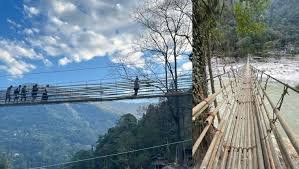
- The Ru-Soam is a traditional cane bridge built by the Lepcha community in Sikkim, mainly found in areas like the Khangchendzonga Biosphere Reserve.
- It is constructed using locally available natural materials such as bamboo, cane, and wood, reflecting sustainable building practices.
- In the Lepcha language, “Ru” refers to cane or rattan, while “Soam” means bridge, together describing its structure.
- The bridge design includes two main cane ropes running parallel, which are firmly tied to trees on both sides to keep the structure suspended.
- Bamboo planks form the walking surface, while additional cane loops are added to improve stability during crossing.
- These hanging loops allow controlled movement and help balance while walking on the bridge.
- Some Ru-Soam bridges can extend up to around 100 metres in length and can support the crossing of a few people at a time.
- The structure reflects traditional knowledge that combines engineering skill with an understanding of the local environment.
Khangchendzonga Biosphere Reserve
- The Khangchendzonga Biosphere Reserve in Sikkim is a high-altitude ecosystem and forms one of the most elevated natural regions in the world.
- Within this landscape lies the world’s third-highest peak, Mount Khangchendzonga, which is a defining feature of the region.
- The reserve shows a wide range of ecological variation, with environments changing gradually from subtropical conditions at lower levels to Arctic-like conditions at higher altitudes.
- This gradual transition of ecosystems supports multiple habitat types and a rich variety of plant and animal life across different zones.
- It also includes several glaciers and lakes, among them the long Zemu Glacier, which stretches for about 26 km.
- In recognition of its natural and cultural value, the Khangchendzonga National Park was declared a UNESCO World Heritage Site in 2016 under the mixed category.