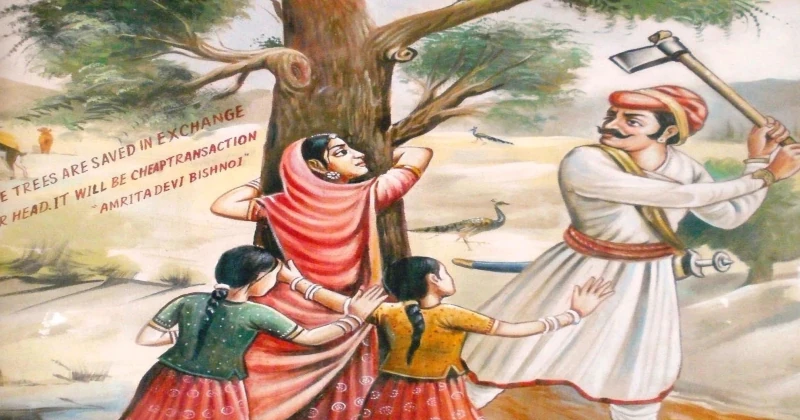
The Bishnoi Movement of 1730 stands as the world’s first recorded instance of organized environmental activism. Rooted in the arid landscapes of Rajasthan, this movement was not merely a protest but a monumental sacrifice where 363 members of the Bishnoi community laid down their lives to protect the sacred Khejri trees. Led by the courageous Amrita Devi Bishnoi, this eco-revolt established the foundational philosophy of “tree-hugging” (Chipko), proving that for the Bishnoi sect, ecological conservation is an inseparable part of spiritual existence.
Nearly three centuries later, the movement remains a high-authority reference for grassroots conservation and has significantly influenced modern environmental policies and awards in India.
Origins of the Bishnoi Sect and the 29 Principles
The ideological framework of the movement dates back to the 15th century, long before the 1730 massacre.
- The Founder: The sect was established in 1485 AD by Guru Jambheshwar (also known as Jambhoji) in the Marwar region of Rajasthan.
- Spiritual Awakening: After witnessing the devastating impact of a severe drought, Jambhoji realized that human disruption of nature’s balance was the root cause of suffering.
- The “Twenty-Nine” (Bishnoi): The name “Bishnoi” is derived from the Marwari words for twenty (bish) and nine (noi). These refer to the 29 commandments laid down by Jambhoji.
- Core Environmental Commandments: Among these principles, two are central to the movement’s history:
- “Jeev Daya Palani”: To show compassion toward all living beings.
- “Runkh Lila Nahi Ghave”: A strict prohibition against cutting green trees.
- Sustainable Living: These principles also emphasize hygiene, non-violence, and the protection of water sources, creating a community of “India’s First Environmentalists.”
The 1730 Khejarli Massacre: India’s First Eco-Revolt
The movement reached its historic turning point in Khejarli village, near Jodhpur, in 1730.
- The Royal Order: Maharaja Abhay Singh of Jodhpur required wood to ignite the lime kilns for the construction of his new palace. He dispatched his soldiers to the Bishnoi-dominated village of Khejarli to fell the Khejri trees.
- The Resistance of Amrita Devi: When the soldiers arrived, Amrita Devi Bishnoi stood in their path. To prevent the feeling, she hugged a tree, famously proclaiming: “A chopped head is cheaper than a felled tree.”
- The Chain of Sacrifice: The soldiers, under royal pressure, disregarded her plea and beheaded her. Her three daughters—Asu, Ratni, and Bhagu—followed their mother’s example and were also martyred.
- Community Mobilization: News spread to 84 nearby villages. In total, 363 Bishnois sacrificed their lives, one by one, by embracing the trees as the axes fell.
- The Aftermath: Upon hearing of the extreme sacrifice, the Maharaja was struck by remorse. He immediately visited the village, apologized to the community, and issued a royal decree (copper plate inscription) banning the cutting of green trees and the hunting of animals in all Bishnoi-inhabited areas.
Strategic Objectives of the Bishnoi Movement
The movement was guided by clear ecological and social objectives that remain relevant today.
- Protection of Biodiversity: A deep-seated commitment to preserving native flora and fauna to maintain the fragile desert ecosystem.
- Prevention of Deforestation: Absolute resistance against the industrial or royal use of forest resources, viewing trees as sacred entities.
- Compassionate Animal Care: Co-existing peacefully with wildlife; the Bishnois are known for nursing injured deer and chinkaras back to health.
- Community Health: Promotion of hygiene and social responsibility as prescribed by their 29 principles.
Unique Cultural and Funeral Practices
The Bishnoi community maintains a lifestyle that prioritizes the conservation of resources.
- Burying the Dead: Unlike most Hindu communities that practice cremation, Bishnois bury their dead. This practice is specifically designed to conserve wood and prevent the felling of trees for funeral pyres.
- Economic Activity: Primarily engaged in dairy farming, they are renowned for high-quality dairy products and sustainable agricultural practices.
- Wildlife Guardians: Their villages are often “oases” in the Thar Desert, where animals roam freely without fear of poachers.
The Success and Global Legacy of the Movement
The success of the Bishnoi Movement is measured by its lasting impact on Indian environmentalism.
- Inspiration for Chipko: The 20th-century Chipko Movement, led by Sunder Lal Bahuguna in the Himalayas, was directly inspired by the 1730 Khejarli revolt.
- The Amrita Devi Bishnoi Wildlife Protection Award: The Government of India established this national award in 2001 to honor those who show exemplary courage in protecting wildlife. The first recipient was Ganga Ram Bishnoi.
- State Recognition: The Rajasthan Government instituted the Amrita Devi Bishnoi Smrithi Paryavaran Award for excellence in forest and wildlife conservation.
FAQs: Understanding the Bishnoi Movement
WHAT WAS THE PRIMARY CAUSE OF THE BISHNOI MOVEMENT?
The movement was triggered by the royal order of the Maharaja of Jodhpur to cut down Khejri trees in the village of Khejarli for the construction of a palace.
WHO LED THE BISHNOI MOVEMENT IN 1730?
The movement was led by Amrita Devi Bishnoi, who, along with her three daughters and hundreds of villagers, hugged the trees to protect them from being felled.
WHAT DOES THE NAME “BISHNOI” SIGNIFY?
The name signifies the 29 principles (Bish=20, Noi=9) established by the sect’s founder, Guru Jambheshwar, to guide an ethical and eco-conscious life.
HOW MANY PEOPLE SACRIFICED THEIR LIVES IN THE KHEJARLI MASSACRE?
A total of 363 Bishnois were martyred while attempting to save the trees from the soldiers of the Maharaja.
WHAT IS THE SIGNIFICANCE OF BURIAL PRACTICES IN THE BISHNOI COMMUNITY?
Bishnois bury their dead instead of cremating them to avoid the use of wood, thereby preventing the necessity of cutting down trees for funeral rites.
WHICH MODERN ENVIRONMENTAL MOVEMENT WAS INSPIRED BY THE BISHNOIS?
The Chipko Movement of the 1970s was directly influenced by the “tree-hugging” tactics utilized by the Bishnois in 1730.
WHAT IS THE AMRITA DEVI BISHNOI WILDLIFE PROTECTION AWARD?
It is a prestigious national award given by the Government of India to individuals or institutions that exhibit extraordinary commitment to wildlife conservation.
WHY ARE BISHNOIS CALLED THE “FIRST ENVIRONMENTALISTS” OF INDIA?
They are so called because their sect was founded in 1485 AD specifically with a mandate to protect trees and wildlife as a core religious duty.
WHAT WAS THE RESULT OF THE BISHNOI MOVEMENT IN THE 18TH CENTURY?
The movement resulted in a royal decree by the Maharaja of Jodhpur, which banned hunting and the cutting of green trees in Bishnoi-inhabited areas.
WHERE IS THE BISHNOI COMMUNITY PRIMARILY LOCATED?
The community is mostly found in the western Thar Desert of Rajasthan, as well as parts of Haryana, Punjab, and northern India.