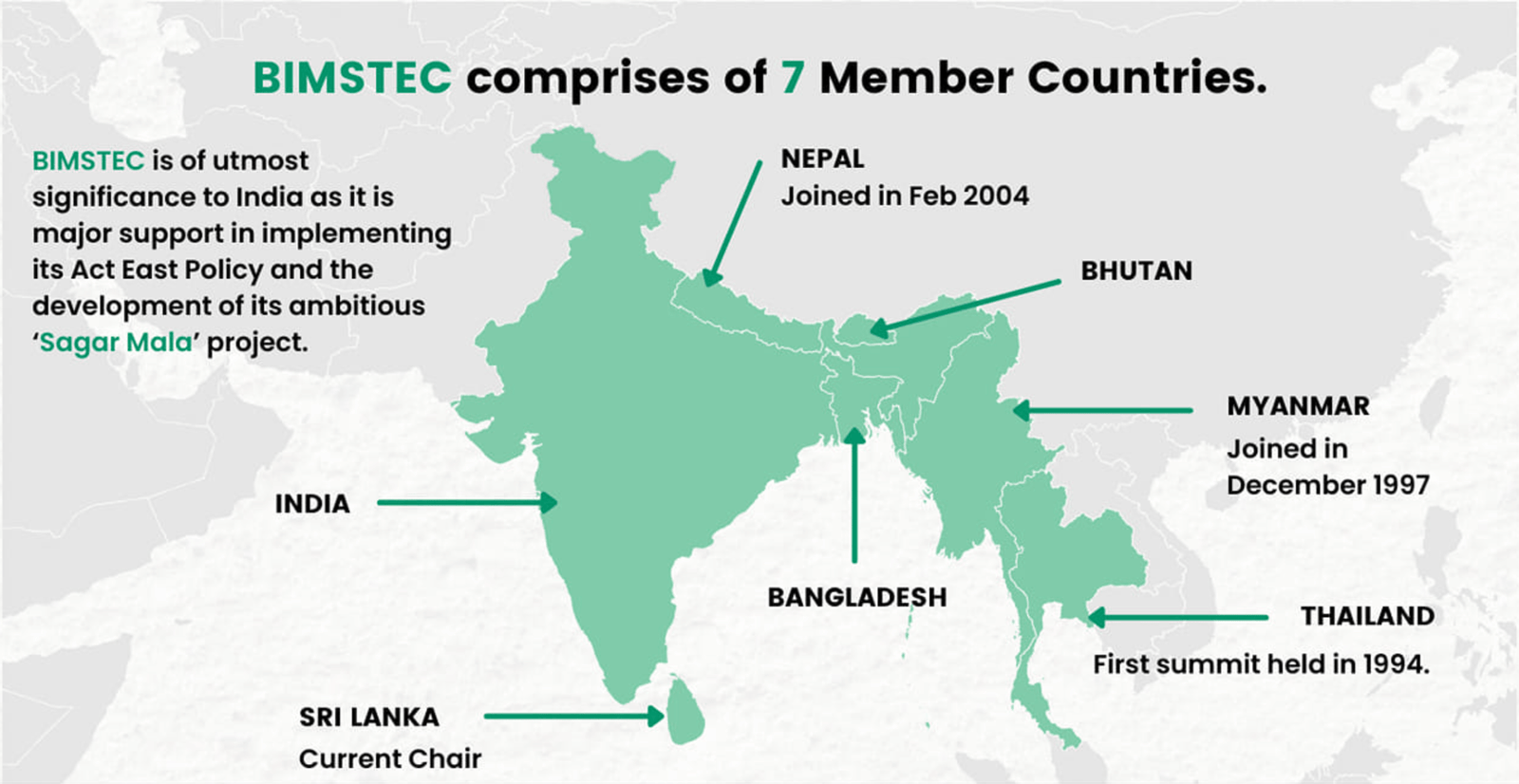
The Bay of Bengal Initiative for Multi-Sectoral Technical and Economic Cooperation (BIMSTEC) is a unique regional organization that serves as a bridge between South Asia and Southeast Asia. Established in 1997, it brings together seven nations surrounding the Bay of Bengal to foster cooperation in trade, technology, and security. In 2026, BIMSTEC became increasingly critical as a stable alternative to SAARC and a cornerstone of the Indo-Pacific strategic landscape.
BIMSTEC: Key Facts
BIMSTEC is not just a geographical grouping but an economic powerhouse, representing a significant portion of the global population and emerging markets.
| Feature | Details |
| Established | June 1997 (Bangkok Declaration) |
| Headquarters | Dhaka, Bangladesh |
| Population (2026) | Over 1.7 Billion (~22% of the global population) |
| Combined GDP | Approximately $4 Trillion |
| Official Language | English |
| BIMSTEC Charter | Institutionalized in March 2022 |
BIMSTEC Member Countries and Leadership
The organization consists of seven members. Five are from South Asia and two are from Southeast Asia, creating a powerful inter-regional link.
1. South Asian Members
- Bangladesh (Capital: Dhaka)
- Bhutan (Capital: Thimphu)
- India (Capital: New Delhi)
- Nepal (Capital: Kathmandu)
- Sri Lanka (Capital: Colombo/Sri Jayewardenepura Kotte)
2. Southeast Asian Members
- Myanmar (Capital: Naypyidaw)
- Thailand (Capital: Bangkok)
Areas of Cooperation: The Sector-Driven Approach
BIMSTEC evolved from six initial sectors in 1997 to a more comprehensive list. Under the new rationalized structure, each member state leads a specific “pillar” of cooperation:
| Member State | Lead Sector / Area of Cooperation |
| Bangladesh | Trade, Investment, and Development |
| Bhutan | Environment and Climate Change |
| India | Security (Counter-Terrorism, Disaster Management, Energy) |
| Nepal | People-to-People Contact (Culture, Tourism, Media) |
| Sri Lanka | Science, Technology, and Innovation (Health, HRD) |
| Myanmar | Agriculture and Food Security (Fisheries, Livestock) |
| Thailand | Connectivity |
Significance of BIMSTEC for India
For India, BIMSTEC is no longer just a secondary grouping; it is a primary vehicle for regional diplomacy and economic growth.
- Foreign Policy Triple-Win: It aligns three of India’s major policies:
- Neighborhood First: Prioritizing immediate neighbors.
- Act East: Linking India with Southeast Asian markets.
- Northeast Development: Connecting landlocked Northeast India to the sea via Myanmar and Bangladesh.
- Alternative to SAARC: Due to the persistent stalemate in SAARC caused by India-Pakistan tensions, BIMSTEC provides a “Pakistan-minus” platform for effective regional integration.
- Strategic Counter-Balance: It allows India to maintain its influence in the Bay of Bengal and counter the expanding footprint of China’s Belt and Road Initiative (BRI).
Key Challenges and Roadblocks
Despite its potential, BIMSTEC faces several structural and geopolitical hurdles that limit its effectiveness.
- Institutional Weakness: The Secretariat in Dhaka is often understaffed and lacks the financial resources to coordinate complex multi-country projects.
- Infrastructure Gaps: Projects like the Kaladan Multi-Modal Transit Transport Project have faced significant delays due to difficult terrain and lack of funding.
- Political Instability: Internal conflicts, particularly the ongoing civil unrest in Myanmar, hamper regional connectivity and joint security efforts.
- Economic Disparities: The massive gap between the size of the Indian economy and smaller nations like Bhutan or Nepal can lead to an “asymmetric” relationship that hinders consensus.
- Overlapping Interests: Several members prioritize other groupings like ASEAN (Thailand/Myanmar) or SAARC, sometimes leading to a lack of dedicated focus on BIMSTEC initiatives.
Frequently Asked Questions (FAQs)
WHAT IS THE FULL FORM OF BIMSTEC?
It stands for the Bay of Bengal Initiative for Multi-Sectoral Technical and Economic Cooperation.
WHERE IS THE BIMSTEC HEADQUARTERS LOCATED?
The permanent secretariat is located in Dhaka, Bangladesh.
WHICH COUNTRIES WERE THE ORIGINAL FOUNDING MEMBERS?
In 1997, it began as BIST-EC, consisting of Bangladesh, India, Sri Lanka, and Thailand.
WHEN DID NEPAL AND BHUTAN JOIN BIMSTEC?
Both nations officially became members in 2004.
WHICH SECTOR IS LED BY INDIA IN BIMSTEC?
India leads the Security pillar, which includes counter-terrorism, transnational crime, energy, and disaster management.
WHY IS BIMSTEC CALLED A “BRIDGE” BETWEEN SOUTH AND SOUTHEAST ASIA?
Because it includes members from both SAARC (South Asia) and ASEAN (Southeast Asia), facilitating trade and diplomatic links between the two regions.
HAS BIMSTEC SIGNED A FORMAL CHARTER?
Yes, the BIMSTEC Charter was signed in March 2022 during the 5th Summit in Sri Lanka.
WHAT IS THE TOTAL POPULATION REPRESENTED BY BIMSTEC?
It represents over 1.7 billion people, which is approximately 22% of the global population.
WHICH MEMBER STATE LEADS THE CONNECTIVITY SECTOR?
Thailand is the lead country for the connectivity sector.
WHAT IS THE “HIMALAYAN-BAY OF BENGAL” LINK?
It refers to the fact that the grouping includes both Himalayan landlocked nations (Nepal, Bhutan) and littoral states (India, Thailand), linking mountain and maritime ecosystems.