The Association of Southeast Asian Nations (ASEAN) is a premier regional intergovernmental organization that facilitates economic, political, and security integration among its members. Since its inception in 1967, ASEAN has evolved from a five-member anti-communist bloc into a cohesive 11-member community that sits at the heart of the Indo-Pacific architecture. For India, ASEAN is not merely a neighboring bloc but the central pillar of its Act East Policy and its vision for a stable, rules-based regional order.
ASEAN: Origin and Institutional Framework
ASEAN was established to foster regional peace and accelerate economic growth through joint endeavors in the spirit of equality and partnership.
Historical Origin
- Association of Southeast Asia (ASA), 1961: The initial precursor formed by Indonesia, Malaysia, the Philippines, Singapore, and Thailand.
- Bangkok Declaration, 1967: The foundational document signed on August 8, 1967, which formally birthed ASEAN.
- Treaty of Amity and Cooperation (TAC), 1976: A landmark treaty establishing a code of conduct for peaceful relations, emphasizing non-interference and peaceful dispute resolution.
- ASEAN Charter, 2008: Conferred a legal identity upon the bloc and established a more structured institutional framework.
The ASEAN Community (2015)
In 2015, the bloc established the ASEAN Economic Community (AEC) to unify member economies and transform the region into a single market and production base.
Fundamental Principles: “The ASEAN Way”
ASEAN operates on a unique set of norms known as the “ASEAN Way,” which prioritizes consensus-based decision-making and quiet diplomacy.
- Sovereignty: Mutual respect for the independence, sovereignty, and territorial integrity of all nations.
- Non-Interference: Strict adherence to the principle of not meddling in the internal affairs of member states.
- Peaceful Settlement: Commitment to resolving all disagreements or conflicts through dialogue rather than force.
- Right to Self-Governance: Every state has the right to lead its national existence free from external interference or coercion.
Membership and Institutional Mechanism
With the recent inclusion of Timor-Leste, ASEAN now represents 11 nations with a combined population of over 675 million people.
Current Member States
- Founding Members: Indonesia, Malaysia, Philippines, Singapore, Thailand.
- Subsequent Members: Brunei, Vietnam, Laos, Myanmar, Cambodia.
- Newest Member: Timor-Leste (admitted in 2025).
How ASEAN Functions
- ASEAN Summit: The highest policy-making body, meeting annually.
- Coordinating Council (ACC): Prepares the summits and coordinates the implementation of agreements.
- ASEAN Secretariat: Headquartered in Jakarta, Indonesia, it provides administrative support.
- ASEAN Regional Forum (RF): A vital platform for security dialogue involving 27 members, including India, the US, and China.
Highlights of the 2025 ASEAN Summit in Kuala Lumpur
The 47th ASEAN Summit (October 25-28, 2025) in Malaysia was a landmark event that addressed critical environmental and strategic challenges.
Major Agreements and Declarations
- Kuala Lumpur Peace Accord: A significant reaffirmation of ASEAN Centrality, aimed at resolving regional conflicts and addressing internal crises (such as the Myanmar situation).
- Declaration on Inclusive Green Growth: Focused on green finance, sustainable investment, and digital transformation to mitigate climate change while maintaining competitiveness.
- Timor-Leste’s Full Entry: Officially welcomed as the 11th member, expanding the bloc’s footprint.
- Trade Breakthroughs: Malaysia signed a Reciprocal Trade Agreement (RTA) with the USA and a comprehensive Free Trade Agreement with South Korea.
India’s Participation in 2025
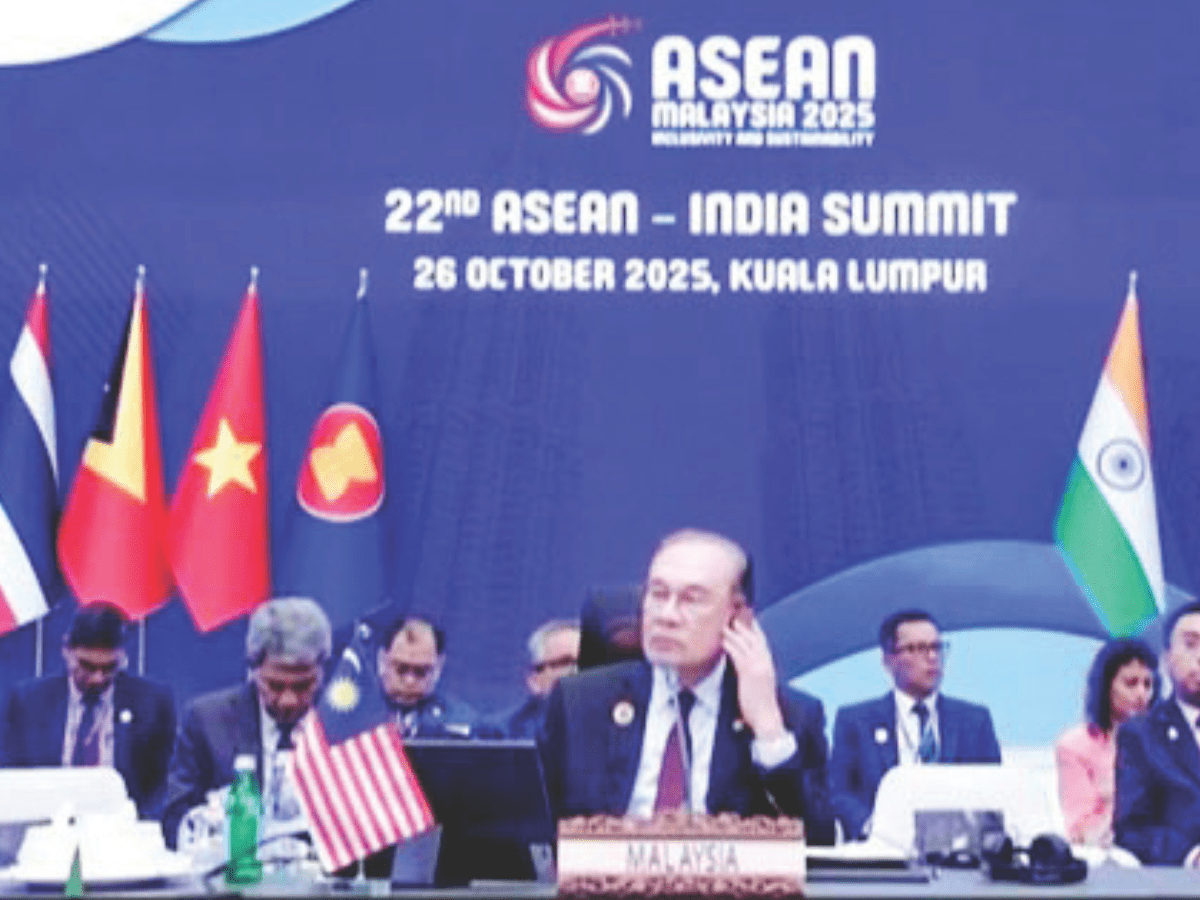
- Represented by the External Affairs Minister (EAM), India reaffirmed its commitment to a “peaceful and prosperous Indo-Pacific.”
- Announced 2026 as the ASEAN-India Year of Maritime Cooperation.
- India emphasized adherence to the UN Convention on the Law of the Sea (UNCLOS) regarding the South China Sea disputes.
5 India-ASEAN Relations: Strategic Convergence
The relationship has transitioned from a “Look East” policy in the 1990s to a vigorous “Act East” policy today.
| Milestone | Year | Status |
| Sectoral Dialogue Partner | 1992 | Initial formal engagement. |
| Full Dialogue Partner | 1996 | Expanded cooperation across sectors. |
| Summit-Level Partnership | 2002 | Annual meetings between heads of state. |
| Strategic Partnership | 2012 | Upgraded during the 20th Anniversary Summit. |
Areas of Cooperation
- Economic: ASEAN is India’s 4th largest trading partner. Total trade exceeded $110 billion in recent years.
- Connectivity: Major projects include the India-Myanmar-Thailand (IMT) Trilateral Highway and the Kaladan Multi-modal project.
- Security: Joint military exercises like the ASEAN-India Maritime Exercise and participation in the ADMM-Plus.
- Socio-Cultural: Initiatives like the Students Exchange Programme and the ASEAN-India Green Fund.
6 Strengths and Challenges in the Relationship
Strengths
- Strategic Location: Control over the Strait of Malacca, a global maritime chokepoint.
- Market Potential: A massive middle class and a dynamic manufacturing hub.
- Cultural Links: Deep historical, religious (Buddhism/Hinduism), and linguistic ties.
Challenges
- Trade Deficit: India’s imports from ASEAN have surged significantly faster than exports, leading to demands for a review of the AITIGA (Trade in Goods Agreement).
- Connectivity Gaps: Infrastructure projects have faced delays due to terrain and political instability in Myanmar.
- China Factor: Diverse views within ASEAN on how to handle China’s territorial claims in the South China Sea often limit collective security actions.
FAQs
WHAT IS THE MAIN MOTTO OF THE ASSOCIATION OF SOUTHEAST ASIAN NATIONS?
The official motto of ASEAN is “One Vision, One Identity, One Community.”
WHERE IS THE HEADQUARTERS OF THE ASEAN SECRETARIAT LOCATED?
The ASEAN Secretariat is permanently headquartered in Jakarta, Indonesia.
WHICH COUNTRY RECENTLY BECAME THE 11TH MEMBER OF ASEAN?
Timor-Leste was officially admitted as the 11th member during the 47th ASEAN Summit held in 2025.
WHO WERE THE FIVE FOUNDING FATHERS OF ASEAN?
The founding nations are Indonesia, Malaysia, the Philippines, Singapore, and Thailand, who signed the Bangkok Declaration in 1967.
IS INDIA A FULL MEMBER OF THE ASEAN GROUPING?
No, India is a Dialogue Partner, not a full member, but it participates in the annual ASEAN-India Summit and the East Asia Summit.
WHAT IS THE SIGNIFICANCE OF THE KUALA LUMPUR PEACE ACCORD SIGNED IN 2025?
It reaffirms ASEAN Centrality in regional peace-making and aims to address criticisms regarding the bloc’s historical inaction in resolving regional crises.
WHAT IS THE “ASEAN WAY”?
It refers to a style of diplomacy characterized by consensus-building, non-confrontation, and non-interference in the internal affairs of member states.
WHICH YEAR HAS BEEN DECLARED AS THE ASEAN-INDIA YEAR OF MARITIME COOPERATION?
India has announced that 2026 will be observed as the ASEAN-India Year of Maritime Cooperation.
WHO ARE THE FREE-TRADE PARTNERS OF ASEAN?
ASEAN has Free Trade Agreements (FTAs) with India, China, Japan, South Korea, Australia, and New Zealand.
WHAT IS THE INDIA-MYANMAR-THAILAND TRILATERAL HIGHWAY?
It is a major connectivity project under India’s Act East Policy designed to link Moreh (India) to Mae Sot (Thailand) via Myanmar.