Context
A recent seminar highlighted the need to diversify activities and comprehensively revitalise Willingdon Island to improve the performance of Cochin Port, while creating greater revenue and employment opportunities.
About Willingdon Island
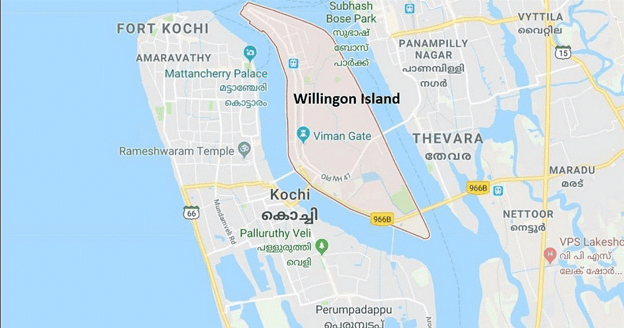
- Location: Kochi, Kerala
- Type: Man-made island, among the largest of its kind in India.
- Creation: Developed in 1936 by dredging soil from Vembanad Lake, Kerala’s largest lake.
- Purpose: Created to develop a deep-water port capable of handling large vessels and to strengthen Kochi’s trade and commerce.
- Designer: Developed under harbour engineer Sir Robert Bristow.
- Name: Named after Lord Willingdon, the then British Viceroy of India.
- Importance: It is an important commercial, naval and fisheries centre, housing:
- Southern Naval Command headquarters of the Indian Navy
- Central Institute of Fisheries Technology
- Cochin Port
- Connectivity: Linked with mainland Kochi through the Venduruthy Bridge.
Who was Lord Willingdon?
- Lord Willingdon was a British administrator who served as the Viceroy and Governor-General of India from 1931–1936.
- He also served as:
- Governor of Bombay: 1913–1918
- Governor of Madras: 1919–1924
- Major events during his tenure:
- Second Round Table Conference (1931) and subsequent resumption of the Civil Disobedience Movement.
- Communal Award (1932) announced by British Prime Minister Ramsay MacDonald.
- Poona Pact (1932) between Mahatma Gandhi and B. R. Ambedkar.
- Government of India Act, 1935, which introduced provincial autonomy.
FAQs
Q1. Where is Willingdon Island located?
In Kochi, Kerala — a man‑made island created in 1936.
Q2. How was Willingdon island created?
By dredging soil from Vembanad Lake to develop a deep‑water port.
Q3. Who designed Willingdon Island?
Harbour engineer Sir Robert Bristow.
Q4. Why is Willingdon island important?
It houses Cochin Port, Southern Naval Command HQ, and Central Institute of Fisheries Technology.
Q5. After whom is Willingdon island named?
Named after Lord Willingdon, British Viceroy of India (1931–1936).