Context
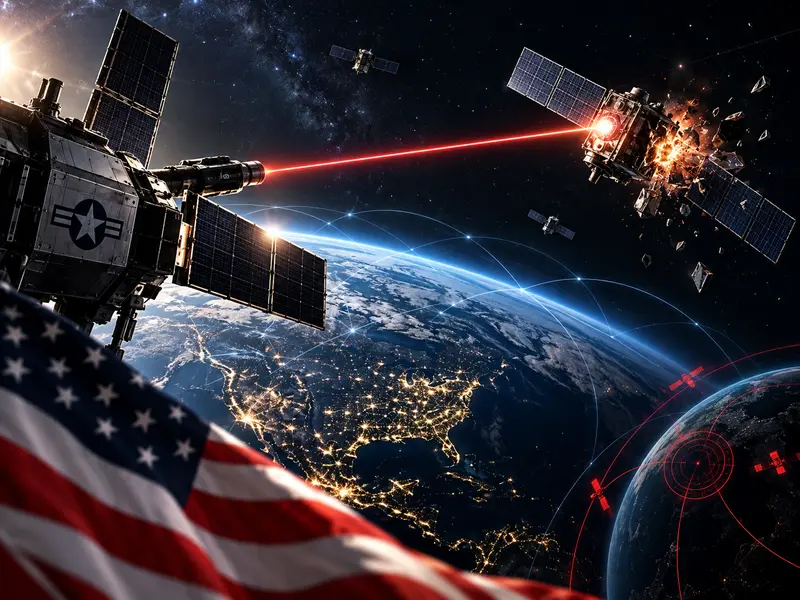
- In September 2026, US Air Force Secretary Troy Meink publicly acknowledged that the United States has “on-orbit space control weapons” intended to protect US forces against hostile action.
- The United States did not disclose the nature, number or deployment timeline of these systems.
- The admission revived debate over the possibility of an arms race in outer space, especially as satellites have become central to military and civilian infrastructure.
Militarisation vs Weaponisation of Space
The two concepts are different.
Militarisation of Space
Use of space assets to support military operations on Earth, such as:
- reconnaissance;
- navigation;
- communications;
- missile warning.
Space has been militarised for decades.
Weaponisation of Space
Deployment or use of capabilities specifically intended to disrupt, disable, damage or destroy targets in or through space.
Thus:
Military use of satellites ≠ Deployment of space weapons
Major Categories of Space Weapons
Earth-to-Space
Weapons launched from Earth against space-based assets.
Example: direct-ascent anti-satellite missiles.
Space-to-Space
Systems located in orbit that can interfere with or attack other spacecraft.
Space-to-Earth
Weapons positioned in space and designed to attack targets on Earth.
The exact category of the newly acknowledged US systems has not been publicly disclosed.
Kinetic and Non-Kinetic Counterspace Capabilities
Kinetic Capabilities
These physically damage or destroy the target.
Examples include:
- direct-ascent ASAT missiles;
- physical collision by co-orbital systems.
Their major risk is the creation of orbital debris.
Non-Kinetic Capabilities
These interfere with space systems without physically destroying them.
Examples include:
- jamming: blocking communication or navigation signals;
- spoofing: transmitting false signals;
- cyberattacks: targeting satellite control or ground networks;
- directed-energy systems: interfering with sensors or electronics.
Therefore, space conflict can occur even without visible destruction of satellites.
Demonstrated Counterspace Capabilities
The most visible demonstration of counterspace capability has been anti-satellite testing.
The United States, Russia, China and India have demonstrated direct-ascent ASAT capability.
India conducted Mission Shakti on 27 March 2019, successfully intercepting an Indian satellite in Low Earth Orbit.
Non-kinetic counterspace activity has also become important.
In February 2022, a cyberattack disrupted Viasat’s KA-SAT satellite network shortly before Russia’s invasion of Ukraine, demonstrating how attacks on ground infrastructure can affect space-enabled services.
Thus:
Counterspace warfare can target the satellite, its signal, or its supporting network.
Why Is Space Becoming a Strategic Domain?
- Military dependency: Satellites support intelligence, navigation, communications and precision targeting.
- Economic dependency: Telecommunications, financial transactions, logistics, weather services and aviation increasingly rely on space infrastructure.
- High-value vulnerability: Disabling a few critical satellites can disrupt much larger terrestrial systems.
- Dual-use character: Many satellites support both civilian and military functions, making crisis management more difficult.
The emerging strategic logic is:
Rising dependence → Greater vulnerability → Counterspace capability → Security competition
What Does International Law Say?
The principal legal framework is the Outer Space Treaty, 1967.
It prohibits states from:
- placing nuclear weapons or other weapons of mass destruction in orbit;
- stationing such weapons in outer space;
- placing WMDs on celestial bodies.
It also requires the Moon and other celestial bodies to be used for peaceful purposes.
However, the treaty does not impose a comprehensive ban on conventional weapons in Earth orbit.
This creates a major legal gap:
WMDs in orbit — prohibited
Conventional counterspace weapons — not comprehensively prohibited
Attempts to Prevent an Arms Race in Space
PPWT
China and Russia proposed the Treaty on Prevention of the Placement of Weapons in Outer Space (PPWT) in 2008.
It sought to restrict placement of weapons in outer space but did not develop into a binding treaty.
PAROS
The United Nations has also pursued discussions on Prevention of an Arms Race in Outer Space (PAROS).
These negotiations reflect broad concern about weaponisation, but no comprehensive global arms-control regime has emerged.
The core challenge is that states disagree over:
- what should qualify as a space weapon;
- how compliance should be verified;
- whether Earth-based anti-satellite systems should also be covered.
What Is the Role of the Artemis Accords?
The Artemis Accords provide principles for peaceful and responsible civil space exploration.
They emphasise:
- transparency;
- interoperability;
- emergency assistance;
- deconfliction;
- preservation of heritage;
- orbital-debris mitigation.
India is a signatory.
However, the Artemis Accords are not an arms-control treaty and do not comprehensively regulate military counterspace capabilities.
Thus, they contribute to responsible space governance, but not to full space disarmament.
Why Does the Issue Matter for India?
Counterspace capability
Mission Shakti demonstrated that India possesses the technological capability to intercept a satellite.
Space situational awareness
India needs stronger ability to track satellites, debris and potentially hostile manoeuvres in orbit.
Resilient space architecture
Future systems should reduce dependence on a few vulnerable assets through redundancy, distributed constellations and secure ground infrastructure.
Strategic rule-shaping
As a major space power and Artemis Accords signatory, India can contribute to international norms on responsible behaviour and harmful interference.
Balanced space doctrine
India must combine credible defensive capability with its stated interest in avoiding an uncontrolled arms race in outer space.
Key Risks of Space Weaponisation
- Security dilemma: Defensive deployments by one country may appear offensive to another, triggering competitive buildup.
- Orbital debris: Destructive ASAT attacks can generate debris that threatens unrelated satellites.
- Escalation ambiguity: Cyber or electronic attacks may be difficult to attribute quickly, increasing the risk of miscalculation.
- Civilian spillover: Attacks on dual-use systems can disrupt telecommunications, navigation, banking and emergency services.
- Crisis instability: Satellites used for missile warning or command-and-control may become high-priority targets during conflict, increasing escalation risks.
Way Forward
- Clarify international norms: States should define unacceptable forms of harmful interference and hostile behaviour in orbit.
- Restrict debris-generating tests: Greater restraint on destructive ASAT testing can reduce long-term orbital risks.
- Improve transparency: Notifications, communication channels and confidence-building measures can reduce miscalculation.
- Strengthen verification: Future arms-control proposals will require mechanisms to monitor compliance and distinguish peaceful from hostile systems.
- Build resilient systems: Countries should protect critical satellites through redundancy, cybersecurity and diversified infrastructure.
The preferred framework should be:
Strategic resilience + Responsible behaviour + Transparency + International rules
FAQs
Q1. What is the difference between militarisation and weaponisation of space?
Militarisation means using space assets to support military activity, while weaponisation involves capabilities designed to disrupt, damage or destroy targets.
Q2. What are the three broad categories of space weapons?
They are Earth-to-space, space-to-space and space-to-Earth systems.
Q3. Are all counterspace weapons kinetic?
No. Jamming, spoofing, cyberattacks and directed-energy systems can interfere with space assets without physically destroying them.
Q4. Does the Outer Space Treaty prohibit all space weapons?
No. It bans nuclear weapons and other WMDs in orbit, but does not comprehensively prohibit conventional counterspace weapons.
Q5. Why is the issue important for India?
India must combine space situational awareness, resilient infrastructure, defensive capability and international rule-shaping as competition in space increases.