The Warm Temperate Western Margin Climate, commonly known as the Mediterranean Climate, is one of the most distinctive temperate climates in the world. It is characterised by hot, dry summers and mild, wet winters, resulting from the seasonal migration of the Subtropical High-Pressure Belt and the Westerlies. The climate supports unique drought-resistant vegetation, intensive orchard farming, and extensive viticulture, making it one of the world’s most productive agricultural regions.
Distribution
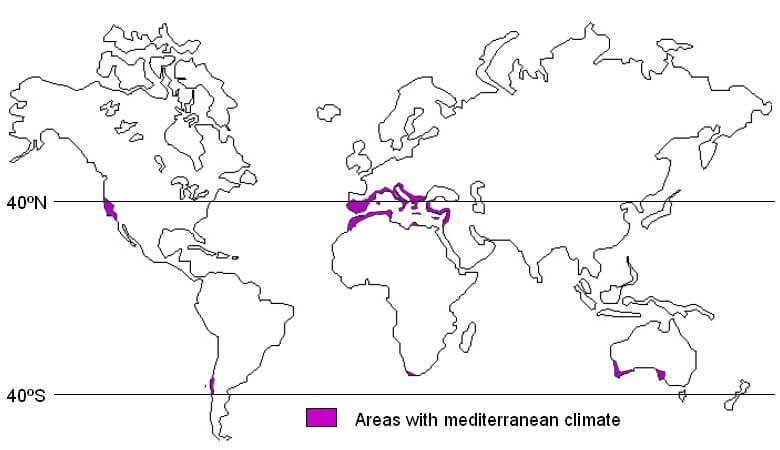
- The Mediterranean Climate is exclusively confined to the western margins of continents between 30° and 45° latitude in both the Northern and Southern Hemispheres.
- It develops due to the seasonal northward and southward migration of the Subtropical High-Pressure Belt and the Westerlies, which produces dry summers and wet winters.
- Major Mediterranean Climate Regions include:
- Mediterranean Basin – Largest area under this climate.
- Central Chile – Best-developed example.
- California – Around San Francisco.
- South-western South Africa – Around Cape Town.
- Southern Australia – Southern Victoria and around Adelaide.
- South-western Australia – Swanland region.
Climatic Characteristics
The distinct seasonal pattern of rainfall is the most distinctive feature of the Mediterranean Climate. Rainfall is concentrated during winter, while summers remain almost rainless.
- Hot and Dry Summers
- During summer, the Subtropical High-Pressure Belt shifts poleward, accompanied by the poleward movement of the Westerlies.
- Consequently, the region comes under the influence of subsiding dry air, which suppresses cloud formation and rainfall.
- Offshore Trade Winds prevail, resulting in hot, dry, and cloudless weather.
- Interior regions often experience prolonged droughts.
- Nights remain comparatively cooler because of rapid terrestrial radiation, though frost is rare.
- Mild and Wet Winters
- During winter, the Westerlies shift equatorward and temperate cyclones associated with these winds bring most of the annual rainfall.
- Rainfall generally occurs as heavy showers, separated by bright and sunny intervals.
- Winters remain cool, humid, and pleasant, creating favourable conditions for agriculture and tourism.
- Distinctive Features
- The Mediterranean Climate forms a transitional climatic zone between the Hot Desert Climate towards lower latitudes and the Cool Temperate Maritime Climate towards higher latitudes.
- Clear skies and abundant sunshine prevail for most of the year, promoting fruit cultivation and grape ripening.
Local Winds
Several local winds strongly influence the weather and agricultural conditions of the Mediterranean region.
- Sirocco
- Sirocco is a hot, dry, dust-laden wind originating from the Sahara Desert.
- It is most common during spring and generally lasts for only a few days.
- The wind can severely damage crops, particularly grapes and olives.
- After crossing the Mediterranean Sea, it absorbs moisture and may produce humid conditions, fog, heavy dew, or rainfall carrying fine reddish Saharan dust, popularly known as “Blood Rain.”
- The Sirocco is known by different local names across the Mediterranean region.
| Local Name |
|
||
| Chili | Tunisia | ||
| Ghibli | Libya | ||
| Leveche | Spain | ||
| Khamsin | Egypt and Malta | ||
| Gharbi | Adriatic and Aegean Sea regions |
- Mistral
- Mistral is a cold, dry wind that blows through the Rhone Valley in southern France.
- Its velocity is intensified by the funnel-shaped Rhone Valley lying between the Alps and the Central Massif, resulting in strong, gusty winds.
Other Important Local Winds
- Similar cold regional winds include:
- Bora – A cold north-easterly wind affecting the Adriatic Coast.
- Tramontana – A cold, dry wind experienced in parts of the western Mediterranean.
- Gregale – A cold wind blowing across the central Mediterranean.
Natural Vegetation
The Mediterranean region supports predominantly xerophytic vegetation, which is specially adapted to withstand the long, hot, and dry summer season. These plants possess small, thick, leathery or waxy leaves, deep root systems, and reduced leaf surfaces, enabling them to conserve moisture and survive prolonged drought conditions. These adaptations allow vegetation to flourish despite the seasonal scarcity of rainfall.
Mediterranean Evergreen Forests
- Mediterranean evergreen forests are dominated by broad-leaved evergreen trees, particularly the Cork Oak, which is extensively found in Spain and Portugal.
- These forests occur mainly in areas receiving higher winter rainfall and are commercially important for timber and cork production.
- The thick bark of the Cork Oak is harvested without damaging the tree and is widely used for manufacturing wine-bottle corks.
- In Australia, Jarrah and Karri are the principal commercial hardwood species.
- Giant Sequoia (Redwood) is the characteristic tree of California and is among the tallest trees in the world.
Evergreen Coniferous Forests
- Important coniferous species include pine, fir, cedar, and cypress.
- These trees possess needle-shaped evergreen leaves, which reduce transpiration and help them withstand prolonged summer droughts.
- They are generally found in higher elevations, where relatively cooler climatic conditions favour the growth of coniferous species. These forests often occur alongside Mediterranean evergreen forests, forming transitional vegetation in mountainous areas.
Mediterranean Shrub Vegetation
- Dense evergreen shrubs occupy extensive areas where forests have been cleared by human activities or where climatic conditions naturally favour shrub growth.
- This vegetation is highly drought-resistant and generally consists of plants with small, leathery leaves, thick bark, and deep root systems.
- Common shrubs include laurel, myrtle, lavender, rosemary, and arbutus, many of which are aromatic and commercially valuable.
- Mediterranean shrub vegetation is known by different local names in different regions.
| Local Name | Region |
| Maquis | Southern France |
| Macchia | Italy |
| Garrigue | Limestone uplands of Europe |
| Chaparral | California |
| Mallee Scrub | Australia |
Wine Production
- Viticulture (grape cultivation) is the most important commercial agricultural activity of the Mediterranean region.
- The combination of hot, sunny summers and mild, wet winters provides ideal conditions for producing high-quality grapes.
- The Mediterranean Basin is the largest wine-producing region in the world, contributing about 75% of global wine production.
- Nearly 85% of the grapes cultivated in the region are processed into wine.
- France, Italy, and Spain are among the world’s leading wine producers and together account for the largest share of global wine production.
- Wine production supports a wide range of agro-based industries, contributes significantly to exports, and plays an important role in the rural economy of Mediterranean countries.
- Several countries are internationally renowned for their distinctive wines.
| Local Wine Name | Region |
| Sherry | Spain |
| Port Wine | Portugal |
| Chianti, Asti and Marsala | Italy |
| Champagne (Paris Basin), Bordeaux (Garonne Basin), Burgundy (Rhône–Saône Valley) | France |
Conclusion
The Warm Temperate Western Margin (Mediterranean) Climate represents a unique interaction between climate, vegetation, and human activities. Its favourable environmental conditions have supported specialised agriculture, flourishing agro-based industries, and distinctive cultural landscapes, making it one of the most economically significant climatic regions of the world.a