Context
Scientists have found evidence that massive floods once occurred on Mars when ancient lakes within Valles Marineris breached their boundaries and released huge amounts of water.
About Valles Marineris
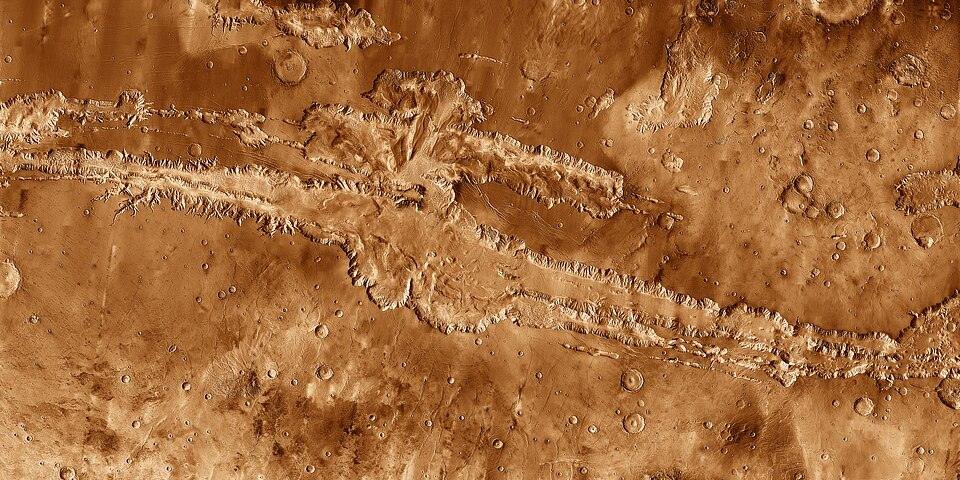
- Valles Marineris is a vast network of interconnected canyons located on Mars, just south of its equator.
- It was identified during the Mariner 9 mission in 1971 and was named after the mission.
- The canyon system stretches about 4,000 km from east to west, nearly 10 times the length of Earth’s Grand Canyon.
- It covers around 20% of Mars’ circumference. Individual canyons can be about 200 km wide, with walls reaching 2–5 km high.
- At its centre, several canyons come together to form a huge depression about 600 km wide and 9 km deep.
- Formation: Scientists believe it developed through a combination of:
- Tectonic activity: Movement and cracking of Mars’ crust, particularly around the Tharsis volcanic region.
- Erosion: Gullies and other features show that erosion also shaped the canyon walls.
- Water activity: Sediments found inside some canyons suggest that ancient lakes once existed
- These ancient lakes may have later overflowed or breached their boundaries, releasing enormous amounts of water towards the east.
- Evidence of these ancient floods provides important clues about Mars’ past climate, water availability and geological evolution.
FAQs
Q1. What is Valles Marineris?
A vast network of interconnected canyons on Mars, located just south of the equator, stretching ~4,000 km east‑west.
Q2. How was Valles Marineris discovered?
Identified during NASA’s Mariner 9 mission in 1971 and named after the spacecraft.
Q3. How does Valles Marineris compare to Earth’s Grand Canyon?
It is nearly 10 times longer, with canyons up to 200 km wide and walls 2–5 km high; central depression is ~600 km wide and 9 km deep.
Q4. What processes formed Valles Marineris?
A mix of tectonic activity (linked to Tharsis volcanism), erosion, and water activity, including ancient lakes and sediments.
Q5. Why are recent flood findings significant?
Evidence of massive ancient floods from breached lakes provides clues about Mars’ past climate, water availability, and geological evolution.