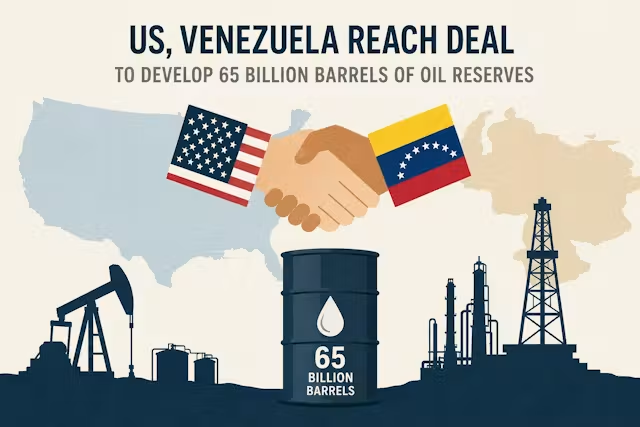
The US–Venezuela oil deal marks a major shift in the energy relationship between the two countries. It combines foreign investment, energy security and geopolitics, while offering Venezuela an opportunity to revive its weakened oil industry.
Context
- On August 31, 2026, the US announced an agreement covering 17 Venezuelan oil fields.
- Venezuela’s National Assembly backed the agreement on September 1, 2026.
- The US expects new agreements with energy companies to potentially more than double Venezuela’s oil production in the coming years.
Key Features
- North American Blue Energy Partners (NABEP) will develop the identified fields under 100-year concessions.
- The US government will receive a 35% equity stake in NABEP’s corporate parent.
- The US will have the right to purchase 20% of production at production cost and a right of first refusal over the remaining output.
- The US will have a veto over board appointments, while a majority of the board must be US citizens.
- The arrangement is governed by US law and US courts.
- NABEP plans up to $100 billion in investment in Venezuela’s oil infrastructure.
- The programme is expected to generate more than $200 billion in taxes and royalties over 25 years.
Why the US Wants Venezuelan Oil
- Refinery Compatibility
- Venezuelan crude is generally heavy and sour, meaning it is denser and has higher sulphur content.
- Much of US shale production is light and sweet.
- Several US Gulf Coast refineries are designed to process heavier crude.
- Hence, the US can export light crude while importing heavier crude that suits particular refineries.
- Energy Security
Greater access to Venezuelan crude could diversify US oil supplies from the Western Hemisphere and reduce exposure to disruptions in other producing regions.
- Venezuela’s Oil Sector
Venezuela has around 303 billion barrels of proven oil reserves, the largest proven reserves in the world. Yet its production remains far below its historical capacity.
- Current output is about 1.1–1.2 million barrels per day, compared with more than 3 million barrels per day during the 1990s.
- Underinvestment, ageing infrastructure, mismanagement and operational problems have weakened the sector.
- The 2007 nationalisation drive resulted in the departure of major foreign companies such as ExxonMobil and ConocoPhillips.
- US sanctions imposed in 2019 further restricted Venezuela’s access to international oil markets and finance.
- A 2023 licence for Chevron enabled limited resumption of oil operations and exports.
- China became a major destination for Venezuelan crude after the sanctions, while Russia also developed significant interests in the sector.
Venezuela demonstrates the resource-to-production gap: large reserves alone cannot ensure high output without capital, technology, infrastructure and effective institutions.
- Geopolitical Significance
- US influence: Greater American participation could strengthen US economic and strategic influence in the Western Hemisphere.
- China and Russia: The arrangement could alter the position of Chinese and Russian interests in Venezuela’s energy sector.
- Energy diplomacy: Access to strategic oil resources can support wider foreign-policy objectives.
- Regional balance: Venezuela’s petroleum sector could become an important factor in the changing distribution of influence across Latin America.
Significance for Venezuela
- Investment: Foreign capital can support the restoration of productive assets.
- Technology: International participation can improve technical and managerial capabilities.
- Revenue: Increased oil activity can raise government earnings and foreign-exchange receipts.
- Economic recovery: Higher petroleum activity can support wider reconstruction.
- Employment: Expansion of the sector can create direct and indirect jobs.
Challenges and Way Forward
| Challenges | Way Forward |
| Infrastructure constraints: Damaged wells, pipelines, refineries and export facilities limit production recovery. | Phased rehabilitation: Restore existing productive assets and critical export infrastructure before major expansion. |
| Large financing needs: Reviving the sector requires sustained capital over many years. | Stable investment regime: Maintain predictable regulations, taxation rules and enforceable contracts. |
| Legal uncertainty: The unusually long concession period and complex contractual structure could lead to disputes. | Legal clarity: Clearly define concession rights, ownership, taxation, regulatory powers and dispute-resolution mechanisms. |
| Political uncertainty: Political changes could affect long-term energy commitments. | Institutional safeguards: Protect major projects through durable legal and regulatory institutions. |
| Transparency concerns: The absence of conventional competitive bidding may affect investor confidence. | Independent oversight: Disclose key contractual terms and establish transparent monitoring mechanisms. |
| Environmental risks: Expanded extraction and transportation could increase pollution and spill risks. | Environmental safeguards: Strengthen impact assessments, spill-response systems and continuous monitoring. |
| Oil dependence: Greater petroleum earnings could increase exposure to fluctuations in global oil prices. | Economic diversification: Invest part of the additional revenue in agriculture, manufacturing, infrastructure and other non-oil sectors. |
Conclusion
The US–Venezuela oil deal could reshape the two countries’ energy and strategic ties. Its success will depend on stable institutions, clear legal arrangements and effective implementation.
It could also influence regional energy flows and investment patterns in the Western Hemisphere.
Its broader impact will depend on whether Venezuela can translate oil-sector revival into sustained economic recovery.
FAQs
Q1. What is the US–Venezuela oil deal?
It is an arrangement under which NABEP will develop 17 Venezuelan oil fields through long-term concessions, with US equity participation and preferential access to production.
Q2. Why is Venezuelan crude suitable for some US refineries?
Its heavy and sour characteristics match the configuration of several US Gulf Coast refineries designed to process heavier crude grades.
Q3. Does the US own 55% of Venezuela’s oil reserves?
No. The 35% equity stake and 20% production purchase right are separate provisions and do not represent ownership of 55% of Venezuela’s reserves.
Q4. Why has Venezuela’s oil production fallen despite its vast reserves?
Underinvestment, ageing infrastructure, mismanagement, operational problems and sanctions have reduced its production capacity.
Q5. What is the geopolitical importance of the agreement?
It could strengthen US influence in the Western Hemisphere and change the position of Chinese and Russian interests in Venezuela’s energy sector.
Q6. What are the main challenges facing the deal?
The major challenges are infrastructure deterioration, financing requirements, legal and political uncertainty, transparency concerns and environmental risks.
Q7. What broader lesson does Venezuela’s oil sector provide?
Natural-resource wealth alone is insufficient. Capital, technology, infrastructure and strong institutions are essential for converting reserves into sustained economic output.