Context
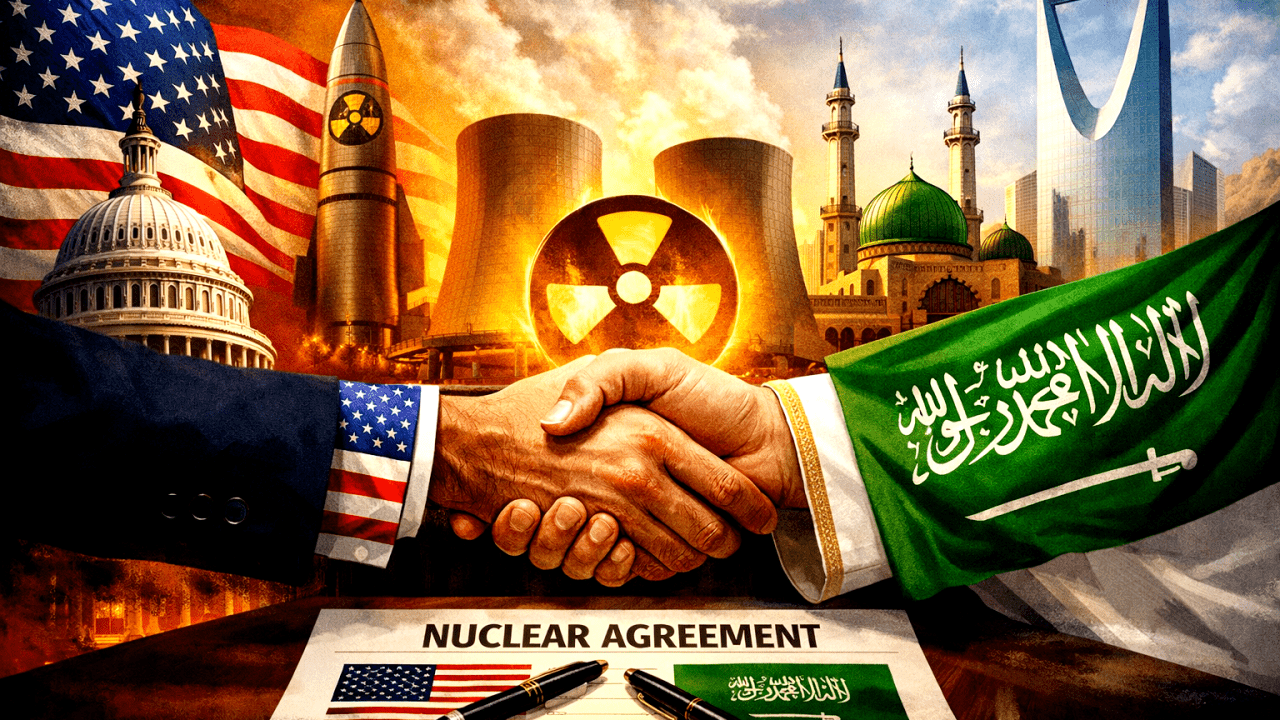
The United States and Saudi Arabia have signed a 30-year Civil Nuclear Deal to expand cooperation in the peaceful use of nuclear energy.
About the Deal
- The 30-year agreement enables US companies to participate in Saudi Arabia’s civilian nuclear energy programme. It is accompanied by a bilateral safeguards agreement, although its detailed provisions have not been publicly disclosed.
- Reports suggest that Saudi Arabia may be permitted to enrich uranium within its territory. Enriched uranium is primarily used as fuel for nuclear power plants but can also be further processed into weapons-grade material if adequate safeguards are not maintained.
- The agreement has been presented by both countries as a framework for peaceful nuclear cooperation, energy security, and long-term strategic collaboration.
Key Provisions
- Section 123 Agreement
- The deal is based on Section 123 of the US Atomic Energy Act, 1954, which provides the legal framework for significant civilian nuclear cooperation between the United States and another country.
- A 123 Agreement authorises the transfer of nuclear materials, equipment, and technology exclusively for peaceful purposes, subject to compliance with international nuclear non-proliferation obligations.
- The agreement requires approval by the US Congress before it can enter into force.
- Safeguards and Verification
- A separate bilateral safeguards agreement accompanies the deal to regulate the peaceful use of transferred nuclear technology and materials.
- The effectiveness of the agreement will depend on International Atomic Energy Agency (IAEA) safeguards, inspections, and verification mechanisms to ensure that civilian nuclear material is not diverted for military purposes.
- However, the detailed safeguards framework has not been made public, raising concerns regarding transparency and oversight.
- India’s 123 Agreement (2008): A Comparison
- India concluded a 123 Agreement with the United States in 2008, ending nearly three decades of restrictions on civilian nuclear cooperation.
- Under the agreement, India placed designated civilian nuclear facilities under India-specific IAEA safeguards in exchange for assured nuclear fuel supply.
- The agreement is regarded as an important benchmark in international civilian nuclear diplomacy.
Key Concerns
- Risk of Nuclear Proliferation
- Domestic uranium enrichment could increase the possibility of diverting nuclear material for military purposes if safeguards are inadequate.
- The agreement will test the effectiveness of the international nuclear non-proliferation framework, particularly the role of IAEA verification.
- Regional Security Implications
- The deal could alter the strategic balance in West Asia, where Israel is widely believed to possess nuclear weapons and Iran’s nuclear programme remains a major security concern.
- It may encourage other countries in the region to pursue similar nuclear capabilities, increasing the risk of a regional arms race.
- The agreement could also influence Iran’s future nuclear policy, potentially intensifying strategic competition in the region.
- Departure from Earlier US Policy: Unlike the 2009 US–UAE Civil Nuclear Agreement, under which the UAE agreed not to undertake domestic uranium enrichment, the Saudi deal is reported to permit indigenous enrichment, indicating a more flexible US approach.
Political Approval: Since the agreement requires ratification by the US Congress, its implementation remains subject to domestic political approval.
Significance
- Strengthens the strategic partnership between the United States and Saudi Arabia.
- Supports Saudi Arabia’s efforts to diversify its energy mix by expanding civilian nuclear power and reducing dependence on oil-based electricity generation.
- Creates commercial opportunities for the US nuclear industry, including companies such as Westinghouse.
- Reinforces civilian nuclear cooperation as an important pillar of bilateral strategic relations.
- Supports the objectives of the Nuclear Non-Proliferation Treaty (NPT) by promoting the peaceful use of nuclear energy while emphasising safeguards against the spread of nuclear weapons.
- Highlights the continuing challenge of balancing peaceful nuclear cooperation with global nuclear non-proliferation objectives.
Conclusion
The US–Saudi Civil Nuclear Deal reflects the growing importance of civilian nuclear energy in international diplomacy. While it strengthens bilateral cooperation and supports Saudi Arabia’s energy diversification, its long-term success will depend on robust safeguards, transparent implementation, Congressional approval, and continued adherence to global non-proliferation norms, while maintaining strategic stability in West Asia.
FAQs
Q1. What is the US–Saudi Civil Nuclear Deal?
Ans: It is a 30-year civilian nuclear cooperation agreement between the United States and Saudi Arabia to promote the peaceful use of nuclear energy while ensuring compliance with non-proliferation commitments.
Q2. What is a Section 123 Agreement?
Ans: A Section 123 Agreement, under the US Atomic Energy Act, 1954, provides the legal framework for the United States to undertake significant civilian nuclear cooperation with another country while ensuring adherence to non-proliferation norms.
Q3. Why has the deal raised concerns about nuclear proliferation?
Ans: Reports indicate that Saudi Arabia may be permitted to enrich uranium domestically. Although enrichment is required for nuclear power generation, it could also provide the capability to produce weapons-grade material if safeguards are inadequate.
Q4. How does the Saudi deal differ from the 2009 US–UAE nuclear agreement?
Ans: The US–UAE agreement prohibited domestic uranium enrichment, whereas the Saudi deal is reported to permit indigenous enrichment, reflecting a comparatively more flexible US policy.
Q5. Why is India’s 123 Agreement relevant in this context?
Ans: India’s 2008 123 Agreement enabled international civilian nuclear cooperation by placing designated civilian nuclear facilities under IAEA safeguards in return for assured nuclear fuel supplies.
Q6. Why is the deal strategically important?
Ans: It strengthens US–Saudi strategic relations, supports Saudi Arabia’s energy transition, and has significant implications for regional security, nuclear diplomacy, and the global non-proliferation regime.
Q7. What is the role of the IAEA in civilian nuclear cooperation?
Ans: The International Atomic Energy Agency (IAEA) ensures that civilian nuclear programmes remain exclusively peaceful through safeguards, inspections, verification, and continuous monitoring of nuclear materials and facilities.