Context
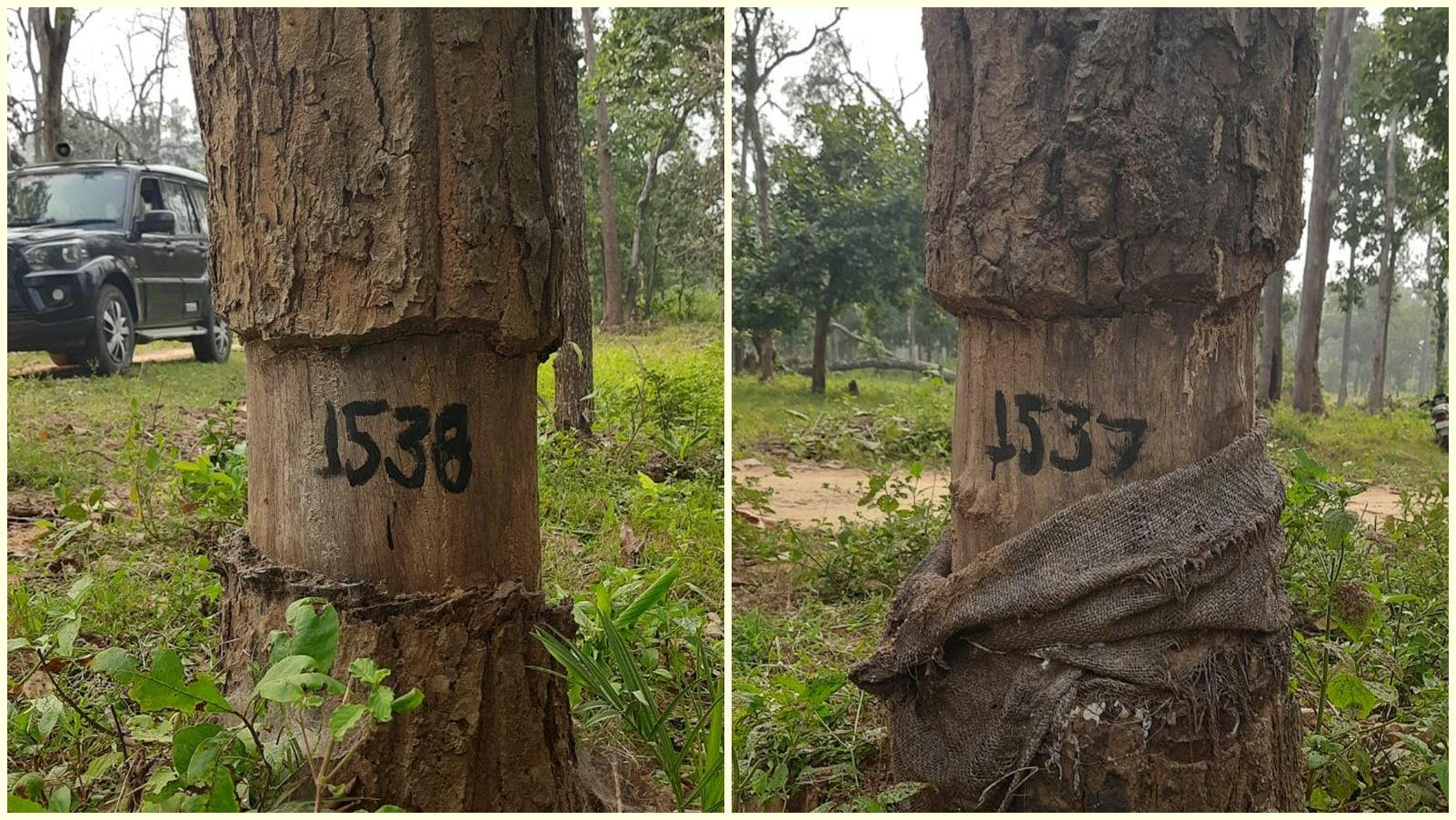
Chhattisgarh’s Forest Department is seeking expert help to save 500+ girdled trees near Karka village in the Udanti-Sitanadi Tiger Reserve (USTR) using bridge grafting, a tree-repair technique. The damage is allegedly linked to encroachment and land clearing for cultivation.
About Girdling (Ring-Barking)
- Definition: A technique of killing a standing tree by removing a continuous outer strip of bark and cambium around its trunk circumference.
- Physiological Impact: Disrupts the downward transport of photosynthetic nutrients from leaves, resulting in root starvation and gradual plant decay.
- Forestry Applications: Deployed in controlled forestry management to clear undesirable or invasive species:
- Eliminates timber felling costs and prevents soil erosion/disturbance.
- Creates standing deadwood (snags) that serve as micro-habitats for wildlife species.
- Facilitates controlled light penetration, giving understory saplings time to mature.
- Illegal Exploitation: Increasingly misused as a tool for unauthorised land clearance and forest encroachment to bypass logging regulations.
Tree Anatomy & Mechanism
- Vascular Cambium: A thin layer of active cells located between xylem (outer wood) and phloem (inner bark). It drives secondary growth (increases trunk thickness/girth), whereas primary growth increases height.
- Layer Structure (Outer to Inner): Bark → Phloem → Vascular Cambium → Xylem → Pith.
- Vascular Functions:
- Phloem: Transports photosynthetic food (sugars) downward from leaves to roots.
- Xylem: Transport water and mineral nutrients upward from roots to leaves.
- Impact of Girdling: Severs the phloem pipeline and destroys the cambium layer, permanently blocking root nourishment and cell regeneration.
- Natural Recovery: Trees attempt self-repair through callus tissue formation (a protective mass of cells growing over the wound).
Bridge Grafting
- Definition: A surgical plant-repair technique used to rescue trees suffering from trunk girdling, animal stripping, or physical bark damage.
- Method: Connects small twigs called scions (bridge wood) to join the intact cambium layers above and below the severed ring.
- Purpose: Restores the downward flow of nutrient transport to prevent root decay until natural bark recovers.
- Key Limitations: Demands high labor expertise and precise timing, yielding low survival rates (e.g., ~10% success rate reported during 2022 trials in USTR – Udanti-Sitanadi Tiger Reserve).
About Udanti-Sitanadi Tiger Reserve (USTR)
- Location: Situated in Gariaband and Dhamtari districts, Chhattisgarh within the Eastern Highlands region.
- Core Composition & Area: Notified in 2009 by combining Udanti and Sitanadi Wildlife Sanctuaries (Total Area: ~1,842.54 sq. km; Core: ~851 sq. km, Buffer: ~991 sq. km).
- Drainage & Hydrology: Located in the Mahanadi River catchment basin. Key tributaries—the Pairi River (from Udanti) and Sondur River (from Sitanadi)—feed into the Mahanadi near Rajim.
- Vegetation & Key Fauna: Tropical dry and moist deciduous forests (dominated by Sal, Teak, Bamboo, Tendu, Mahua, and Bija); serves as a key habitat for the endangered Wild Water Buffalo.
- Governance Framework: Notified by the State Government on the recommendation of the NTCA (National Tiger Conservation Authority), a statutory body under the WPA (Wildlife Protection Act, 1972) (specifically via the 2006 Amendment to the Act).
FAQs
Q1. Why does a girdled tree die?
Ans. Girdling cuts the phloem and destroys the cambium, stopping food supply to roots and preventing normal wound repair.
Q2. What is cambium?
Ans. Cambium is a layer of dividing cells between xylem and phloem that increases the girth of stems and roots through secondary growth.
Q3. How does bridge grafting save a girdled tree?
Ans. It uses scions from dormant, one-year-old stems to reconnect tissues above and below the wound, restoring food flow to roots.
Q4. How is the Mahanadi formed in this region?
Ans. The Pairi and Sondur rivers join near Rajim to form the Mahanadi.
Q5. How does forestry girdling differ from encroachment-linked girdling?
Ans. Forestry girdling selectively removes unwanted trees, while encroachment-linked girdling is allegedly used to clear forests for cultivation.