Context
- Recently, Prime Minister Narendra Modi gifted Russian President Vladimir Putin a Russian-translated edition of the Thirukkural during their bilateral meeting.
- The gesture highlights the cultural and literary heritage of Tamil Nadu and the wider cultural links between India and Russia.
About Thirukkural
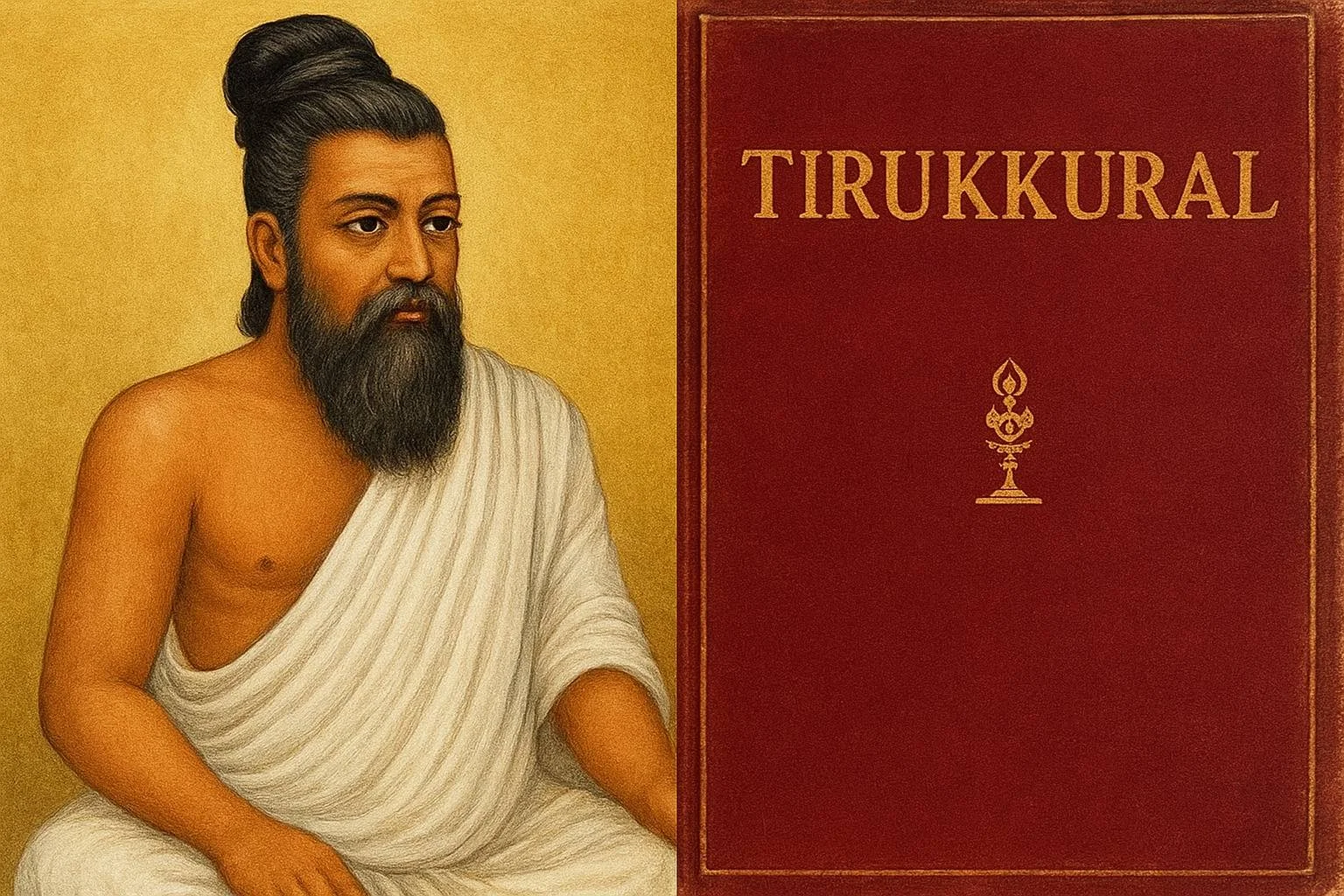
- Thirukkural is a classical Tamil work composed by the poet-philosopher Thiruvalluvar, also known as Valluvar.
- It is one of the most important works of ancient Tamil literature and is widely regarded as a major text on ethics, morality and practical wisdom.
- It is believed to have been composed more than two millennia ago, generally placed between 300 BCE and 500 BCE.
- The word Thirukkural broadly means “sacred couplets”. Its individual verses are known as kurals.
- The work contains 1,330 couplets, organised into 133 chapters, with 10 couplets in each chapter.
- Each kural is written in a short and highly condensed poetic form, making its teachings easy to remember and quote.
Three Sections of Thirukkural
The 1,330 couplets are divided into three major sections — Aram, Porul and Inbam:
- Aram (Virtue) – 38 chapters
- Focuses on moral conduct and personal virtues.
- Covers values such as righteousness, truth, gratitude, compassion and charity.
- Emphasises the importance of living a morally responsible and disciplined life.
- Porul (Wealth/Polity) – 70 chapters
- Deals with worldly affairs and social life.
- Discusses governance, administration, economy, friendship, leadership and social responsibilities.
- Provides practical guidance on good governance and the responsible use of wealth and power.
- Inbam (Love) – 25 chapters
- Explores love, human emotions and relationships.
- Presents love as a source of emotional fulfilment and happiness, rather than merely physical passion.
- It is traditionally discussed through Kalaviyal, dealing with love before marriage, and Karpiyal, dealing with marital love.
Major Themes and Teachings
- Moral life: Thirukkural places ethical conduct at the centre of a meaningful human life.
- Compassion and kindness: It considers kindness, charity and concern for others essential for individual and social well-being.
- Universal outlook: Its teachings focus on human values rather than divisions based on caste, religion, race or creed.
- Consequences of immoral conduct: It warns that greed, jealousy, anger and harsh behaviour can bring misery to individuals and society.
- Good governance: The work provides guidance on leadership, justice, administration and the duties of rulers, making it relevant beyond personal ethics.
- Human relationships: It discusses friendship, family, love and social relationships as important aspects of human life.
- Spirituality: The opening chapter, Kadavul Vazhthu (Praise of God), reflects on the idea of God and the importance of wisdom and moral living.
- Practical wisdom: Rather than being limited to abstract philosophy, the work connects moral principles with everyday human behaviour and social life.
Significance
- Thirukkural is significant not only as a Tamil literary classic but also as a work of universal ethical and social thought.
- Its concise verses address issues such as personal morality, governance, social responsibility and human relationships, giving it relevance even today.
- Its translation into different languages has helped carry Tamil literary and philosophical traditions to a wider global audience.
The presentation of its Russian translation to President Putin therefore represents both India’s cultural diplomacy and the international recognition of India’s diverse literary heritage.
FAQs
Q1. Who composed the Thirukkural?
Thirukkural was composed by the Tamil poet-philosopher Thiruvalluvar, also known as Valluvar. It is a major work of classical Tamil literature dealing with ethics, morality and practical wisdom.
Q2. How many couplets and chapters are there in the Thirukkural?
The Thirukkural contains 1,330 couplets, organised into 133 chapters, with 10 couplets in each chapter.
Q3. What are the three major sections of the Thirukkural?
The work is divided into three sections: Aram (Virtue) with 38 chapters, Porul (Wealth/Polity) with 70 chapters, and Inbam (Love) with 25 chapters.
Q4. What are the major teachings of the Thirukkural?
It emphasises moral conduct, compassion, truth, charity, good governance, social responsibility, human relationships and responsible use of power and wealth. Its teachings are presented as universal human values.
Q5. Why is the Thirukkural relevant in contemporary India and globally?
Its teachings on ethical living, good governance and harmonious human relationships remain relevant today. Its translation into different languages, including Russian, also promotes Tamil literary heritage and India’s cultural diplomacy.