Why in the News?
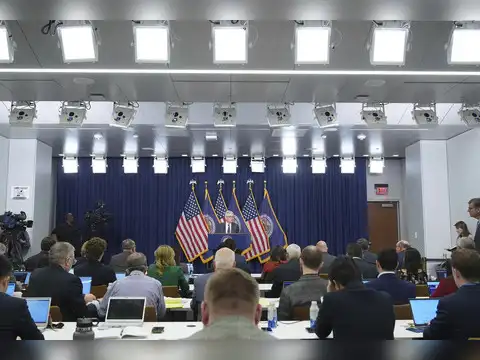
- The US Federal Reserve (Fed) recently reduced interest rates by 25 basis points amid a rare situation of rising inflation and rising unemployment.
- This policy decision has triggered debate on how the dual mandate of the Fed, price stability and maximum employment, can be achieved when both goals are in conflict.
Key Highlights
- The Fed’s Mandate and its Normal Operation
- The Fed has a dual mandate:
- Maintain stable prices (low and predictable inflation).
- Achieve maximum sustainable employment.
- Typically, these two objectives are complementary:
- Strong growth → more jobs but risk of inflation.
- Weak growth → job losses but low inflation.
- Monetary policy usually adjusts interest rates to balance the cycle.
- The Fed has a dual mandate:
- Unusual Economic Context
- Since the past year, both inflation and unemployment have been rising together.
- This breaks the conventional trade-off (as seen in the Phillips Curve) and resembles stagflation-like conditions.
- Such a scenario challenges the effectiveness of monetary policy tools.
- Reason for the Rate Cut
- Labour market indicators showed weaker job creation than earlier estimated.
- The Fed described the economy as being in a “low hiring, low firing” phase—meaning job creation is slowing, while risks of unemployment remain.
- To pre-empt a sharper rise in unemployment, the Fed opted for a small rate cut as a risk management strategy.
- Inflationary Pressures Remain
- Inflation has been inching upward but remains at levels considered moderate by historical standards.
- The Fed clarified that the rate cut is not meant to dismiss inflation risks but to balance short-term employment concerns with longer-term price stability.
- Policy Divergence within the Fed
- The Summary of Economic Projections (SEP) revealed differing views:
- Some policymakers expect the need for further rate cuts.
- Others believe the current cut is sufficient.
- This divergence highlights the uncertainty of the economic outlook and the difficulty of policymaking in such conditions.
- The Summary of Economic Projections (SEP) revealed differing views:
Key Terms
- Inflation
- Definition: Inflation refers to the sustained rise in the general price level of goods and services in an economy over a period of time, leading to a decrease in the purchasing power of money.
- Measurement: It is usually measured using indices such as the Consumer Price Index (CPI) or the Wholesale Price Index (WPI), which track the average change in prices.
- Types: Inflation can be classified as demand-pull inflation (caused by excess demand), cost-push inflation (caused by rising production costs), or built-in inflation (caused by wage–price spirals).
- Impact: Moderate inflation is considered healthy for economic growth, but very high inflation (hyperinflation) erodes savings and destabilizes the economy.
- Control: Central banks use tools like interest rate adjustments, open market operations, and reserve requirements to manage inflation levels.
- Unemployment
- Definition: Unemployment is a condition where individuals who are willing and able to work at prevailing wages cannot find employment.
- Types: It includes frictional unemployment (temporary job transition), structural unemployment (mismatch of skills and jobs), cyclical unemployment (due to economic downturns), and seasonal unemployment (linked to specific industries).
- Measurement: The unemployment rate is calculated as the percentage of the labor force that is unemployed and actively seeking work.
- Consequences: High unemployment reduces income levels, weakens demand in the economy, and may increase social tensions.
- Policy Response: Governments and central banks address unemployment through job creation programs, fiscal stimulus, skill development, and supportive monetary policies.
- Price Stability
- Definition: Price stability means maintaining a stable level of prices in the economy, avoiding both prolonged inflation and deflation.
- Significance: It ensures predictability in the economy, allowing businesses and consumers to make long-term financial decisions with confidence.
- Indicator: Many central banks define price stability as keeping inflation around 2% annually, as it supports sustainable growth.
- Benefits: It helps protect the real value of money, preserves savings, and promotes stable investment and consumption patterns.
- Challenges: External shocks such as commodity price hikes, currency fluctuations, or supply disruptions often make achieving price stability difficult.
- Monetary Policy
- Definition: Monetary policy refers to the process by which a country’s central bank manages money supply and interest rates to achieve economic objectives.
- Types: It can be expansionary (increasing money supply to stimulate growth) or contractionary (reducing money supply to control inflation).
- Objectives: Key goals include controlling inflation, ensuring financial stability, managing unemployment, and supporting economic growth.
- Instruments: Tools include repo rate, reverse repo rate, cash reserve ratio, open market operations, and quantitative easing.
- Limitations: Its effectiveness may be reduced during liquidity traps, weak financial systems, or global economic shocks.
- Stagflation
- Definition: Stagflation is an unusual economic condition where high inflation occurs simultaneously with stagnant economic growth and high unemployment.
- Causes: It can result from supply-side shocks (e.g., rise in oil prices), poor monetary management, or structural rigidities in the economy.
- Impact: Stagflation creates a policy dilemma, as measures to reduce inflation often worsen unemployment, and measures to reduce unemployment may increase inflation.
- Solution Approaches: It requires a mix of supply-side reforms, productivity improvements, and carefully balanced monetary-fiscal measures.
- Phillips Curve
- Definition: The Phillips Curve illustrates an inverse relationship between inflation and unemployment in the short run.
- Concept: It suggests that lower unemployment tends to be associated with higher inflation, and higher unemployment with lower inflation.
- Short-Run vs Long-Run: While the trade-off is visible in the short run, in the long run the curve becomes vertical, implying no permanent trade-off between inflation and unemployment.
- Policy Relevance: Policymakers historically used the Phillips Curve to decide whether to prioritize reducing inflation or unemployment.
- Criticism: It fails during periods of stagflation, when both inflation and unemployment rise together, challenging the curve’s validity.
- Supply-Side Shocks
- Definition: Supply-side shocks are unexpected events that affect the production side of the economy, influencing costs and output.
- Positive vs Negative Shocks: A positive shock increases supply (e.g., a breakthrough in technology), while a negative shock reduces supply (e.g., natural disasters or oil price hikes).
- Impact on Prices: Negative shocks usually lead to higher costs and inflation, while positive shocks may reduce prices and stimulate growth.
- Examples: Oil crises, global supply chain disruptions, crop failures, or sudden changes in trade policy are common supply-side shocks.
- Policy Challenge: Managing such shocks is difficult because they are often external and unpredictable, limiting the effectiveness of demand-side monetary policies.
Implications
- Monetary Policy Effectiveness
- Traditional interest rate changes may not work well in an economy facing both rising inflation and unemployment.
- This demonstrates the limits of demand-side tools when inflation is driven by supply-side shocks.
- Central Bank Credibility
- The independence of the Fed is critical for maintaining public and market trust.
- If credibility is compromised, controlling inflation and managing expectations becomes harder.
- Need for Policy Coordination
- Fiscal measures (such as targeted spending, labour market programs, or structural reforms) may be better suited to address supply-side constraints.
- Monetary and fiscal policy coordination is essential to restore balance.
- Global Economic Spillovers
- Fed decisions influence global capital flows, exchange rates, and financial stability.
- Any loss of confidence in US monetary policy would have ripple effects on emerging markets and global trade.
- Long-term Structural Concerns
- Issues like labour supply constraints, trade frictions, and productivity challenges are beyond the scope of monetary policy.
- Structural reforms are required to address these underlying weaknesses.
Challenges and Way Forward
| Challenge | Why it Matters | Short-term Measures | Long-term Measures |
| Dual mandate conflict | Inflation and unemployment rising together makes trade- offs sharper | Cautious and data- driven rate adjustments | Develop robust frameworks that account for stagflation-like scenarios |
| Limits of monetary policy | Supply-side shocks cannot be solved by interest rate changes | Acknowledge limits and avoid over- reliance on rate cuts | Promote structural reforms in labour, trade, and productivity |
| Central bank credibility | Loss of independence weakens monetary effectiveness | Clear communication and transparency in decision-making | Institutional safeguards to protect independence |
| Policy divergence within Fed | Differing views can confuse markets | Use forward guidance to clarify consensus outlook | Strengthen analytical frameworks for complex scenarios |
| Global spillovers | US policy affects global stability | Gradual policy changes with strong communication | Strengthen global cooperation through international forums |
Conclusion
The Federal Reserve’s dual mandate, balancing price stability and employment, becomes particularly difficult when inflation and unemployment rise together. In such situations, monetary policy alone cannot resolve the problem. What is required is a combination of cautious monetary steps, credible central bank independence, and coordinated fiscal and structural reforms to ensure sustainable economic stability.
| Ensure IAS Mains Question
Q. How does the Federal Reserve’s dual mandate complicate policy-making in situations where both inflation and unemployment rise simultaneously? Discuss with reference to the limits of monetary policy and the need for complementary reforms. (250 words) |
| Ensure IAS Prelims Question
Q. With reference to monetary policy, consider the following statements: 1. The Federal Reserve has a single mandate of ensuring price stability, unlike most central banks. 2. In a situation where both inflation and unemployment are rising, monetary policy becomes less effective in addressing economic imbalances. Which of the statements given above is/are correct? a) Only 1 b) Only 2 c) Both 1 and 2 d) Neither 1 nor 2 Answer: b) Only 2 Explanation: Statement 1 is incorrect: The Fed has a dual mandate: price stability and maximum employment. Many other central banks, like the ECB, have primarily a single mandate of price stability. Statement 2 is correct: Rising inflation with rising unemployment indicates a supply-side problem (stagflation-like), where monetary tools (rate changes) are less effective. |
|
Also Read |
|
| UPSC Foundation Course | UPSC Daily Current Affairs |
| UPSC Monthly Magazine | CSAT Foundation Course |
| Free MCQs for UPSC Prelims | UPSC Test Series |
| ENSURE IAS NOTES | Our Booklist |