Context
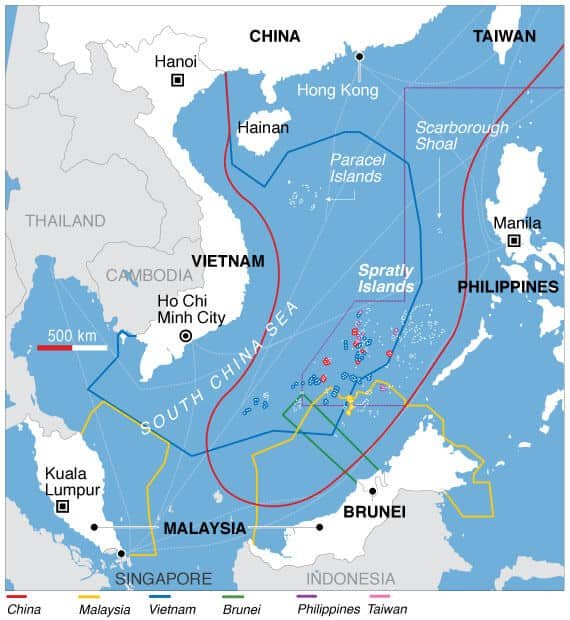
- The South China Sea (SCS) is a strategically important maritime region in the Indo-Pacific, where several countries have overlapping territorial and maritime claims.
- Its importance stems from its role in international trade, energy security, fisheries and maritime connectivity.
Significance
- Global Trade and Resources
- Around 20% of global trade passes through the South China Sea, making it an important corridor for international commerce.
- The region has significant fishing grounds and hydrocarbon resources.
- Its sea lanes facilitate the movement of energy supplies and commercial goods across the Indo-Pacific.
- India’s Interests
- About 55% of India’s trade in the Indo-Pacific region passes through the South China Sea.
- India has energy interests in the region through hydrocarbon exploration cooperation with Vietnam, initiated in 2011.
- The region is also relevant to India’s maritime security and freedom of navigation.
Major Disputes
- China’s Maritime Claims
- China claims a large portion of the South China Sea through the nine-dash line, with several claims overlapping those of neighbouring coastal states.
- China has developed infrastructure on disputed maritime features, including artificial islands, ports, airstrips and military facilities.
- Major Disputed Areas
- The Spratly Islands have witnessed extensive infrastructure development and competing territorial claims.
- China has exercised control over the Paracel Islands since 1974, although their sovereignty remains disputed.
- The Scarborough Shoal is another major area of contention.
- China has strengthened military infrastructure on Woody Island, including radar and missile-related systems.
- International Legal Dimension
- In 2016, an arbitral tribunal constituted under the United Nations Convention on the Law of the Sea (UNCLOS) found that there was no legal basis for China’s claimed historic rights to resources within the relevant maritime areas beyond the rights provided under the Convention.
- China rejected the tribunal’s ruling and continues to maintain its position on the dispute.
Way Forward
- Diplomatic dialogue should remain the primary means of managing competing claims and preventing escalation.
- Regional mechanisms should promote confidence-building measures and reduce the risk of maritime incidents.
- A legally binding Code of Conduct can establish agreed rules for activities and dispute management in the region.
- Regional cooperation should uphold UNCLOS, freedom of navigation and peaceful dispute settlement.
Conclusion
The South China Sea combines major economic, resource and strategic interests, making regional stability important for the wider Indo-Pacific. For India, secure sea lanes and uninterrupted commercial activity are particularly significant. Effective regional mechanisms can help manage competing claims and reduce the possibility of escalation.
FAQs
- What is the nine-dash line?
The nine-dash line is the demarcation used by China to represent its extensive claims in the South China Sea. These claims overlap with those of several other states.
- Why is the South China Sea important for the Indo-Pacific?
Its location connects major maritime routes and economies, making it relevant to trade, energy security, maritime connectivity and regional stability.
- What is UNCLOS?
UNCLOS is the principal international legal framework governing maritime zones, navigation and rights over marine resources.
- Why is freedom of navigation important in the South China Sea?
It allows vessels to use maritime routes in accordance with international law and supports uninterrupted commercial and lawful maritime activity.
- What is a Code of Conduct for the South China Sea?
A Code of Conduct would establish agreed rules for state behaviour in the region, helping manage disputes and reduce the risk of maritime confrontation.
- Why is the South China Sea important for India’s maritime security?
The region forms part of India’s wider Indo-Pacific maritime interests. Secure sea lanes and freedom of navigation are important for uninterrupted commercial and strategic maritime activity.