Important questions for UPSC Pre/ Mains/ Interview:
|
Context
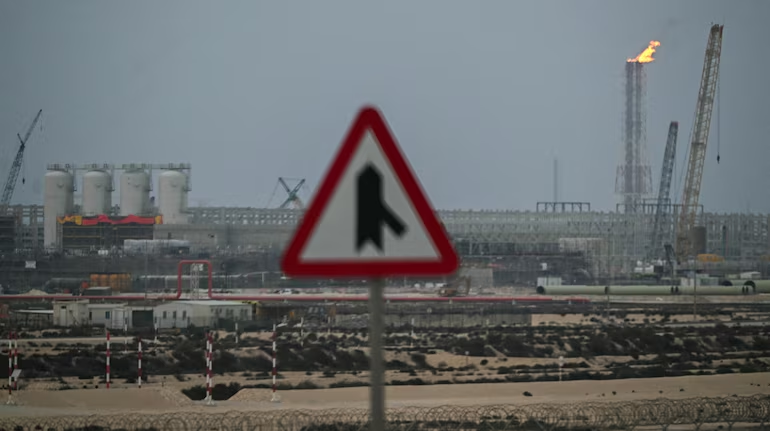
Recent missile strikes on Qatar’s Ras Laffan Industrial City – a major global LNG hub – amid escalating West Asia conflict have raised serious concerns about global gas supply disruptions and India’s energy security, especially given India’s heavy dependence on imported LNG.
Q1. What is Ras Laffan and why is it strategically important?
- Ras Laffan Industrial City (Qatar) is the world’s largest LNG production and export hub.
- It handles gas processing, liquefaction, storage and export infrastructure.
- It accounts for ~20% of global LNG supply.
- It is closely linked to the South Pars/North Dome gas field, the world’s largest natural gas reserve.
- Key significance:
- Backbone of global LNG trade
- Critical node in global energy supply chains
- Central to Qatar’s energy economy
Q2. What triggered the Ras Laffan attack and how did the conflict escalate?
- Israel struck the South Pars gas field (shared by Iran and Qatar).
- Iran retaliated by targeting energy infrastructure across Saudi Arabia (Yanbu refinery), Kuwait and Qatar (Ras Laffan).
- Consequences:
- Fires and damage at LNG facilities
- Temporary suspension of LNG production
- Escalation from transit disruption to infrastructure targeting
- Oil market reaction: Brent crude surged above $100, peaked at $119, stabilised around $112
Q3. Why is the Ras Laffan strike more serious than earlier Hormuz disruptions?
- Earlier risks were related to shipping routes (Strait of Hormuz), causing short-term delays.
- The current crisis involves direct damage to production infrastructure – long term supply shocks.
- It will lead to slow recovery of supply, uncertainty in global LNG availability and increased volatility in energy markets.
Q4. What are the implications for India’s long-term energy contracts?
- India has long-term LNG contracts with Qatar (Petronet LNG – ~7.5 MTPA, GSPC – ~1 MTPA, GAIL – smaller volumes)
- Domestic gap: Consumption = ~189 MMSCMD and Production = ~90 MMSCMD.
- Risks:
- Supply disruption may trigger force majeure clauses
- Contracted volumes may not be delivered
- Increased reliance on spot LNG markets (costlier)
Q5. What are the broader economic implications for India?
- Inflationary pressure: Rising LNG and crude prices increase fuel costs, transportation costs and overall inflation.
- Fiscal impact: The government may increase subsidies (especially LPG) and absorb price shocks.
- Energy shortages: Early signs of LPG supply delays and potential industrial gas shortages.
- Trade impact: India–Qatar trade (~$14 billion+) may be affected. Energy imports dominate bilateral trade.
Q6. How is India responding through diversification of energy sources?
- India is reducing dependence on Gulf suppliers and looking for new sourcing regions (like USA, Norway, Russia, Canada, Algeria).
- Implications
- Positive:
- Reduced geopolitical risk
- Greater supply resilience
- Negative:
- Higher transportation costs
- Increased landed price of LNG
- Positive:
Q7. What are the key risks and policy challenges ahead?
- Energy Security Risks
- Overdependence on West Asia
- Vulnerability to geopolitical conflicts
- Limited domestic gas production
- Market Risks
- Volatility in global LNG and crude prices
- Increased reliance on spot markets
- Infrastructure Risks
- Lack of strategic LNG reserves
- Limited storage capacity
Q8. What measures are required going forward?
- Diversification of energy import sources
- Expansion of strategic petroleum and gas reserves
- Boosting domestic exploration and production
- Investment in renewable energy, green hydrogen and alternative fuels.
- Strengthening maritime security and diplomatic engagement in West Asia.
Conclusion
The Ras Laffan attack marks a shift from transit disruptions to direct targeting of global energy infrastructure, significantly raising risks for global LNG supply. For India, heavily dependent on Qatar for gas imports, the crisis underscores the urgency of diversification, strategic reserves, and energy transition to balance security, affordability, and sustainability.