Context
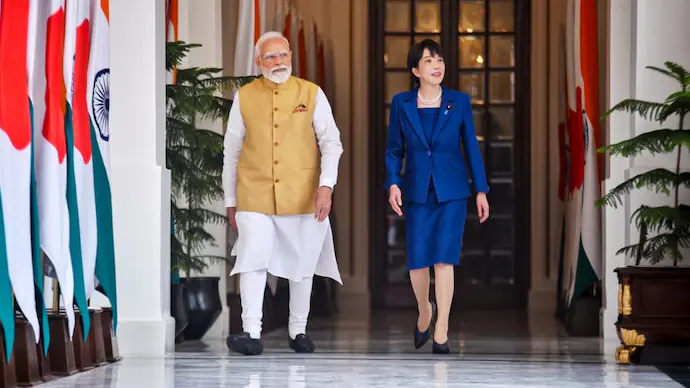
Japanese Prime Minister Sanae Takaichi is on her inaugural visit to India for the 16th India–Japan Annual Summit. The summit focuses on reviewing progress under the India–Japan Special Strategic and Global Partnership while expanding cooperation in trade, investment, technology, defence, and regional security. The visit follows Prime Minister Narendra Modi’s visit to Tokyo for the 15th India–Japan Annual Summit in August 2025.
India–Japan Annual Summit
Instituted in 2006, the India–Japan Annual Summit is the highest bilateral dialogue mechanism under which the Prime Ministers of both countries meet annually on a rotational basis.
The summit provides an opportunity to:
- Review progress across the bilateral relationship.
- Expand economic, technological, and strategic engagement.
- Exchange views on regional and global developments.
- Promote business, trade, and investment.
Prime Minister Takaichi is accompanied by a high-level business delegation, underscoring the growing economic dimension of bilateral ties.
Economic Relations
Economic ties have expanded steadily over the past decade, making Japan one of India’s leading investment and infrastructure partners.
- Around 1,400 Japanese companies operate in India, with nearly half engaged in manufacturing.
- Bilateral trade reached US$27.5 billion during 2025–26.
- Japanese investment in India stood at US$3.2 billion between April and December 2025.
- Japan continues to support major infrastructure projects, including the Mumbai–Ahmedabad High-Speed Rail Corridor.
- A recent investment of US$1.6 billion secured a 20% stake in Yes Bank.
These developments underscore Japan’s role as one of India’s key partners in infrastructure development and industrial growth.
Strategic Importance
The relationship has emerged as a key pillar of India’s Indo-Pacific strategy and regional engagement.
Both countries seek to:
- Promote a Free, Open, Inclusive, and Rules-based Indo-Pacific.
- Strengthen maritime security and regional stability.
- Expand defence and security cooperation.
- Promote a stable, multipolar, and rules-based regional order.
As members of the Quad, alongside the United States and Australia, India and Japan collaborate on maritime security, resilient supply chains, critical and emerging technologies, disaster resilience, and global health.
Regional and Sub-national Engagement
State–Prefecture Cooperation
State–Prefecture engagement has emerged as a unique pillar of bilateral cooperation.
Recent developments include:
- Visits by the Chief Ministers of Haryana, Punjab, and Uttar Pradesh to Japan.
- Visits by Governors of several Japanese Prefectures to India.
- Establishment of the India–Japan Governors’ Network in February 2026 to promote investment, technology, skill development, and local-level collaboration.
India–Japan Act East Forum
Japan is the only country with which India has established a dedicated institutional mechanism for the development of the North-Eastern region through the India–Japan Act East Forum.
The Forum promotes collaboration in:
- Infrastructure
- Urban development
- Energy
- Agriculture
- Tourism
- Skill development
The North-East serves as a strategic bridge connecting India’s Act East Policy with Japan’s Free and Open Indo-Pacific Vision, strengthening connectivity between South Asia and Southeast Asia.
Recent initiatives include Japanese delegations visiting Manipur and an agreement with Meghalaya to provide skill training and employment opportunities to 5,000 youth.
Evolution of Bilateral Relations
Centuries-old civilisational and cultural ties have evolved into a comprehensive strategic relationship.
| Year | Milestone |
| 2000 | Global Partnership |
| 2006 | Strategic and Global Partnership |
| 2014 | Special Strategic and Global Partnership |
The two countries will commemorate 75 years of diplomatic relations in 2027.
Today, bilateral engagement is supported by more than 70 institutional mechanisms, facilitating regular consultations across political, economic, strategic, and security domains.
Eight Pillars of the Partnership
The India–Japan partnership is anchored on eight key pillars:
- Economy
- Economic Security
- Mobility
- Environment
- Technology and Innovation
- Healthcare
- People-to-People Exchanges
- State–Prefecture Cooperation
Institutional Mechanisms
Major bilateral mechanisms include:
- 2+2 Foreign and Defence Ministers’ Meeting
- Foreign Ministers’ Strategic Dialogue
- Economic Security Dialogue
- India–Japan Act East Forum
- National Security Adviser-level consultations
These mechanisms facilitate regular policy coordination across strategic, economic, and security domains.
Emerging Areas of Cooperation
Economic security and advanced technologies have become important pillars of bilateral engagement.
During the First India–Japan Economic Security Dialogue (Tokyo, 2024), both countries identified five priority sectors:
- Semiconductors
- Critical minerals
- Pharmaceuticals
- Clean energy
- Information and Communication Technology (ICT)
Recent initiatives include:
- Memorandum of Cooperation on Mineral Resources (2025), followed by the first Joint Working Group meeting in 2026.
- Memorandum of Cooperation on Semiconductor Supply Chains (2023).
- Japan–India AI Cooperation Initiative (2025) and the inaugural Strategic AI Dialogue.
These initiatives aim to build resilient supply chains, strengthen economic security, and promote innovation in critical technologies.
Defence and Security Cooperation
Defence cooperation has steadily expanded through regular military exercises, technology collaboration, and institutional engagement.
Major initiatives include:
- Joint Declaration on Security Cooperation (2025).
- Bilateral exercises:
-
- JAIMEX (Naval)
- Dharma Guardian (Army)
- Veer Guardian (Air Force)
- Coast Guard Joint Exercise
- Participation in multilateral exercises such as MALABAR and MILAN.
- Defence technology collaboration, including implementation of the UNICORN Mast project.
These initiatives have enhanced interoperability and reinforced mutual strategic trust.
Significance of the Partnership
- Reinforces India’s Act East Policy and complements Japan’s Free and Open Indo-Pacific Vision.
- Promotes a free, open, inclusive, and rules-based Indo-Pacific.
- Strengthens resilient supply chains through collaboration in semiconductors, critical minerals, clean energy, and other critical technologies.
- Expands cooperation in artificial intelligence, digital technologies, innovation, and economic security.
- Deepens maritime security and defence cooperation in the Indo-Pacific.
- Accelerates infrastructure and socio-economic development in India’s North-Eastern region.
- Diversifies India’s economic and strategic partnerships, reducing dependence on concentrated supply chains and markets.
- Contributes to regional stability through coordinated engagement in bilateral and multilateral forums.
Conclusion
The India–Japan Special Strategic and Global Partnership has evolved into one of India’s most trusted and comprehensive bilateral relationships, spanning economic growth, technological innovation, connectivity, defence, and regional security. As both countries approach 75 years of diplomatic relations in 2027, deeper engagement in emerging technologies, resilient supply chains, North-East development, and Indo-Pacific cooperation is expected to further strengthen their shared vision of a free, open, inclusive, and rules-based Indo-Pacific, while contributing to long-term peace, stability, and sustainable development.