Context
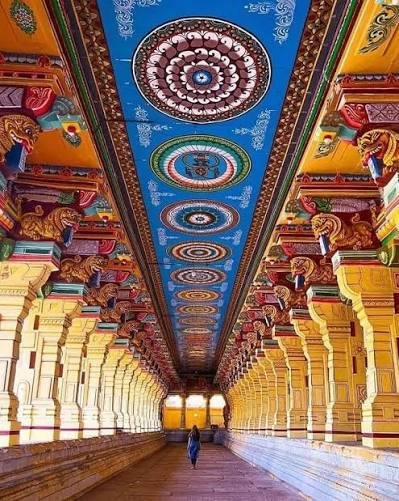
During the 18th BRICS Summit in New Delhi, Prime Minister Narendra Modi welcomed BRICS leaders with the Ramanathaswamy Temple corridor as the backdrop. The choice brought Tamil Nadu’s religious and architectural heritage into the spotlight.
About Ramanathaswamy Temple
- Location and Religious Significance
- The temple is located at Rameswaram on Pamban Island, Tamil Nadu, and is dedicated to Lord Shiva.
- According to tradition, Lord Rama worshipped Shiva at Rameswaram after returning from Lanka. This gives the temple a unique association with both Rama and Shiva.
- It is one of the 12 Jyotirlingas, where Shiva is worshipped as a Jyotirlinga, meaning “pillar of light”. Ramanathaswamy is the only Jyotirlinga in southern India.
- It is also one of the four Char Dham pilgrimage sites, along with Badrinath, Dwarka and Puri. It is the only Shiva temple among the four Char Dham shrines.
- Historical Evolution
- The temple developed gradually from an earlier simple structure into the large complex seen today.
- 12th century: Chola rulers constructed the first stone temple.
- Later: The Pandyas and Vijayanagara rulers contributed to its expansion.
- 1513: Vijayanagara ruler Krishna Deva Raya visited the temple after his Lanka campaign and made substantial offerings.
- Nayaka period: The Sethupathi rulers of Ramnad became its principal patrons and played a major role in completing the present complex.
- The outermost corridor, famous for its huge number of pillars, was constructed much later, largely under Muthuramalinga Sethupathi.
- Architectural Features
- The temple is a major example of Dravidian architecture, known for its gopurams, carved pillars and massive stone structures.
- The complex covers about 15 acres and is enclosed by high compound walls (madil).
- Its most distinctive feature is its long pillared corridors, extending for about 1.17 km (3,850 feet) in total.
- The famous outer corridor contains 1,212 pillars, each around 6.9 metres high, making it widely regarded as the longest temple corridor in the world.
- The pillars and supporting beams are arranged in a carefully planned grid and carry floral designs, mythical figures and other intricate carvings.
- The temple has prominent eastern and western gopurams, with the eastern Rajagopuram rising about 126 feet.
- The complex contains 36 water bodies, including 22 sacred wells (theerthams) used in religious rituals.
- Why is the Corridor Special?
- The long rows of pillars create a strong perspective effect, with the columns appearing to converge towards a distant point.
- This arrangement was designed not merely for decoration but as a processional space meant to be experienced while walking through it.
- Its enormous scale and distinctive Dravidian design make the corridor an important symbol of Tamil architectural heritage.
Conclusion
The Ramanathaswamy Temple represents the meeting of religious tradition, Dravidian architecture and centuries of regional patronage. Its appearance on the BRICS diplomatic stage also showcased India’s civilisational heritage as part of its cultural diplomacy.
FAQs
Q1. Where is the Ramanathaswamy Temple located?
At Rameswaram on Pamban Island, Tamil Nadu; dedicated to Lord Shiva.
Q2. What is the religious significance of Ramanathaswamy Temple?
It is one of the 12 Jyotirlingas and the only Jyotirlinga in southern India; also part of the Char Dham pilgrimage.
Q3. Which dynasties contributed to the development of Ramanathaswamy Temple?
Initially built by the Cholas (12th c.), expanded by Pandyas and Vijayanagara rulers, with major patronage from the Sethupathi rulers of Ramnad.
Q4. What is the Ramanathaswamy Temple’s most distinctive architectural feature?
Its pillared corridors — 1.17 km long with 1,212 pillars — regarded as the longest temple corridor in the world.
Q5. Why was the Ramanathaswamy Temple highlighted during the BRICS Summit?
The corridor backdrop showcased India’s civilisational heritage and Tamil Nadu’s Dravidian architecture in cultural diplomacy.