Important questions for UPSC Pre/ Mains/ Interview:
|
Context
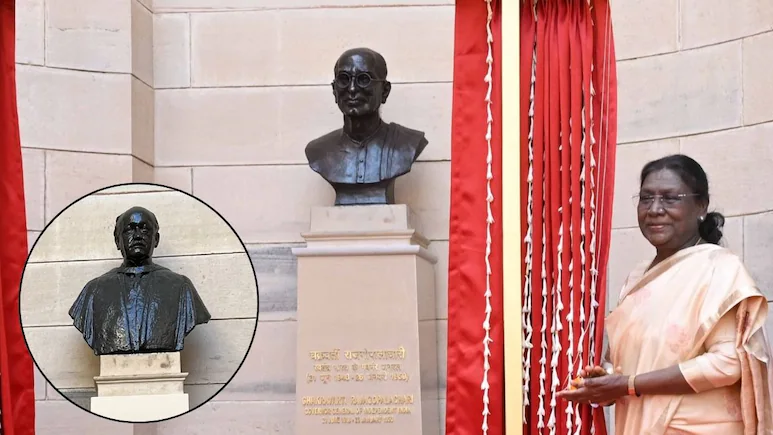
President Droupadi Murmu unveiled a statue of C. Rajagopalachari (Rajaji) at Rashtrapati Bhavan, replacing the bust of Edwin Lutyens. The decision symbolises recognition of Rajaji’s role in India’s freedom struggle, governance transition, and ideological debates shaping independent India.
Q1. Who was C. Rajagopalachari and what was his role in the freedom movement?
- Born in 1878 in Thorapalli, Tamil Nadu.
- Joined the Indian National Congress in early 20th century sessions (1906–07).
- Chairman of Salem Municipal Council (1917), indicating early administrative exposure.
- Close associate of Mahatma Gandhi after 1919.
- Gave up legal practice during the Non-Cooperation Movement.
- Led the Vedaranyam Salt Satyagraha in 1930 in South India.
- Arrested multiple times for civil disobedience.
- He combined legal acumen with grassroots mobilisation.
Q2. What was the Rajaji Formula and why is it significant?
- Proposed during 1942–44 to resolve Congress–Muslim League deadlock.
- Suggested plebiscite in Muslim-majority districts after independence.
- Proposed safeguards for defence, commerce, and communication in case of partition.
- Gandhi agreed to consider it; Jinnah rejected it.
- Reflected Rajaji’s pragmatic approach to communal negotiations.
Significance:
- Early recognition of partition possibility.
- Attempt at negotiated constitutional settlement.
- Demonstrated independence from mainstream Congress strategy.
Q3. How did Rajaji contribute to social reform and language debates?
- On Temple Entry Reform
- Supported legislation removing disabilities against Dalits.
- Introduced Temple Entry Authorisation and Indemnity Act (1939).
- Enabled Dalit entry into Meenakshi Temple (Madurai).
- Balanced reform with caution to prevent social unrest.
- On Hindi Policy
- Introduced compulsory Hindi in 1938 as Premier of Madras.
- Faced anti-Hindi protests.
- Later opposed the imposition of Hindi as the sole official language (1965).
- Supported English as a neutral link language.
- His position evolved from promotion to opposition of coercive imposition.
Q4. What was Rajaji’s role in post-Independence governance?
- Premier under Government of India Act, 1935.
- Only Indian Governor-General (1948–1950).
- Home Minister (1950–51).
- Chief Minister of Madras (1952–54).
- He bridged colonial administration and republican governance.
- Administrative contributions:
- Advocated decentralisation.
- Emphasised fiscal discipline.
- Upheld constitutionalism.
Q5. Why did Rajaji form the Swatantra Party and what did it represent?
- Founded the Swatantra Party in 1959.
- Criticised Nehruvian socialism and central planning.
- Advocated market-oriented economy with regulatory safeguards.
- Emphasised the need for strong Opposition in democracy.
- Opposed excessive state ownership and bureaucratic control.
- Ideological position:
- Classical liberalism adapted to Indian context.
- Supported free enterprise but rejected unregulated capitalism.
Q6. What is Rajaji’s enduring political and intellectual significance?
- Political Significance
- Represented principled dissent within Congress tradition.
- Advocated negotiated politics over mass confrontation (in later years).
- Emphasised moral accountability in public life.
- Cultural and Intellectual Contributions
- Authored simplified versions of Ramayana and Mahabharata.
- Promoted ethical interpretation of tradition.
- Advocated reformist reading of scriptures.
- Contemporary Relevance
- Symbol of transition from colonial elite to Indian statesmanship.
- His liberal economic views resonate in modern policy debates.
- Replacement of Lutyens’ bust symbolises reinterpretation of colonial legacy.
Q7. What broader governance themes emerge from Rajaji’s life?
- Balance between conviction and pragmatism.
- Federalism and linguistic accommodation.
- Social reform within the constitutional framework.
- Opposition as democratic necessity.
- Moral restraint in the exercise of power.
- Rajaji consistently treated political authority as a responsibility, not entitlement.
Conclusion
Rajagopalachari stands as a multifaceted figure—freedom fighter, negotiator, reformer, administrator, and liberal thinker. His career reflects India’s transition from colonial rule to constitutional democracy. The renewed public recognition of his legacy underscores debates on governance ethics, economic policy, linguistic federalism, and institutional balance in contemporary India.