Context
Physical AI is emerging as a major area of industrial innovation, particularly in manufacturing and logistics. In June 2026, a McKinsey expert projected that robotics and Physical AI could create at least $1 trillion in economic value by 2040, mainly in these sectors.
About Physical AI
- Definition: Physical AI refers to AI systems that perceive, reason and interact with the physical world, enabling machines to perform tasks beyond digital environments.
- Core components: It integrates AI models, sensors, actuators and control systems, allowing machines to interpret environmental information and execute physical actions.
- Physical intelligence: It processes spatial relationships, motion and physical constraints, enabling machines to operate in changing real-world environments.
- Adaptive behaviour: Unlike conventional robots following fixed instructions, Physical AI can use real-time feedback to adjust actions, improving flexibility within its operational limits.
How Does Physical AI Work?
- Perception: Cameras, LiDAR and other sensors collect environmental data, enabling machines to identify objects, obstacles and surrounding conditions.
- Reasoning and planning: AI models interpret sensor inputs and evaluate physical constraints to determine suitable actions or movement paths.
- Physical execution: Actuators, such as motors and robotic joints, convert control instructions into movements, allowing machines to perform physical tasks.
- Feedback and correction: Continuous sensor feedback helps machines detect deviations and adjust movements, improving accuracy and adaptability.
Major Applications of Physical AI
- Manufacturing: AI-enabled robotic arms can identify and handle components of varying shapes, supporting flexible assembly and material handling.
- Logistics: Autonomous forklifts and warehouse robots can navigate around obstacles and transport goods, improving the flexibility of warehouse operations.
- Transportation: Autonomous vehicles combine environmental sensing with decision-making to respond to road conditions, supporting automated navigation.
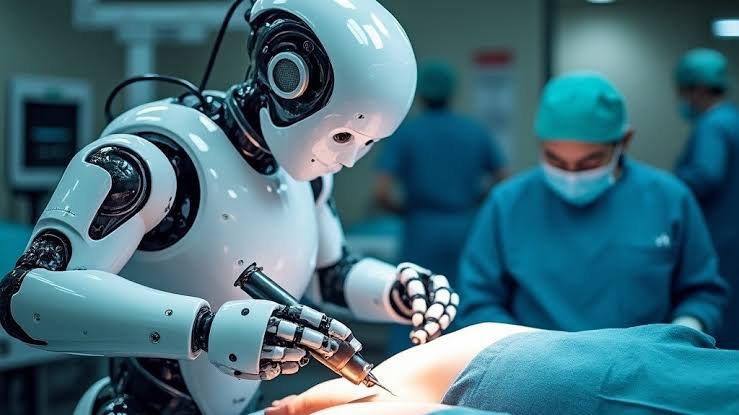
- Healthcare: AI-enabled medical robots are being developed for specialised procedures and assistive tasks, potentially improving precision and accessibility.
Significance of Physical AI
- Industrial productivity: Automating variable and repetitive physical tasks can improve operational efficiency and support more flexible production.
- Workplace safety: Deploying autonomous systems in hazardous environments can reduce human exposure to dangerous tasks, subject to reliable safety controls.
- Economic opportunities: Growing adoption could expand demand for robotics, advanced sensors and specialised technical services, supporting new industrial value chains.
- Workforce transformation: Human–machine collaboration may shift workers towards supervision, maintenance and problem-solving, increasing the importance of technical skills.
Key Challenges
- Technical reliability: Unpredictable environments and sensor errors can affect machine performance, making real-world testing and safety validation essential.
- High deployment costs: Advanced hardware, computing infrastructure and integration requirements can limit adoption, particularly among smaller enterprises.
- Training and safety gaps: Limited physical-world training data and uncertain performance in unfamiliar situations restrict large-scale deployment.
FAQs
Q1. What is Physical AI?
It refers to AI systems capable of perceiving, reasoning and acting in the physical world.
Q2. What are its main components?
AI models, sensors, actuators and control systems.
Q3. How is Physical AI different from traditional robotics?
It enables more adaptive decision-making through AI-based perception and real-time feedback rather than relying entirely on fixed instructions.
Q4. What are its major applications?
Manufacturing robots, autonomous forklifts, self-driving vehicles and AI-enabled medical robots.
Q5. What is its projected economic potential?
A McKinsey expert estimated that robotics and Physical AI could generate at least $1 trillion in economic value by 2040, mainly in manufacturing and logistics.