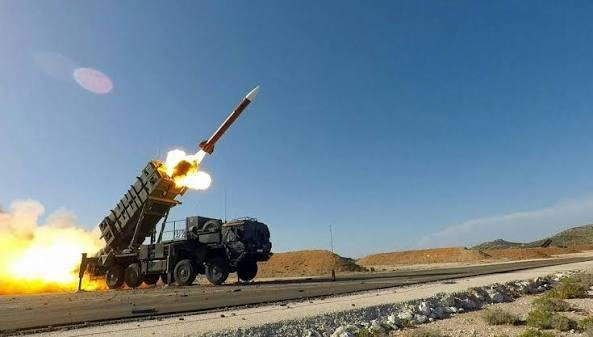
Context
- NATO plans to procure around 1,000 Patriot interceptor missiles to strengthen allied air-defence capabilities.
- Lockheed Martin has received critical components from General Motors for Patriot interceptors, reflecting efforts to increase production amid ongoing international conflicts.
About
- Patriot stands for Phased Array Tracking Radar for Intercept on Target. It is a mobile surface-to-air missile defence system originally developed by Raytheon Technologies, a U.S. defence company.
- The system is operated by the U.S. Army and can engage aircraft, tactical ballistic missiles and cruise missiles, depending on the interceptor used.
Key Features
- A Patriot battery is the basic firing unit comprising a phased-array radar, engagement control station, computers, power-generation equipment and launchers.
- The system uses Track-Via-Missile (TVM) guidance, through which the mobile engagement control centre provides mid-course correction commands.
- A battery can have up to 8 launchers, with each launcher carrying 4 ready-to-fire missiles.
- Around 90 personnel may be assigned to a battery, while only 3 personnel at the engagement control station are required to operate it during combat.
- Its radar has a range of more than 150 km and can simultaneously track up to 100 potential targets.
- PAC-2 uses a blast-fragmentation warhead, whereas PAC-3 employs hit-to-kill technology.
- Depending on the version, Patriot interceptors can engage targets at altitudes exceeding 24 km.
Operational Use
- Patriot was first used in combat during the 1991 Gulf War, when batteries were deployed in Saudi Arabia, Kuwait and Israel.
- The system was subsequently used during the 2003 Iraq invasion.
- It is operated by 19 countries, including the United States, Germany, Poland, Ukraine, Japan, Qatar, Saudi Arabia and Egypt.
FAQs
- What is an interceptor?
An interceptor is a missile designed to engage a hostile or incoming target. In the Patriot system, different interceptor variants provide different capabilities.
- What is the difference between a Patriot battery and an interceptor?
A battery is the complete firing unit containing the radar, control systems, power equipment and launchers. An interceptor is the missile launched by that unit to engage a target.
- What is the role of the engagement control centre?
The engagement control centre coordinates the system’s operations and supports missile guidance by transmitting mid-course correction commands to the interceptor.
- What does “hit-to-kill” technology mean?
Hit-to-kill technology destroys a target through direct physical impact rather than relying primarily on an explosive warhead.
- Why does Patriot have different interceptor variants?
Different variants provide different interception capabilities. The appropriate interceptor can therefore be selected according to the threat being engaged.
- Why is mobility an important feature of the Patriot system?
Mobility allows the system’s components to be deployed and positioned according to operational requirements instead of remaining confined to a permanently fixed installation.
- What does the Patriot system integrate?
The system brings together target detection and tracking, engagement control, missile guidance and interception within an integrated air-defence architecture.