Context
- India is investigating LG Electronics and Samsung Electronics over alleged underpayment of customs duty on imported components used in manufacturing OLED television panels.
- The dispute relates to the tariff classification of imported OLED display parts, bringing attention to the high-value components behind modern electronic displays.
- Beyond the tariff issue, OLED technology is important for India because displays are a critical part of the electronics manufacturing value chain.
What Is OLED?
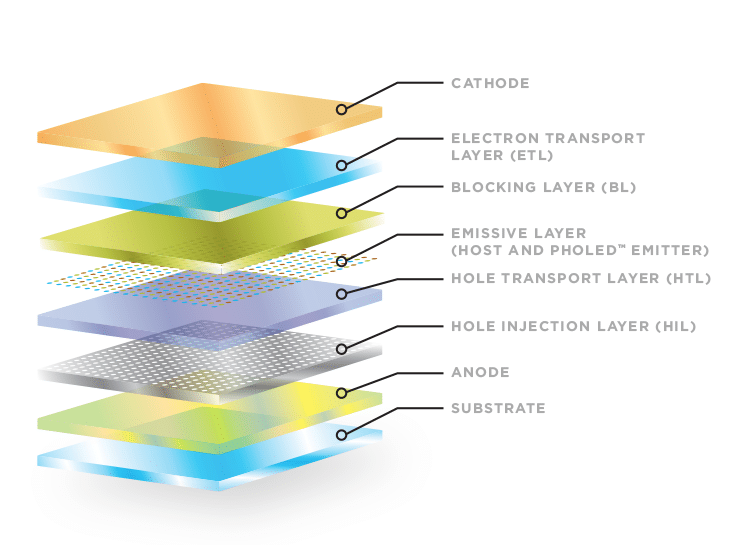
OLED (Organic Light-Emitting Diode) is a display technology in which carbon-based organic materials emit light when electrically stimulated.
- It consists of thin organic layers sandwiched between two electrodes, at least one of which is transparent.
- OLED is self-emissive: each pixel produces its own light and therefore does not require a separate backlight.
- Individual pixels can switch completely off, enabling deep blacks and very high contrast.
- Thin organic layers enable ultra-thin, flexible, foldable, transparent and potentially rollable displays.
How Does OLED Work?
- When voltage is applied, electrons and positive charges move through the organic layers and recombine in the emissive layer. The resulting energy excites organic molecules, which release energy as visible light.
- Thus, OLED produces light directly at the pixel level, unlike LCD technology that depends on a separate backlight.
OLED vs LCD
| Feature | OLED | LCD |
| Light generation | Each pixel emits light | Requires backlight |
| Black level | Pixel can switch off completely | Backlight remains present |
| Contrast | Very high | Comparatively lower |
| Form factor | Can be thin and flexible | Generally more rigid |
| Key limitation | Burn-in/material ageing | Backlight adds thickness |
India’s Display Manufacturing Push
- The India Semiconductor Mission (ISM) covers both semiconductor and display ecosystems. The Display Fab scheme provides approved projects fiscal support of up to 50% of project cost.
- The scheme specifically seeks manufacturing capability for TFT-LCD and AMOLED display panels.
- The Electronics Component Manufacturing Scheme (ECMS) further supports electronics value-chain development and includes display-module sub-assemblies among its target segments.
Together, these measures reflect an effort to deepen domestic capability from final-device assembly towards components and display manufacturing.
Key Challenge
- Advanced OLED manufacturing requires large capital investment, specialised materials, precision fabrication equipment and mature supplier networks.
- India’s central challenge is therefore not merely assembling OLED-based products but progressively building capability across the display value chain.
FAQs
Q1. What does OLED stand for?
OLED stands for Organic Light-Emitting Diode.
Q2. Why is OLED called self-emissive?
Because each pixel generates its own light without requiring a separate backlight.
Q3. What is AMOLED?
Active-Matrix OLED (AMOLED) uses an active-matrix system to individually control pixels, making it suitable for high-resolution displays.
Q4. What is PHOLED?
Phosphorescent OLED (PHOLED) uses phosphorescent emitters to improve the efficiency of light generation.
Q5. Which Indian programme supports display fabrication?
The India Semiconductor Mission’s Display Fab scheme supports establishment of display fabrication facilities in India.