Context
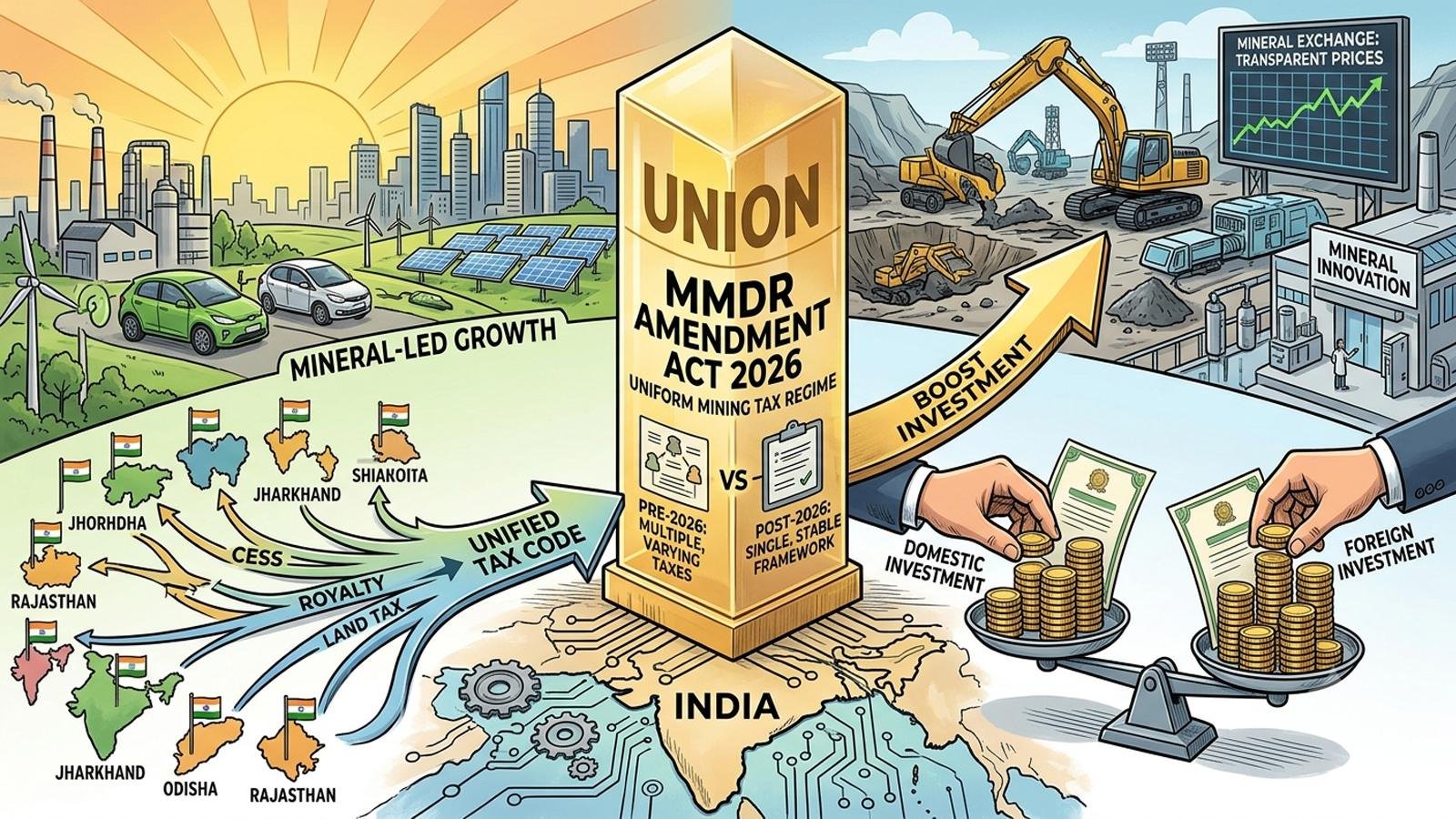
- The Mines and Minerals (Development and Regulation) Amendment Act, 2026 seeks to create a uniform framework for levies on mineral rights and mineral-bearing land by restricting specified State taxes and cess.
- The move has raised concerns in mineral-rich States such as Odisha and Jharkhand over revenue and fiscal powers, especially after the 2024 Supreme Court judgment recognised States’ power to tax mineral rights under Entry 50 of the State List.
Key Provisions of the Amendment
- Restriction on State levies: States are barred from imposing specified new taxes or cess on mineral rights and mineral-bearing land, subject to the Central framework.
- Past dues: Certain unpaid or unrecovered State levies imposed before the amendment will be extinguished as per the amended law.
- Uniformity in mining costs: Limits multiple State-level levies to provide greater cost certainty for the mining sector.
- State revenue share: The Centre states that States will continue to receive the major share of mining revenues, with around 90% of mining revenue accruing to States in 2025–26.
Why Are Critical Minerals Important?
- Technology Dependence: Critical minerals such as lithium, cobalt, graphite, nickel and REEs are essential for EVs, batteries, semiconductors, renewable energy and defence technologies.
- Supply-Chain Security: India’s import dependence on several critical minerals creates supply-chain vulnerabilities, especially due to concentrated global production and processing.
- Energy and Strategic Security: Ensuring reliable access to these minerals is crucial for India’s energy transition, technological development and national security.
Major Steps Towards Mineral Self-Reliance
- MMDR Amendment, 2023: Removed six minerals, including lithium, titanium, niobium and tantalum, from the restricted atomic-mineral list, enabling greater private-sector participation.
- Centralised Auctions: The Centre can auction mining leases and composite licences for 24 critical and strategic minerals, while the auction revenue goes to the concerned State.
- Exploration Licence (EL): Introduced for 29 critical and deep-seated minerals, allowing private exploration over an area of up to 1,000 sq. km under a single licence.
- National Critical Mineral Mission (NCMM): Approved in 2025 with an outlay of ₹34,300 crore over seven years for exploration, mining, processing, recycling and overseas mineral acquisition.
- Overseas Assets: Khanij Bidesh India Ltd. (KABIL) facilitates acquisition of strategic mineral assets abroad, including lithium resources in Argentina.
- Mineral Recycling: A ₹1,500-crore incentive scheme promotes recovery of critical minerals from battery waste and e-waste.
- Foreign Investment: Up to 100% FDI under the automatic route is permitted in mining and exploration of specified metal and non-metal ores, subject to applicable restrictions.
- Exploration Support: The National Mineral Exploration Trust (NMET) provides financial support for exploration of critical and deep-seated minerals.
Significance
- Economic Competitiveness: A stable supply of critical minerals can support domestic manufacturing and reduce input-related disruptions.
- Energy Security: Reliable access to lithium, cobalt, nickel and REEs can support India’s EV and renewable-energy expansion.
- Strategic Autonomy: Greater domestic and overseas access to critical minerals can strengthen defence, electronics and advanced technology sectors.
- Investment and Innovation: A predictable mining framework can encourage private investment, exploration and mineral-processing capabilities.
- Resource Efficiency: Greater focus on processing and recycling can improve mineral recovery and reduce dependence on primary imports.
Challenges
- State Fiscal Autonomy: Mineral-rich States may face reduced flexibility to raise revenue from mineral resources.
- Centre-State Tensions: The amendment may create concerns over the balance between Union regulation and States’ taxation powers, particularly after the 2024 Supreme Court judgment.
- Revenue Uncertainty: The actual impact on States such as Odisha will depend on the law’s detailed implementation.
- Limited Domestic Capacity: India still needs stronger exploration, processing, refining and recycling capabilities to reduce import dependence.
- Environmental Impact: Increased mining may affect land, biodiversity, water resources and local communities.
Way Forward
- Cooperative Federalism: Consult mineral-rich States while framing rules on State levies to balance national and State interests.
- Complete Value Chain: Strengthen the entire chain from exploration and mining to processing and recycling.
- Technology and R&D: Promote domestic exploration and processing technologies to reduce dependence on foreign technology.
- Circular Economy: Expand recycling, urban mining and resource efficiency to supplement primary mineral supplies.
- Sustainable Mining: Ensure benefits for mineral-producing regions and local communities while protecting land, water and biodiversity.
FAQs
Q1. What is the main objective of the MMDR Amendment Act, 2026?
Ans. It aims to create a more uniform framework for taxes and levies on mineral rights and mineral-bearing land.
Q2. Why are critical minerals important for India?
Ans. They are essential for EVs, batteries, renewable energy, semiconductors, electronics and defence.
Q3. What is KABIL?
Ans. Khanij Bidesh India Ltd. (KABIL) is a government joint venture established to acquire and develop strategic mineral assets abroad.