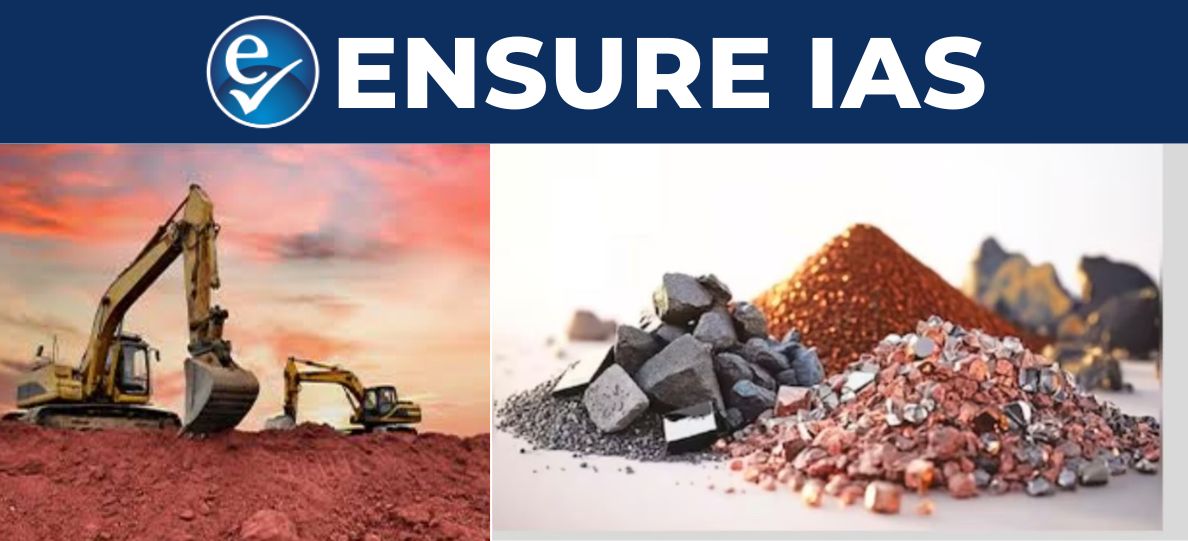
- In February 2025, The Ministry of Mines, through a gazette notification, reclassified Barytes, Felspar, Mica, and Quartz from the category of minor minerals to major minerals.
- This decision comes after the approval of the National Critical Mineral Mission by the Union Cabinet on 29th January 2025.
- The change is aimed at enhancing the exploration, mining, and extraction of critical minerals associated with these four minerals, thus benefiting industries across energy, technology, and healthcare sectors.
Context: National Critical Mineral Mission
- The National Critical Mineral Mission (NCMM), approved by the Union Cabinet, focuses on the exploration and mining of critical minerals within India.
- The mission includes:
- Recovery of critical minerals from other minerals, overburden.
- Promoting self-sufficiency in key minerals required for technological advancements, especially in sectors like energy transition, spacecraft industries, and healthcare.
- This reclassification supports the mission by ensuring that minerals like Barytes, Felspar, Mica, and Quartz, which contain critical minerals such as Lithium, Beryl, and Tantalum, are mined more effectively.
Minerals in Focus:
1. Quartz, Felspar, and Mica
- These minerals are primarily found in pegmatite rocks, which also contain important critical minerals such as Lithium, Beryl, Niobium, Tantalum, Molybdenum, Tin, Titanium, and Tungsten.
- While these minerals were previously mined for construction, glass, or ceramics, their potential for providing critical minerals (e.g., Lithium) was not fully realized.
- By classifying them as major minerals, mining operations will now be focused on extracting critical minerals along with the primary minerals, allowing for better recovery and reporting.
2. Barytes
- Barytes has several industrial applications, such as in oil and gas drilling, electronics, radiation shielding, and medical applications (e.g., in high-density concrete used to block x-ray emissions).
- It is often found in association with other minerals like Antimony, Cobalt, Copper, Lead, Manganese, and Silver. When mined, it’s often impossible to avoid extracting the associated minerals.
- Classifying Barytes as a major mineral will ensure its optimal extraction along with these associated minerals, leading to increased recovery of critical minerals.
Why were they Shifted from the category of minor minerals to major minerals?
- By moving these minerals to the major mineral category, the government aims to encourage scientific mining practices that target not just the primary minerals but also the critical minerals found in association with them.
- This shift will support the exploration and extraction of minerals like Lithium, Beryl, and Tantalum, which are vital for the advancement of technology and the energy transition.
- The move is expected to lead to more intensive exploration for these minerals, as major minerals are subject to more stringent exploration standards and regulatory measures than minor ones.
- As critical minerals are key to the development of technologies in electric vehicles, renewable energy, telecommunications, and healthcare, this reclassification will help secure India’s supply of these minerals, reducing dependence on imports.
Implications of the Reclassification
- The lease period for mines involved in the extraction of these minerals will be extended to 50 years under the MMDR Act, 1957.
- This is an increase from the previous lease period applicable to minor minerals.
- The extension will start from the date of grant or the completion of any renewal period, whichever is later.
- With the reclassification, mines extracting Barytes, Felspar, Mica, and Quartz will now be registered and regulated as major minerals under the Indian Bureau of Mines.
- The transition will take place over a 4-month period (up to 30th June 2025), allowing for a smooth shift in regulatory oversight.
- The revenue generated from the mining of these minerals will continue to accrue to State Governments, as it did previously under the minor mineral classification. The reclassification does not affect the revenue-sharing model with state authorities.
Benefits of the Move
- The new classification will ensure that critical minerals associated with Quartz, Felspar, Mica, and Barytes are properly identified, extracted, and reported, ensuring better utilization of national mineral resources.
- India is set to benefit from an increased supply of minerals critical for the production of electronics, batteries, renewable energy technologies, and medical equipment. This is vital for the energy transition and spacecraft industries, ensuring the country can cater to growing global demand for these technologies.
- By enhancing domestic production and exploration of critical minerals, India will strengthen its economic security and technological independence, reducing reliance on imports of critical minerals from countries like China and Australia.
About MMDR Act, 1957
Features of the MMDR Act
Amendments to the MMDR Act
|