Context
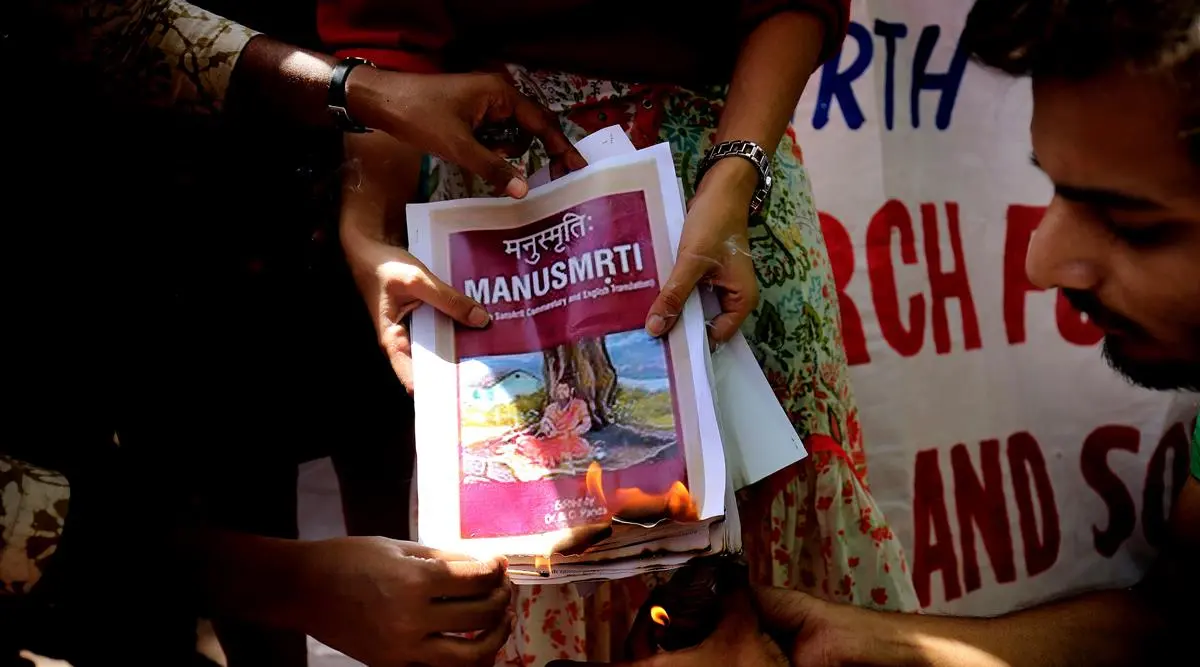
Recent discussions on the Manusmriti (Manava Dharmashastra) have highlighted the need to understand ancient Indian texts in their historical and social context, rather than relying only on interpretations developed during the colonial period.
Shruti, Smriti and Sources of Dharma
- Ancient Indian thought recognised a hierarchy of sources for determining Dharma—the duties and morally appropriate conduct expected of an individual.
- Shruti: Literally, “that which is heard”; refers primarily to the Vedas, traditionally regarded as divine revelation received by sages.
- Smriti: Literally, “that which is remembered”; includes texts composed from remembered and interpreted traditions. Manusmriti belongs to this category.
- Sadachara: Conduct followed by virtuous and respected members of society.
- Atmanastushti: Acceptance based on one’s inner moral conscience, particularly when other sources do not provide a clear rule.
Manusmriti: Key Features
- It is one of the important early texts of the Dharmashastra tradition.
- It contains 12 chapters and primarily deals with Dharma, covering social, moral, legal and administrative duties.
- Major themes include:
-
- Social duties and conduct: Duties and responsibilities at different stages of life.
- Marriage and family: Norms relating to marriage and family relationships.
- Inheritance and property: Rules for succession and distribution of property, including special provisions for the eldest son and Stridhan (woman’s property).
- Governance and justice: Duties of the ruler, administration and penalties for offences.
- Four Ashramas: Brahmacharya, Grihastha, Vanaprastha and Sannyasa.
- Four Varnas: Social classification into Brahmana, Kshatriya, Vaishya and Shudra.
- Eight forms of marriage: Different forms are described with varying levels of social acceptance.
Colonial Interpretation of Manusmriti
- Sir William Jones translated the Manusmriti into English in 1794, making it accessible to European scholars.
- Colonial scholars often classified it under categories such as “Hindu law”, which may not fully reflect its ancient social and intellectual context.
- Hence, the text should be studied through its historical context, while avoiding purely colonial or modern interpretations.
Why Contextual Interpretation Matters
- Historical Context: Manusmriti reflects the social structure and institutions of its time and should be understood accordingly.
- Not Universal Practice: Its prescriptions should not be treated as practices followed by all communities, regions or periods.
- Modern Distinction: Ancient norms should be assessed separately from modern legal and constitutional values.
- Comparative Understanding: Concepts such as women’s protection and maintenance can be compared with later legal developments, without assuming that ancient and modern systems were identical.
FAQs
Q1. What is Manusmriti?
Ans. Manusmriti, or Manava Dharmashastra, is an important text of the Smriti/Dharmashastra tradition. It discusses Dharma, social conduct, family, property, governance and justice.
Q2. What is the difference between Shruti and Smriti?
Ans. Shruti refers primarily to the Vedas, traditionally regarded as revealed knowledge. Smriti refers to remembered and transmitted traditions, including texts such as the Manusmriti.
Q3. What are the four sources used for determining Dharma?
Ans. They are Shruti, Smriti, Sadachara and Atmanastushti. They represent revealed knowledge, remembered tradition, accepted virtuous conduct and one’s moral conscience respectively.
Q4. What is Stridhan?
Ans. Stridhan refers broadly to property or assets belonging to a woman. Manusmriti contains provisions concerning women’s property and its inheritance.
Q5. Who translated Manusmriti into English in 1794?
Ans. Sir William Jones produced an English translation in 1794, contributing to the text’s study within European and colonial scholarship.