Why in the News?
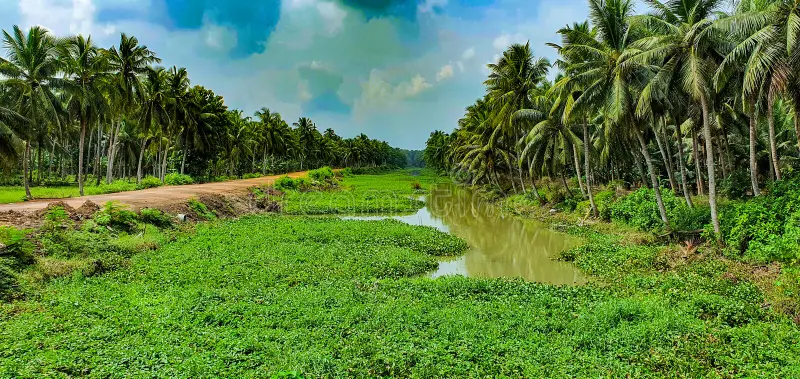
- In the past six years, nearly 1 lakh coconut trees have died in the Central Godavari (Konaseema) delta because salty water entered a freshwater drain and poisoned the soil.
- The issue started after incomplete dredging (2013 & 2017) of the Shankaraguptam drain, which allowed sea backwater to flow inland.
- Farmers, experts, and officials have warned since 2019, but the government has not yet acted fully due to delays in funding.
| Dredging
1. Meaning: Dredging is the process of removing silt, mud, sand, or debris from the bottom of rivers, lakes, canals, drains, or ports to make them deeper or to restore smooth water flow. 2. Why it’s done: a. To prevent flooding by keeping water channels clear. b. To allow ships or boats to move in ports and rivers. c. To maintain irrigation and drainage systems in agriculture. d. To stop waterlogging and stagnation. 3. In Konaseema case a. The Shankaraguptam freshwater drain was partially dredged (desilted) in 2013 and 2017. b. But the middle 7.9 km portion was left untouched. c. This created an uneven slope, which allowed salty backwater from the Godavari river to flow backward into farmlands instead of draining out. d. Result → Coconut trees died because of salty soil and waterlogging. |
Key Highlights
- Coconut’s importance in Konaseema
- Coconut trees cover 54,000 hectares and give India’s highest yield.
- They provide livelihood to people in 15+ jobs like traders, peelers, oil extractors, and coir makers.
- Trees live around 80 years and each tree can give 220 coconuts per year.
- Drain problem due to incomplete dredging
- The Shankaraguptam drain (22.7 km) carries extra rain and farm water to the Godavari river branch.
- Parts of the drain were desilted in 2013 and 2017, but a 9 km middle portion was left untouched.
- This caused the natural water flow to break, and salty river water started entering villages.
- Damage since 2019
- Farmers noticed trees dying suddenly from 2019.
- By 2025, about 1 lakh trees across nine villages (e.g., Kesanapalli, Gollapalem) had died.
- In Kesanapalli alone, 5,000 trees across 500 acres perished, affecting 150 farmers.
- Scientific studies
- In 2022, soil and water tests showed high salts (chlorides, fluorides, sulphates) in fields.
- In 2023, YSR Horticulture University confirmed that backwater floods every month cause waterlogging and high salt in soil, stunting trees.
- Both studies said the solution is to finish dredging the drain.
- Official response so far
- A 2019 plan to dredge the remaining section was not approved.
- A new proposal of ₹10 crore is pending financial clearance.
- Meanwhile, paddy fields shrank from 14,000 acres to 3,400 acres.
- Groundwater has become salty, so a 350 km pipeline is being built to bring drinking water by 2027.
Implications
- Loss of livelihoods
- Farmers lost mature coconut trees which took decades to grow.
- Many allied jobs (coir, oil, peeling, trading) have collapsed.
- Farmers now depend on buying coconuts from far-off villages.
- Agriculture under stress
- Salty water killed paddy fields, reducing land under cultivation.
- Farmers are forced to shift to aquaculture, but shrimp is risky due to disease.
- Soil salinity makes it hard to grow alternative crops.
- Water scarcity
- Hand pump water is salty; families are spending money on purified water.
- This has become a heavy financial burden for rural households.
- Cultural impact
- Coconuts are essential in rituals (e.g., weddings), but healthy coconuts are rare
- People even paint coconuts green for ceremonies.
- Migration may increase as livelihoods collapse.
- Governance failure
- The disaster is man-made due to incomplete works.
- Despite knowing the cause since 2019, bureaucratic delays
- People have lost trust in government promises.
Challenges and Way Forward
| Challenges | Solution |
| Incomplete dredging | Finish dredging entire drain |
| Backflow from river | Build sluice gates / regulators |
| Silt and poor maintenance of drains | Regular yearly desilting |
| Waterlogging in fields | Field drains, raise ridges, salt-tolerant trees |
| High salt content damages trees | Soil leaching with freshwater + gypsum use |
| Loss of coconut trees and farmer’s income | Compensation, replanting subsidy, crop insurance |
| People spend on bottled water | Speed up drinking water pipeline, temporary RO units |
| Risky aquaculture (Shrimp disease) | Biosecure aquaculture + insurance |
| Lack of accountability | Public dashboard + joint task force |
Conclusion
The Konaseema crisis is a man-made ecological disaster caused by incomplete work on a drain. What was once a source of life has now turned into a source of poison for both soil and water. Farmers have lost their main livelihood, water has turned salty, and even cultural traditions are suffering. The solution is clear — complete the dredging, block backflow, reclaim soils, and ensure safe drinking water. Unless the government acts quickly and transparently, entire villages may be forced to abandon their land.
| Ensure IAS Mains Question
Q. The Konaseema coconut tree crisis in Andhra Pradesh highlights the ecological risks of faulty water management and incomplete infrastructure works. Discuss the socio-economic and environmental implications of such man-made disasters and suggest long-term solutions. (250 words) |
| Ensure IAS Prelims Question
Q. Consider the following statements about the recent coconut tree deaths in the Godavari delta (Konaseema region): 1. The crisis was triggered due to incomplete dredging of the Shankaraguptam freshwater drain, which allowed saline backwaters to enter farmlands. 2. The Coconut Development Board identified the trees as 30–40 years old with a normal lifespan of nearly 80 years. 3. Farmers have shifted completely to brackish water aquaculture as it is a safe and disease-free alternative. Which of the statements given above is/are correct? a) 1 only b) 1 and 2 only c) 2 and 3 only d) 1, 2 and 3 Answer: b) 1 and 2 only Explanation Statement 1 is correct: Incomplete dredging of the Shankaraguptam freshwater drain (middle 7.9 km stretch left untouched) caused uneven slopes. This allowed saline backwaters from the Godavari to flow into farmlands instead of draining out → leading to waterlogging and soil salinity → coconut tree deaths. Statement 2 is correct: A Coconut Development Board team reported that the affected trees were 30–40 years old. Normally, coconut trees can live up to 80 years under healthy conditions. Statement 3 is incorrect: Farmers are not shifting completely to aquaculture. Many turned to brackish water aquaculture out of desperation, but it is risky, prone to diseases and frequent losses. Thus, it is not considered a safe and sustainable alternative. |