Context
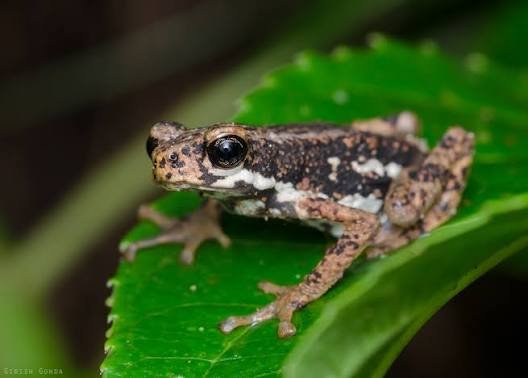
Karnataka has declared the Malabar tree toad (Pedostibes tuberculosus) as its state amphibian, becoming the first Indian state to do so.
About the Species
- Local Names: Known locally as Malenadina Mara Gantikappe (tree toad of Malnad) and Petu.
- Classification: Belongs to the toad family Bufonidae (order Anura); it is the only species in the monotypic genus Pedostibes.
- Discovery & Rediscovery: First described in 1876 and rediscovered in 1980 at Silent Valley National Park (Kerala) after over 100 years without sightings.
- Distribution: Strictly endemic to the Western Ghats, a global biodiversity hotspot.
- Habitat: Found in evergreen and moist deciduous forests (50–1,000+ m elevation), usually near streams, on tree trunks, and inside tree cavities.
Key Features
- Arboreal Lifestyle: Unlike most common ground toads, it climbs and lives primarily on trees.
- Breeding Pattern: Comes down to breed in calm pools near streams during March–June (before the peak monsoon).
- Indicator Species: Acts as a bio-indicator, signaling healthy, moisture-rich evergreen forests with clean stream habitats.
Conservation Concerns
- Climate Change Impact: Studies project up to a 68.7% drop in suitable habitat within protected areas, with suitability falling in the central Western Ghats and shifting toward parts of the southern Western Ghats.
- Habitat Loss: Forest degradation and habitat fragmentation threaten the toad due to its small, scattered population.
- Data Gaps: Exact population numbers and specific habitat needs remain poorly known.
- Conservation & Legal Status:
- IUCN Red List: Listed as Endangered.
- WPA, 1972 (Wildlife Protection Act, 1972): Protected under Schedule II.
Importance of State Symbols
- Conservation Awareness: Naming state symbols brings public and policy focus to overlooked species—especially amphibians, which are highly sensitive to climate change.
- Karnataka’s Other State Symbols: Alongside the Malabar Tree Toad (State Amphibian), Karnataka’s official symbols include the Asian Elephant (Animal), Indian Roller (Bird), Sandalwood (Tree), Lotus (Flower), Southern Birdwing (Butterfly), Carnatic Carp (Fish), Mango (Fruit), and the Asiatic Honeybee (Apis cerana) (Honeybee).
FAQs
Q1. What is unusual about its habit?
Ans. It is an arboreal (tree-dwelling) toad.
Q2. Where does it breed?
Ans. In ground-level pools near streams, mainly from March to June.
Q3. What is its distribution?
Ans. Endemic to the Western Ghats.