Context
The centuries-old India–Tibet trade route through Lipulekh Pass has recently reopened. A 17-member Indian delegation entered Taklakot in Tibet after China cleared cross-border trade.
About Lipulekh Pass
- Location: Pithoragarh district of Uttarakhand, in the Kumaon Himalayas.
- Altitude: Approximately 5,334 metres.
- It connects Uttarakhand with the Tibet Autonomous Region of China.
- The pass lies in the India–Nepal–China border region, giving it major strategic importance.
- It was the first Indian border post opened for trade with China in 1992.
- Other India–China trading passes include:
- Shipki La, Himachal Pradesh: 1994
- Nathu La, Sikkim: 2006
Significance
- Strategic: Its location near the India–China–Nepal border makes it important for border security and Himalayan connectivity.
- Trade: It has historically served as a trade route between the Indian subcontinent and the Tibetan Plateau.
- Religious: It is an important route for the Kailash Mansarovar Yatra.
- Local economy: Traditional cross-border trade supports communities such as the Bhotiyas of Uttarakhand.
- Connectivity: Its reopening can strengthen economic and people-to-people links in the Himalayan border region.
India–Nepal Territorial Dispute
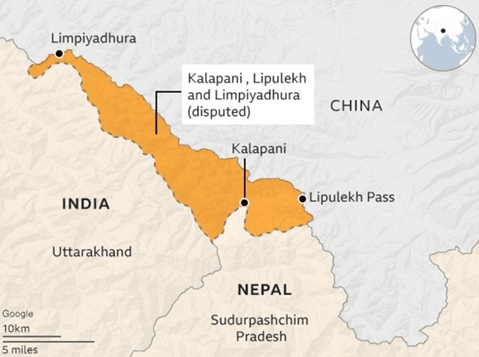
The dispute mainly concerns the Kalapani–Lipulekh–Limpiyadhura region and the interpretation of the Kali River boundary.
- Sugauli Treaty, 1816: Following the Anglo-Nepal War, the treaty established the Kali River as a boundary between Nepal and British India.
- Core disagreement: India and Nepal differ over the source of the Kali River.
- India’s position: The Kali originates near Kalapani, placing Kalapani, Lipulekh and Limpiyadhura on the Indian side.
- Nepal’s position: Nepal identifies the river’s source farther west and consequently claims these areas.
- Thus, differing interpretations of historical treaties and maps have resulted in a continuing boundary dispute.
China’s Role
- Lipulekh is also significant because it connects India with Tibet, making the issue sensitive in India–Nepal–China relations.
- Nepal has objected to India–China arrangements concerning Lipulekh, arguing that its territorial claims should be taken into account.
- In 2015, India and China agreed to use Lipulekh for bilateral trade and the Kailash Mansarovar pilgrimage, leading to protests from Nepal.
Way Forward
- Diplomatic dialogue: Continue India–Nepal negotiations to resolve the boundary issue peacefully.
- Evidence-based approach: Examine historical treaties, maps and other records to establish the boundary.
- Confidence building: Strengthen communication and border-management mechanisms.
- Neighbourhood sensitivity: Address Nepal’s concerns while protecting India’s legitimate strategic and territorial interests.
- Border development: Promote connectivity and livelihood opportunities for Himalayan border communities.