Context
- The NASA–ISRO NISAR satellite recently captured radar images of lava spreading from Krasheninnikov volcano in Russia’s Kamchatka Peninsula, demonstrating its ability to monitor volcanic activity and surface changes from space.
Krasheninnikov Volcano and Recent Eruption
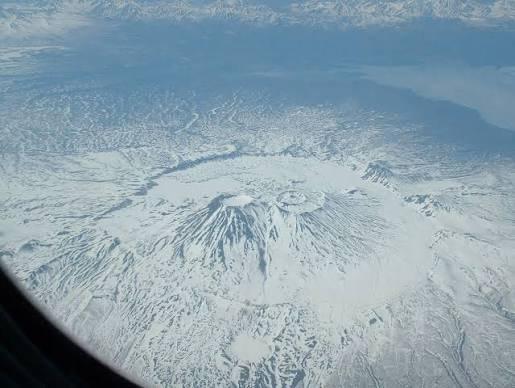
- Krasheninnikov is an active volcanic complex in the eastern Kamchatka Peninsula of Russia, located along the Pacific Ring of Fire.
- It consists of two adjoining stratovolcano cones situated within a large collapse caldera.
- Kamchatka is one of the world’s most volcanically active regions because of its location near converging tectonic plates.
- Krasheninnikov had remained dormant for several centuries before eruptive activity resumed in August 2025.
- The eruption began shortly after a powerful magnitude 8.8 earthquake struck offshore Kamchatka and produced ash emissions and lava flows from the volcanic complex.
- The event provided an opportunity to observe how rapidly volcanic landscapes can change during an active eruption.
NISAR: Radar Monitoring of Volcanic Change
- NISAR (NASA-ISRO Synthetic Aperture Radar) is a joint Earth-observation satellite mission of NASA and ISRO, launched in July 2025 aboard ISRO’s GSLV-F16.
- It is the first satellite mission to combine L-band and S-band Synthetic Aperture Radar (SAR) for detailed observation of Earth’s surface.
- Radar imaging allows NISAR to observe the surface during day or night and through cloud cover, making it particularly useful during volcanic eruptions.
- Its repeated observations of Krasheninnikov captured the progressive spread of lava, helping scientists track changes in the volcanic landscape.
- NISAR revisits nearly all of Earth’s land and ice-covered surfaces on a 12-day repeat cycle, enabling comparison of surface changes over time.
- Beyond volcanoes, the mission can monitor earthquakes, landslides, glaciers, vegetation and land deformation, supporting disaster assessment and environmental monitoring.
FAQs
Q1. Where is Krasheninnikov volcano located?
It is located on the eastern Kamchatka Peninsula of Russia.
Q2. What type of volcano is Krasheninnikov?
It is a volcanic complex consisting mainly of two stratovolcano cones.
Q3. What is NISAR?
NISAR is the NASA-ISRO Synthetic Aperture Radar Earth-observation satellite.
Q4. What makes NISAR technologically distinctive?
It combines L-band and S-band radar for high-resolution monitoring of Earth’s changing surface.
Q5. Why is radar useful for monitoring volcanoes?
Radar can track surface deformation and lava changes even through clouds and darkness.