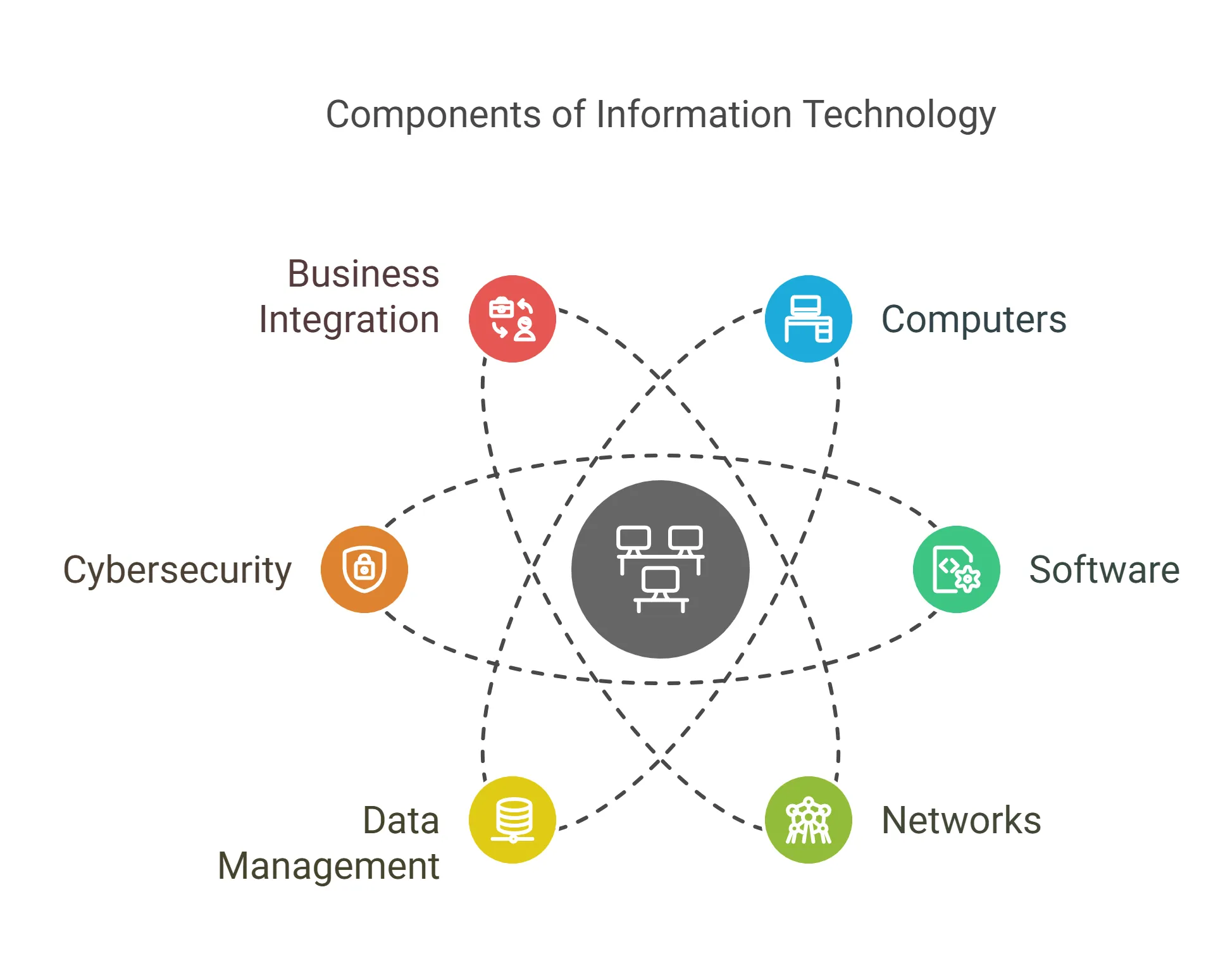
Information and Communication Technology (ICT) is a comprehensive umbrella term encompassing all technical tools and infrastructures used to manage information and facilitate communication. It integrates manufacturing and service industries to enable the processing, storage, transmission, and display of digital data. In the modern era, ICT serves as the backbone of a knowledge-based economy, driving efficiency in governance, business, and daily human interaction.
Conceptual Framework of ICT
To understand ICT, it is essential to break down its core components:
- Information: Knowledge derived from data placed within a specific context. It is the message intended for communication, often encoded in organizational processes or documented systems.
- Communication: The process of exchanging information through a common system of symbols. It can be verbal, non-verbal, deliberate, or unintended.
- ICT Integration: The use of technology (hardware and software) to make human-to-human, human-to-machine, and machine-to-machine (M2M) communication more efficient.
Key Types of ICT Technologies
The ICT landscape is rapidly evolving, bridging traditional mediums with futuristic innovations.
1. Cellular and Wireless Networks
- Mobile Generations: Evolving from 1G (analog) in the 1980s to 5G (ultra-low latency), and currently progressing toward 6G, which is expected to offer omnipresent wireless intelligence by the early 2030s.
- Wi-Fi: Uses radio waves for high-speed data transmission over short distances. Wi-Fi Direct allows device-to-device connection without a centralized local area network (LAN).
- Li-Fi (Light Fidelity): A wireless optical networking technology that uses LEDs to transmit data, offering superior bandwidth and security compared to Wi-Fi.
2. Short-Range and Proximity Technologies
- NFC (Near-Field Communication): Short-range wireless connectivity (within centimeters) primarily used for contactless payments and data exchange.
- RFID (Radio Frequency Identification): Uses radio waves to track items via tags and readers. It is a cornerstone of modern logistics and inventory management.
3. High-Performance and Space Infrastructure
- Supercomputers: Systems designed for intensive tasks like molecular modeling and quantum mechanics.
- Space Internet: Powered by satellite constellations (e.g., SpaceX’s Starlink) to provide high-speed global connectivity, even in remote regions.
Multidisciplinary Applications of ICT
ICT plays a transformative role across various sectors by automating processes and improving access:
- Education: Facilitates E-learning and open distance learning, providing universal access to e-journals and virtual repositories.
- Agriculture: Provides weather forecasts, price control information, and warning alerts to farmers.
- Medicine: Essential for computerized diagnostics (MRI, CT scanners) and E-channeling (online doctor consultations).
- Defence: Enables network-centric battlefield management and real-time combat surveillance.
- E-Governance: Integrates government-to-citizen (G2C) and government-to-business (G2B) transactions.
ICT Landscape in India: Policy and Growth
India’s ICT sector contributes approximately 13% to the country’s GDP, with a target to reach 20% ($1 trillion) by 2025.
1. Regulatory Framework
- Digital Personal Data Protection Act, 2023: Establishes a framework for personal data privacy in the digital economy.
- Telecommunications Act, 2023: Consolidates century-old laws (like the 1885 Telegraph Act) to modernize spectrum allocation and network operation.
- IT Amendment Rules, 2023: Empowers the government to flag “misleading” content and removes legal immunity for intermediaries failing to comply.
2. Major Government Initiatives
- Digital India Programme (2015): A flagship mission focusing on digital infrastructure as a utility and governance on demand.
- National Broadband Mission: Aims to bridge the digital divide and provide universal broadband access.
- NMEICT (National Mission on Education through ICT): Houses initiatives like SWAYAM (online courses) and the National Digital Library.
Critical Challenges for ICT in India
Despite rapid growth, several bottlenecks hinder the equitable spread of ICT benefits:
- Digital Divide: While 67% of urban Indians use the internet, only 31% of the rural population has access.
- Cybersecurity: Rising frequency of malware and ransomware attacks as the digital footprint expands.
- Telecom Stress: High fixed costs for rural entry and falling Average Revenue Per User (ARPU) stress service providers.
- Privacy Risks: Increased data collection has heightened concerns regarding the control and potential misuse of personal information.
Frequently Asked Questions (FAQs)
What is the difference between 5G and 6G?
5G provides high-speed, low-latency mobile connectivity, while 6G (under development) aims for sub-millisecond latency and integrated satellite-terrestrial networks.
How does Li-Fi differ from Wi-Fi?
Wi-Fi uses radio waves, whereas Li-Fi uses light waves (LEDs) for data transmission, making it potentially faster and more secure in enclosed spaces.
What is “Space Internet”?
It is internet connectivity provided via a constellation of low-earth orbit (LEO) satellites, allowing for high-speed access in areas where cables cannot reach.
Is NFC safe for financial transactions?
Yes, NFC is considered safe because it requires extreme proximity (a few centimeters) and uses encryption for sensitive data transfers.
What are the components of an RFID system?
An RFID system consists of an antenna, a reader (which emits radio waves), and a tag (which stores and transmits data).
What is the “Digital Divide”?
The gap between people who have easy access to the internet and digital technology and those who do not, often based on geography or economic status.
How is ICT used in e-governance?
It allows for the electronic delivery of government services, such as paying taxes, renewing licenses, and accessing public records online.
What is SWAYAM?
SWAYAM is an Indian government platform that offers free online courses from school level to post-graduation.
What are M2M communications?
Machine-to-Machine (M2M) refers to direct communication between devices using any communications channel, often used in the Internet of Things (IoT).
Which act governs telecommunications in India as of 2024?
The Telecommunications Act, 2023, which replaced the Indian Telegraph Act of 1885.